


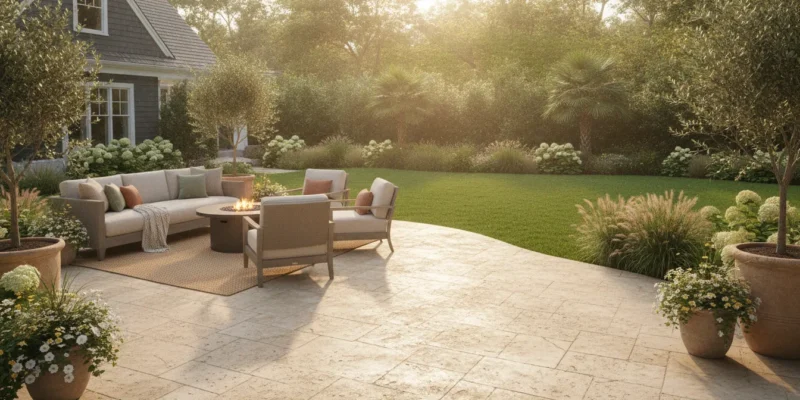
Choosing a patio or driveway material on Long Island is not only a design decision. Freeze-thaw cycles, deicing salts, drainage, snow removal, and future repairs all affect how the surface performs. The right installation should match both your property and the way you use it. Planning a new patio or driveway? Contact Gappsi through our contact page
Gappsi helps homeowners across Nassau and Suffolk Counties weigh those tradeoffs before construction begins. Understanding how each material responds to local conditions makes the comparison more useful than choosing from a color chart alone.
Stamped Concrete vs. Pavers: Which Patio Material Fits Long Island Best?
Both materials can create a durable outdoor gathering space, but they are built differently and respond differently to the demands of Long Island properties. Stamped concrete starts as integrally colored concrete that is textured with stamps while it is still wet, then sealed after curing. The process can reproduce the look of brick, stone, or wood while creating one continuous surface. Proper maintenance and sealer application are important for preserving its durability, slip resistance, and appearance, especially where winter deicing salts are used. The stamped concrete care guidance explains why that protection matters. Interlocking pavers are individual manufactured units installed over a prepared base, typically including compacted aggregate and a setting bed. Their use has expanded as manufacturing methods have improved, and the finished surface can be arranged in consistent patterns with different colors, shapes, and sizes. Because the units are separate, their joints allow slight movement without cracking. That flexibility can be useful when a patio experiences seasonal ground movement.
- Appearance: Stamped concrete offers a continuous pattern with the option to mimic masonry materials. Pavers provide defined joints and a structured, modular look.
- Movement: A stamped concrete slab is monolithic, so substrate movement can contribute to cracking. Individual pavers can shift slightly without creating one continuous crack.
- Maintenance: Stamped concrete depends on a maintained sealer. Pavers generally need less surface maintenance, although their joints may require attention.
- Design flexibility: Concrete can be colored and stamped in a selected pattern. Pavers can be mixed into borders, bands, and field patterns, including Italian porcelain and natural stone options.
The right choice depends on the patio’s size, grade, drainage, expected use, and the look you want beside the home. A stamped concrete patio may suit homeowners who prefer a seamless surface and a unified pattern. Pavers may be the better fit when future access, localized repairs, drainage through sand-filled joints, or detailed pattern changes are priorities. Gappsi evaluates both approaches as part of a complete design-build plan. The company offers custom concrete and paver options for Long Island patios, with installation details tailored to the site rather than selected from a single material preference. You can review porcelain and natural stone pavers for additional material possibilities, then speak with our masonry and design-build team about the conditions at your property. Contact Gappsi through our contact page
How Much Does a Stamped Concrete Patio Cost Compared to Pavers?
For many Long Island homeowners, a stamped concrete patio offers a lower starting cost than pavers or natural stone while still allowing the surface to echo the look of slate, brick, or flagstone. General installed estimates place stamped concrete at about $17 to $25 per square foot. A seamless texture may begin near $17 per square foot, while a patterned option such as Ashlar Slate commonly falls around $20 to $22 per square foot. The ranges below are useful for early planning, not a substitute for a site-specific proposal. Final Long Island pricing depends on excavation, drainage, demolition, base preparation, access for equipment, project size, layout, color, borders, steps, and the complexity of the chosen pattern. Gappsi evaluates those conditions before recommending a material or presenting a fixed scope.
| Material | Typical installed cost per sq ft | Notes |
|---|---|---|
| Stamped concrete | $17 to $25 | Seamless textures can start near $17. Patterned stamps, including Ashlar Slate, often run about $20 to $22. |
| Quality concrete pavers | $25 to $45 | Higher installation cost, with individual units that can be removed and replaced if a localized repair is needed. |
| Natural flagstone | $30 to $50+ | Material selection, stone thickness, cutting, setting, and site access can move the final quote substantially. |
On a typical 400-square-foot patio, those differences can put stamped concrete roughly $3,000 to $12,000 below premium alternatives. The actual gap depends on the materials and installation details being compared. A simple stamped design should not be compared with a highly detailed paver layout that includes multiple colors, soldier-course borders, curves, or extensive base work. Initial cost is only one part of the decision. Pavers generally cost more to install, but their modular construction can make future repairs more targeted. If one area settles or becomes damaged, a contractor may remove and reset individual units rather than patching a continuous slab. Stamped concrete creates a clean, uninterrupted surface and can deliver a convincing stone or brick pattern at a lower entry price. But it requires appropriate sealer care and any future crack repair may remain visible. For a balanced comparison, ask Gappsi to price the same patio footprint, access conditions, drainage plan, borders, steps, and finish level in both materials. That approach shows whether the lower initial price of stamped concrete outweighs the repair flexibility and long-term design preferences associated with pavers. Cost ranges are general estimates adapted from published contractor pricing examples and should not be treated as a Long Island quote.
Which Holds Up Better in Long Island Freeze-Thaw Conditions?
Long Island patios face repeated cycles of freezing, thawing, snow removal, and exposure to deicing salts. Those conditions make drainage, surface protection, and the ability to accommodate small movements more important than appearance alone. Both stamped concrete and interlocking pavers can perform well when installed over a properly prepared base. But they respond differently when moisture and temperature changes put stress on the installation.
How stamped concrete responds to winter exposure
A stamped concrete patio is a continuous, monolithic surface. Its sealer serves as a sacrificial coat that wears down before the concrete itself, helping minimize damage from the combination of water and deicing salts. This protection is useful during Long Island winters, but it depends on choosing the right product and maintaining it correctly. A municipal stamped-concrete care guide explains that proper cleaning, maintenance, and sealer application are essential for preserving durability and slip resistance. The main structural concern is movement beneath that continuous surface. Ground settling or thermal expansion can eventually produce cracks in stamped concrete. A crack can often be repaired, but the patch may remain visible because the surrounding pattern and color are difficult to reproduce exactly. Direct ultraviolet exposure and heavy traffic can also cause the stamped pattern and color to fade over time. Snow should be removed before applying deicing salt, since salt placed over accumulating snow can increase the risk of surface damage.
Why pavers tolerate movement and salt differently
Interlocking pavers are made of individual units separated by sand-filled joints. Those joints allow slight movement without cracking, which gives the surface more flexibility as the ground and temperatures change. They also allow water to seep between the units, improving drainage and reducing surface runoff. That drainage is especially valuable where melting snow could otherwise remain on the surface or collect near the patio edge. Pavers are generally more resistant to salt damage because they do not rely on a surface sealer to remain durable. If an individual unit is damaged, it can usually be removed and replaced without demolishing the entire patio. However, this advantage depends on proper base preparation and stable installation. Poor drainage or an inadequate compacted base can still lead to settlement, uneven areas, or joint erosion.
- Freeze-thaw movement: Interlocking pavers allow slight individual movement, while stamped concrete is more vulnerable to cracking when the substrate shifts.
- Deicing salts: Stamped concrete benefits from a maintained sacrificial sealer. Pavers do not depend on a sealer that can fail, giving them an advantage in salt-exposed areas.
- Water management: Paver joints allow infiltration and drainage. Stamped concrete requires deliberate grading and drainage planning.
- Long-term appearance: Stamped concrete can fade under UV exposure, while pavers offer replaceable individual units if damage occurs.
Balanced verdict: For a Long Island property with frequent salt exposure, drainage challenges, or concern about future ground movement, interlocking pavers generally offer the stronger freeze-thaw profile. A stamped concrete patio remains a practical choice when homeowners prefer its continuous surface and pattern. Provided Gappsi designs the drainage, prepares the base, and maintains the sealer for local winter conditions. The best material is the one matched to the site’s grading, soil, traffic, and maintenance expectations.
What Maintenance Do Stamped Concrete Patios and Pavers Really Need?
Both materials are manageable for Long Island homeowners, but they ask for care in different places. A stamped concrete patio has a continuous surface, so there are no joints for weeds to grow through. Its main maintenance responsibility is protecting the finish and sealer. Interlocking pavers need less surface treatment, but their joints require periodic attention to control weeds and preserve stability.
Stamped concrete maintenance
Routine care is straightforward. Sweep or blow away leaves, dirt, and other debris, then hose the patio when the surface becomes dirty. For oil, food, or other stubborn stains, a carefully controlled power washing can help. The pressure and cleaning method should suit the sealer and concrete finish, since overly aggressive cleaning can leave uneven results. The most important recurring task is resealing every two to three years, depending on exposure, traffic, and the condition of the existing sealer. Sealer acts as a sacrificial layer that wears down before the stamped concrete itself and helps reduce damage from the combination of water and deicing salts. Proper cleaning, maintenance, and sealer application also help preserve the surface’s appearance and slip resistance. A local care guide from the City of Austin identifies resealing as a more frequent requirement for stamped concrete than for interlocking pavers: see its maintenance comparison. Winter care matters on Long Island. Remove accumulating snow from the surface before applying de-icing salt. This reduces the amount of salt trapped against the sealer and helps limit avoidable surface damage. If the finish is already worn or peeling, have it assessed before the next freeze-thaw season. Gappsi can also help with professional patio cleaning and sealing when a patio needs more than routine homeowner care.
Paver maintenance and joint care
Interlocking pavers generally require minimal maintenance on the surface itself. Sweep them regularly and rinse away ordinary dirt as needed. Their colors are integral to the units, so a scratch does not remove a thin surface coating in the same way it can affect some finishes. The more important inspection point is the space between each paver. Over time, joint material can wash out, settle, or become vulnerable to weeds. Periodically topping up the joints with polymeric sand helps discourage weed growth and supports the interlocking system’s stability. The joints also allow water to drain between pavers, so keeping them properly filled without blocking drainage is part of responsible maintenance. A contractor should first identify the existing joint material and clean the surface correctly before adding new sand.
- Stamped concrete: sweep or blow debris, hose as needed, power wash suitable stains carefully, and reseal about every two to three years.
- Interlocking pavers: sweep and rinse the surface, inspect joints, and replenish polymeric sand when it has eroded or weeds begin appearing.
- Both materials: remove snow thoughtfully, address spills promptly, and inspect drainage after major storms.
In practical terms, stamped concrete trades joint-free cleaning for a regular sealing schedule. Pavers trade sealing for periodic joint maintenance. Gappsi can review the patio’s material, age, drainage, and winter exposure before recommending a care plan that fits the installation.
How Do Repairs Compare When a Patio Gets Damaged?
The repair path depends largely on whether the patio is made from separate units or one continuous slab. That difference matters on Long Island, where settling, temperature changes, snow removal, and deicing salts can expose weaknesses over time.
Repairing stamped concrete
Stamped concrete is a monolithic pour. The color and pattern are applied to a continuous concrete surface, rather than assembled from individual pieces. If a crack develops because of substrate movement, or if a section becomes discolored or damaged. The contractor may need to clean and stabilize the area, fill or patch the defect, and recreate the surface texture and color as closely as possible. The documented cause of cracking can include ground movement and thermal expansion, so the underlying problem should be evaluated before applying a cosmetic repair. Municipal guidance on stamped concrete also notes that repairs may be visible. A larger failure can require cutting out and replacing part of the slab. That creates a practical cost issue: the work is not limited to one removable piece. Matching an older stamped pattern, color variation, and sealer sheen can require additional labor, and a repaired area may remain noticeable even when the workmanship is sound. In some cases, replacing a larger section or the entire patio produces a more consistent appearance, but it also increases demolition, disposal, material, and installation costs.
Repairing interlocking pavers
Interlocking pavers offer a more targeted repair process. A contractor can usually lift the affected units, correct a localized base or drainage issue when necessary, and install matching replacement pavers. The rest of the patio stays in place. Burlington, Vermont specifications describe damaged pavers as removable and replaceable without large-scale demolition: see the repair guidance. This can reduce the scope of labor and limit disruption to the surrounding landscape. The main cost variables are the number of damaged units, access, base repairs, edge restraints, and whether matching pavers are still available. A perfect color match is not always possible if the original material has weathered, so a professional should inspect the existing installation before promising an invisible repair. For a stamped concrete patio, repairs can be efficient when damage is minor and isolated, but patch visibility is a realistic consideration. For pavers, individual replacement often makes localized damage easier to manage. Gappsi evaluates the surface, base, drainage, and surrounding hardscape before recommending a patch, unit replacement, section replacement, or full rebuild.
Which Patio Adds More Resale Value to a Long Island Home?
There is no single patio material that guarantees a higher resale price. A well-designed outdoor living area can strengthen a home’s curb appeal, improve how the property functions, and help buyers picture themselves using the yard. Both stamped concrete and interlocking pavers can contribute to that impression when the design suits the house and the installation is built to last. A stamped concrete patio creates a continuous surface with a custom pattern and color. It can mimic brick, stone, or wood while keeping the visual lines relatively seamless, which may make a compact entertaining area feel more open. The material’s design flexibility gives homeowners room to coordinate the patio with steps, retaining walls, walkways, or the home’s exterior palette. Interlocking pavers offer a different type of appeal. Their individual shapes, colors, borders, and laying patterns can create a more architectural appearance. If a section is damaged later, individual units can generally be removed and replaced without demolishing the entire patio, according to guidance from the City of Burlington. That repairability can be a practical selling point, particularly for buyers thinking about long-term ownership.
Why installation quality matters more than the material label
Resale value is influenced less by whether a listing says concrete or pavers and more by whether the finished work looks intentional and performs properly. Poor grading, weak base preparation, uneven transitions, drainage problems, visible cracking, or sloppy edges can reduce the perceived value of either material. Conversely, accurate layout, stable foundations, proper slope, clean detailing, and a design that connects the patio to the rest of the property can make the investment feel complete. Long Island patios also need to handle freeze-thaw cycles, snow removal, and deicing salts. Stamped concrete is a monolithic surface that may crack when the substrate moves, while pavers can allow slight movement through their joints. That does not make pavers automatically better. It means the contractor must match the system to the site and explain maintenance honestly. Stamped concrete needs appropriate sealing, and pavers need a properly compacted base and maintained joints. Gappsi approaches these decisions as a designer-builder, not as a material salesperson. Its Italian craftsmanship heritage informs the attention given to proportion, material transitions, and finish details. A thoughtful plan may use stamped concrete, interlocking pavers, or complementary surfaces such as porcelain and natural stone pavers, depending on the home and the homeowner’s priorities. To discuss which approach fits your property, Contact Gappsi through our contact page for a site-specific recommendation. Contact Gappsi through our contact page
Frequently Asked Questions
Is a stamped concrete patio cheaper than pavers?
Usually, stamped concrete has a lower initial installation cost than natural stone and some paver systems. A general estimate for stamped concrete is about $17 to $25 per square foot. While the final price depends on site preparation, access, pattern, color, drainage, and the selected paver. On Long Island, Gappsi should compare complete installed systems rather than material prices alone.
What is the downside of stamped concrete?
The main considerations are cracking risk and recurring sealer maintenance. Because stamped concrete is a continuous surface, ground movement or thermal expansion can lead to visible cracks. A government care manual also explains that sealer helps limit damage from water and deicing salts. So it must be maintained for a Long Island driveway or patio exposed to winter conditions. Stamped concrete care guidance
How much does a 20×20 stamped concrete patio cost?
A 20-by-20 patio covers 400 square feet. Using the general $17 to $25 per square foot estimate. Stamped concrete would calculate to approximately $6,800 to $10,000 before project-specific items such as demolition, grading, drainage, steps, borders, or difficult access. Gappsi can provide a more useful estimate after reviewing the property and design.
Is a stamped concrete patio a good idea for Long Island?
It can be, especially when you want a seamless surface, a broad choice of brick, stone, or wood-like patterns, and a stable area for outdoor furniture. Pavers may be the better fit where flexible movement, drainage through sand-filled joints, or individual unit replacement is a priority. The right choice depends on the site, winter exposure, use, and maintenance expectations.
Ready to Choose the Right Patio Surface?
A thoughtful material decision can help your patio or driveway suit Long Island’s climate, maintenance expectations, and overall design. Gappsi can review your space, compare stamped concrete and interlocking pavers, and help you plan the next step with clear guidance. Contact Gappsi through our contact page