What Is DecoTurf? The Pro Tennis Court Surface

If you’ve ever watched a professional tennis match, you’ve seen a DecoTurf court. For over 40 years, it was the iconic blue surface of the US Open, the stage where legends were made. But this world-class surface isn’t just for the pros. Homeowners across Long Island are choosing DecoTurf for their backyard sports game courts because it offers the perfect blend of durability, consistent play, and low maintenance. It’s a multi-layered acrylic system engineered to withstand intense play and harsh weather, providing a true ball bounce for everything from tennis to pickleball. This guide explains what makes this surface so special and why professional installation is key.

https://youtu.be/CAf1erJDuBY

What is a DecoTurf Court?

If you’ve ever watched a professional tennis match, you’ve likely seen a DecoTurf court in action. It’s a world-renowned, high-performance surface used for everything from Grand Slam tournaments to backyard sports games courts. But it’s not just for the pros. Homeowners who want a durable, consistent, and beautiful court for tennis, pickleball, or basketball often choose DecoTurf for its reliability and professional feel. It provides a consistent ball bounce and speed, making it a favorite for players at every skill level. This multi-layer acrylic surface is engineered for intense play and designed to withstand the elements, which is why it’s a popular choice for outdoor courts right here on Long Island.

The Composition of a Professional-Grade Surface

What makes a DecoTurf court so special lies in its layered construction. Think of it as a sophisticated recipe designed for peak athletic performance. The system is built on a foundation of either asphalt or concrete, which provides a stable and level base. On top of this base, several layers of specialized materials are applied to create the final playing surface. This meticulous layering process is what gives the court its signature playability, durability, and vibrant color. Each layer has a specific job, from providing cushioning to ensuring a consistent texture for predictable ball behavior. It’s this attention to detail that separates a professional-grade court from a simple paved surface.

Core Materials: Acrylic, Rubber, and Silica

The magic of DecoTurf comes from its unique blend of materials. According to experts, “DecoTurf is a type of hard tennis court surface. It’s built with layers of acrylic resin, rubber, silica, and other materials.” The acrylic resins provide the vibrant, long-lasting color and create a tough, weather-resistant finish. Fine rubber particles are mixed into the cushion layers to absorb shock, which helps reduce stress on a player’s joints. Finally, silica sand is used in the top layers to control the texture of the court. This texture determines the speed of play and the grip underfoot, ensuring a safe and consistent experience every time you step onto the court.

How Hard Courts Compare to Grass and Clay

When choosing a court surface, it helps to understand the main differences between the three primary types: hard, clay, and grass. Grass courts, like those at Wimbledon, are fast and offer a low ball bounce, favoring players with a strong serve-and-volley game. Clay courts, famous at the French Open, are the slowest of the three and produce a high bounce, leading to longer rallies. Hard courts like DecoTurf fall right in the middle. They offer a consistent, medium-fast pace and a true bounce, making them an excellent all-around surface that accommodates various playing styles. Plus, hard courts require significantly less maintenance than grass or clay, making them a practical and popular choice for clubs and private homes.

Exploring DecoTurf Surface Systems

DecoTurf isn’t a single, one-size-fits-all product. Instead, it’s a family of surface systems designed to meet different needs, budgets, and playing preferences. As one source notes, “DecoTurf offers different types of court systems to fit all kinds of play.” Whether you’re building a new multi-sport court for your family, looking for a surface that’s easier on your body, or need to resurface an existing court that has seen better days, there’s a DecoTurf system that’s right for the job. Understanding these options helps you make an informed decision and create a court that you’ll enjoy for years to come. Each system uses the same core technology but is tailored for specific applications and performance characteristics.

DecoColor Hardcourt: Built for Durability

The DecoColor system is the classic, non-cushioned hardcourt. It’s known for its exceptional durability and is a fantastic choice for high-use areas like schools, parks, and residential sports games courts. This system provides the consistent ball speed and true bounce that players expect from a professional hardcourt. Because it doesn’t have the extra cushioning layers, it’s often a more budget-friendly option while still delivering top-tier performance and longevity. Its tough acrylic finish stands up to harsh weather and resists fading, ensuring your court looks great season after season with minimal upkeep. It’s the workhorse of the DecoTurf lineup, delivering reliable playability day in and day out.

DecoTurf Cushioned Hardcourt: Easier on Your Body

For players who want a more forgiving surface, the cushioned DecoTurf system is the perfect solution. This option is specifically “designed to be softer. It uses special rubber to absorb impact, which makes it easier on players.” By incorporating layers of granulated rubber, the court provides significant shock absorption, reducing the strain on knees, ankles, and the lower back. This makes playing more comfortable and can help reduce the risk of injury, allowing you to play longer. It’s an ideal choice for active families and older players who want the performance of a hardcourt with added comfort. You get all the benefits of a true bounce and consistent play, with less physical toll.

Deco Premier Court: A Smart Overlay Solution

Do you have an existing concrete or asphalt court that’s covered in cracks? The Deco Premier Court system is an innovative solution designed for resurfacing. This “special surface helps fix cracks in old courts and stops new ones from forming for many years.” It’s a flexible, fabric-based overlay system that is installed over the existing surface, effectively creating a new, stable foundation for the DecoTurf color coating system. This is a cost-effective way to revitalize an old court without the expense of a complete demolition and rebuild. It’s a key part of a professional restoration and sealing process that brings a worn-out court back to life.

A Legacy in Professional Tennis

DecoTurf’s reputation isn’t just built on its technical specifications; it’s forged in the heat of professional competition. For decades, this surface has been the stage for some of the most iconic moments in tennis history. Its selection for major tournaments and Olympic Games speaks volumes about its quality and consistency. When a professional organization chooses a court surface, they need to know it will perform flawlessly under the highest levels of scrutiny and play. DecoTurf has consistently met and exceeded those standards, which is why “DecoTurf has been used for thousands of courts at schools, clubs, hotels, and private homes all over the world.”

A Surface with Grand Slam and Olympic History

The list of prestigious events held on DecoTurf courts is long and impressive. It has been the official court surface for the Olympic Games, the ATP World Tour Finals, and numerous other professional tournaments around the globe. This widespread adoption at the highest levels of sport provides peace of mind for homeowners. When you choose DecoTurf for your backyard court, you’re not just getting a playing surface; you’re getting a piece of professional sporting history. You can trust that the surface is engineered to provide the same level of quality and performance that the world’s best athletes rely on for their biggest matches.

The US Open’s Former Surface

Perhaps DecoTurf’s most famous role was as the long-time surface of one of tennis’s four major championships. As its official Wikipedia page notes, “DecoTurf was famously used at the US Open for a long time, from 1978 to 2019.” For over four decades, the iconic blue and green courts in Flushing Meadows, New York, were DecoTurf. This long-standing partnership meant that generations of tennis legends, from Connors and McEnroe to Sampras and Serena, battled for the title on this very surface. This legacy solidifies DecoTurf’s place as a truly elite and historically significant court surface in the world of tennis.

Still a Top Choice for Tournaments Worldwide

While its tenure at the US Open has ended, DecoTurf remains a premier choice for professional tournaments across the globe. Its reliability and consistent playability ensure it stays on the schedule for many top-tier events. According to records, “DecoTurf is currently used at several major tennis tournaments, including the Washington Open, Dubai Championships, Canada Masters, China Open, Japan Open, and Shanghai Masters.” This continued presence on the pro tour demonstrates that DecoTurf is still a leading surface, trusted by tournament directors and players alike to provide a world-class competitive environment. It’s a testament to the surface’s enduring quality and performance.

Why Expert Installation Matters

A high-performance surface like DecoTurf is only as good as its installation. The process is a precise science that requires expertise, specialized equipment, and a deep understanding of site preparation and material application. Simply having the best materials isn’t enough; they must be installed correctly to ensure proper performance, durability, and longevity. An improper installation can lead to premature cracking, inconsistent ball bounce, and poor drainage, ultimately compromising the quality of your court. That’s why choosing the right team for the job is the most critical decision you’ll make when building your new sports games court.

The Company Behind DecoTurf

DecoTurf is manufactured by a leader in the sports surfacing industry. Specifically, “It’s made by the sports surfaces part of California Products Corporation, located in Andover, Massachusetts.” This company has a long history of developing innovative and high-quality acrylic surfaces for a variety of sports. Their commitment to research and development ensures that DecoTurf remains at the forefront of court technology. By focusing exclusively on sports surfaces, they have honed their products to meet the exacting demands of athletes at all levels. This specialization is a key reason why the DecoTurf brand is synonymous with quality and performance in the industry.

The Importance of a Certified Installer Network

To maintain its high standards, the manufacturer of DecoTurf relies on a select group of installers. The company has “a network of approved installers around the world” who are trained in the specific techniques required for a flawless application. These certified professionals understand the nuances of site preparation, crack repair, and the multi-layer application process. At Gappsi, our team has the experience and skill to ensure your DecoTurf court is built to professional standards. We handle every aspect of the project, from initial design and excavation to the final line painting, guaranteeing a beautiful and high-performing court for your Long Island home.

View Gappsi’s YouTube Channel for Videos on DecoTurf Tennis Court – California Sports Surfaces Long Island, NY

If you play the time-honored game of tennis, you might want to invest in your own DecoTurf Tennis Court. The advantages are many.

  • No need to reserve ahead of time
  • No club fees to pay
  • No tedious travel to and from.

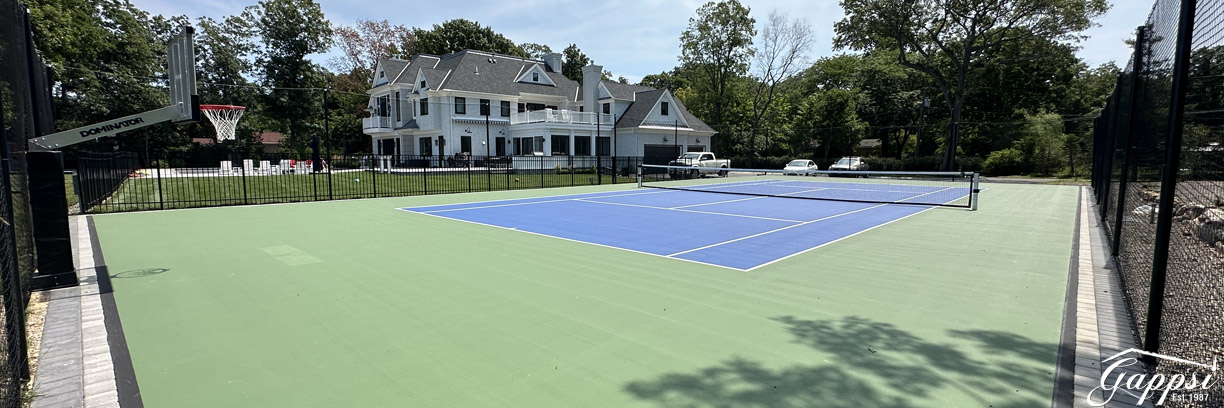
We recently installed this tennis court for a private residence in Belle Terre, NY, overlooking the water.  The base for this asphalt tennis court is made of layers of crushed stone, gravel, and stone dust, providing a stable foundation. The base is critical for the court’s durability and stability.  It should be designed to prevent the court from shifting or settling.  We installed two layers of asphalt on 6 inches of oversized recycled concrete and 4 inches of finer state-approved crushed concrete.  The final layer is the DecoTurf paint.   

DecoTurf Tennis Court

DecoTurf has built its reputation by manufacturing the highest-quality tennis court surfaces for all project types, from prestigious tournaments to private residence surfaces. Their tennis court surfacing products are known for their consistent speed of play, proper ball bounce, durability, low maintenance, vibrant, long-lasting colors, and overall customer value.
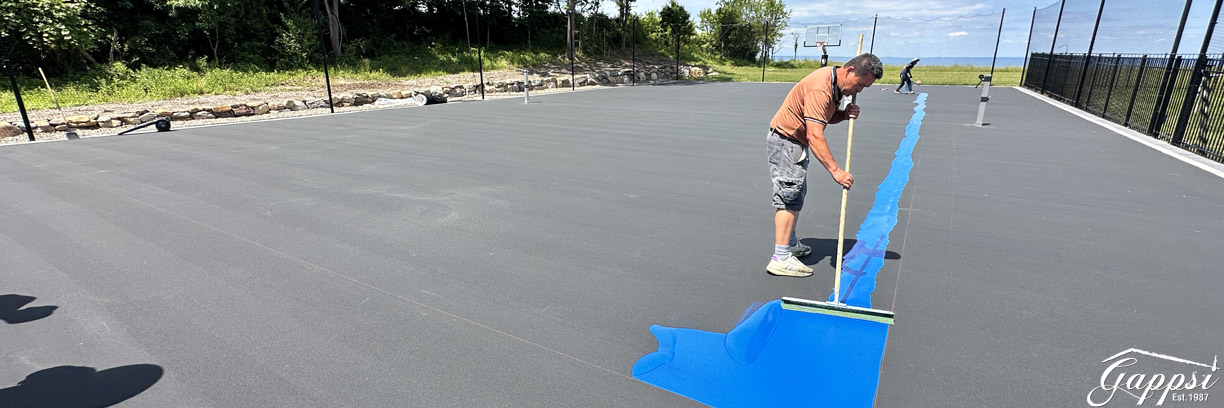
decoturf-tennis-courts---california-sports-surfaces-long-island-ny3Hard Courts with cushioning and an acrylic paint color system are a popular solution for customers who want the low maintenance of a hard court with some of the resilience and “give” of a soft court. Several rubberized cushioning systems have been developed to ease the pain of playing on a hard court. Some cushion systems like DecoTurf utilize 2 to 3 coats of heavy-grade rubber granules followed by three or more coats of fine-grade rubber granules squeezed on top of the asphalt surface.

Cushioned hard courts can have a medium to fast pace of play depending on how much sand is used in the acrylic coatings. The big draw for cushioned hard courts is that they require virtually no maintenance. You must blow or brush leaves and debris off the surface and pressure clean as needed!

For this project, we kept the tennis court’s paint 4 inches away from the very edge of the asphalt. We used DecoTurf paint made explicitly for sports game courts. We used a darker green for the outer perimeter and a navy blue for the center of the tennis court, then striped with white lines.

Running Bond Border
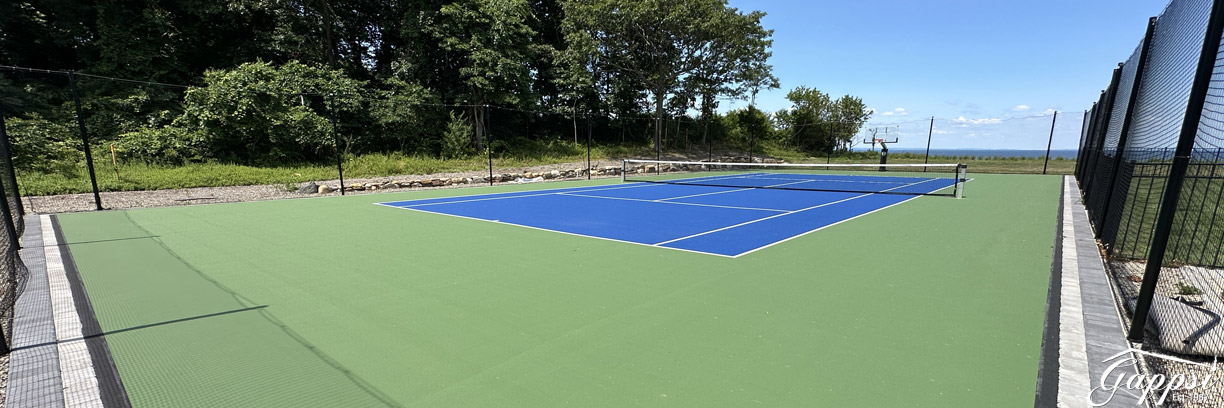
decoturf-tennis-courts---california-sports-surfaces-long-island-nyWe bordered the tennis court with a charcoal color border for the perimeter and a running bond border in multiple gray colors.  The Running Bond, also known as the stretcher bond, is a type of brick bond that is characterized by its simple, repetitive pattern. In this bond, bricks are laid with their long sides (or stretchers) facing outwards, and each row of bricks is offset from the one above and below it by half a brick length.

Out of Bounce Netting and Fencing

We fenced the tennis court with out-of-bounce netting, which looks much softer than chain link fencing. Three-inch powder-coated posts 12 feet high were used. Netting is paramount for sports fields as it prevents balls from leaving the restricted area and keeps spectators safe from unfortunate accidents while playing.

Dominator Netting – Finally, an Easy-to-Adjust Net

We installed regulation tennis netting. The posts are adjustable and can be extended to play volleyball,  badminton, or pickleball. Elevate your tennis game with our adjustable-height tennis nets. Perfect for players of all levels, these nets offer versatility and convenience.  

Every tennis net we sell is adjustable, so it doesn’t matter if your posts are not exactly standard distance apart. Your tennis net will fit. And if you have a slightly smaller court like some of our clients do, you ran out of space, but you love tennis so much you just had to squeeze a tennis court in, it’s not a problem.
decoturf-tennis-courts---california-sports-surfaces-long-island-ny1Dominator Adjustable Basketball Hoop

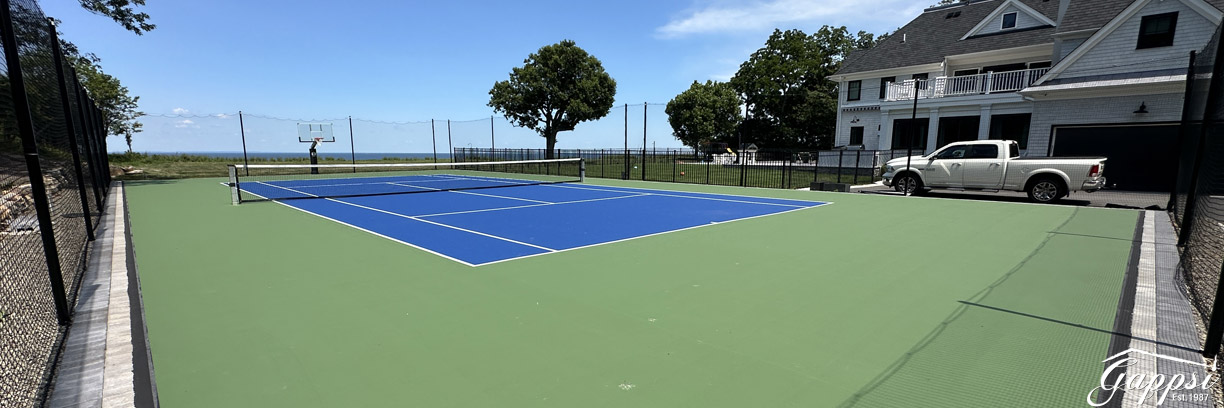
We installed a Dominator basketball hoop on one side of the tennis court.  The Dominator basketball hoop is an aluminum adjustable 72-inch professional hoop. Gappsi is an authorized dealer for Dominator, and we have them on display at the Gappsi showroom.

With a professional Dominator basketball hoop, you always have the home-court advantage. Other hoops rust and become difficult to adjust over time, but Dominator hoops don’t have that problem.

Multi-Sport Game Court Options

A tennis court is a versatile playing area for the entire family! It offers a variety of games that don’t require extensive equipment or complicated setup and that both children and adults can enjoy!

You can add other sports to a tennis court by installing nets, hoops, and other equipment or dividing the court with cones.

  • Basketball: Install basketball hoops and keys
  • Hockey: Cut a hockey “D” into the court for practice stick tricks, dribbling, and goal-scoring
  • Cricket: Add a cricket wicket to the edge of the court
  • Netball: Install a netball goal circle and hoop
  • Football: Use the court’s non-directional surface to improve ball control and footing
  • Hopscotch: add hopscotch to a tennis court by using different colored tiles or game lines to separate activities.
  • Add unique color paint tailored explicitly for your court surface to your court games. Gappsi can creatively imprint games onto your court. Add kid’s games to any court or playground, like 4 Square, Tetherball, Shuffleboard, Bean Bag Toss, and many others.
decoturf-tennis-courts---california-sports-surfaces-long-island-ny2At Gappsi, our team can always guide you through the process and answer your questions. From getting the right supplies to installing them, our professionals are equipped to deal with any challenge that comes their way. Check out our Sports Game Court Gallery to be inspired by design ideas.

This property is right on the water in Belle Terre. It is the latest sports game court built by Gappsi in Belle Terre, NY. 

SCHEDULE A MEETING TODAY WITH GAPPSI

Frequently Asked Questions

How much maintenance does a DecoTurf court actually require? One of the best features of a DecoTurf court is how little upkeep it needs compared to clay or grass. Your main tasks will be keeping it clean from leaves, dirt, and other debris. A simple sweep with a broom or a leaf blower usually does the trick. For a deeper clean, you can gently pressure wash the surface as needed. Because the acrylic surface is non-porous and durable, you won’t have to worry about the constant watering, rolling, and line-painting that other court types demand.

Is the cushioned DecoTurf surface really that different from the standard hardcourt? Yes, the difference is something you can feel. While both the cushioned and standard DecoColor systems provide a professional-grade, true ball bounce, the cushioned version adds layers of granulated rubber beneath the surface. This addition provides significant shock absorption, which reduces the impact on your joints, particularly your knees and ankles. It’s an excellent choice for players who want to enjoy longer games with more comfort or for families with members of all ages playing on the court.

Can I use a DecoTurf court for sports other than tennis? Absolutely. While DecoTurf is famous for tennis, its consistent and durable surface is perfect for a variety of sports. It’s a popular choice for pickleball and basketball, and we can easily add the appropriate lines and equipment, like adjustable nets or basketball hoops. The reliable footing and true bounce make it a versatile foundation for almost any sport you’d play on a hard surface, turning your backyard into a multi-sport hub for the whole family.

How long can I expect a professionally installed DecoTurf court to last? With proper installation and basic maintenance, a DecoTurf court is a long-term investment that can last for many years. The multi-layer acrylic system is designed to withstand harsh weather, intense play, and UV exposure without fading or breaking down. The key to its longevity is the quality of the initial installation, from the base preparation to the final coating. Periodically, after several years of use, the court may need a simple resurfacing to refresh the color and texture, which is a straightforward process.

Why is it so important to use a certified installer for a DecoTurf court? A DecoTurf court is a high-performance system, and the final result depends entirely on the quality of the installation. The process involves precise steps, from ensuring the asphalt or concrete base is perfectly level to applying each layer of acrylic, rubber, and silica at the correct thickness. Certified installers have the specific training and experience to execute this process flawlessly. Choosing an expert team like Gappsi ensures your court will have a consistent ball bounce, proper drainage, and the durability to last for years to come.

Key Takeaways

  • Choose a surface with a proven legacy: DecoTurf is the same multi-layer acrylic system used in professional tournaments, offering a true ball bounce and exceptional durability that makes it a practical, low-maintenance choice for home sports games courts.
  • Tailor your court to your playing style: You can choose the right DecoTurf system for your family, whether you need the classic durability of a standard hardcourt, the joint-friendly shock absorption of a cushioned surface, or a specialized overlay to restore an old court.
  • Rely on certified installers for lasting results: A high-performance surface requires precise installation, so working with an experienced team ensures your court is built correctly from the foundation up, guaranteeing its playability and longevity.
Related Articles

Share this page:

Does a Pickleball Court Increase Home Value? A Guide

Here on Long Island, our backyards are our sanctuaries. They’re where we host barbecues, watch our kids play, and unwind after a long week. Lately, a new sound is joining the summer buzz: the distinct pop of a pickleball game. From Montauk to Manhasset, homeowners are converting parts of their yards into private courts. But with property values in Nassau and Suffolk counties being a constant topic, every upgrade needs to be a smart one. This brings up a critical point for any local homeowner considering the project: does a pickleball court increase home value in our unique market?

pickleball-courts-at-home-increase-home-values-glen-head-nyPickleball courts at home increase home values for homeowners who are constantly on the lookout to boost their property’s resale value.  Investing in recreational amenities, particularly a tennis or pickleball court, can be a game changer.
His and her sinks, open floor plans, and pools used to be the hottest trends in real estate.  Then the trend was signature golf courses and beach clubs.  Now all eyes are on pickleball courts. These days, if you want to sell your house, build a pickleball court. That’s right. A recent spike in keyword search data from Zillow shows pickleball courts are the hot new commodity people want in a new place to live.

What Real Estate Agents Are Saying

Real estate agents are witnessing a trend where homeowners are reconfiguring their spaces to accommodate pickleball courts.  They are even converting driveways or repurposing existing sports facilities on ultra-luxury properties.  Pickleball courts at home increase home values.

As a homeowner when you add a pickleball court you immediately boost your property value.   Adding a tennis or pickleball court to a property is similar to upgrading a kitchen or bathroom – it can provide an instant boost in value.  The logic is simple: recreational spaces are attractive features that potential buyers are willing to pay extra for.

Pickleball is a popular sport across various age groups and demographics.  The USA Pickleball Association notes a surge in the sport’s popularity. Homes equipped with courts cater to a broad audience, potentially speeding up the sale process.  It allows homeowners and their families to engage in a fun, healthy activity without leaving their property.

Pickleball Sports Game Courts Impact on Landscape and Space

It is essential to consider the overall impact on the landscape. A well-designed court can enhance the aesthetic appeal of a property. Strategic placement and landscaping around the court can create a serene, resort-like ambiance. However, homeowners must ensure they have ample space so that the court doesn’t feel cramped or diminish the utility of the backyard. While adding a pickleball court is a significant investment, the benefits of property value, lifestyle upgrades, and potential income make it a worthy consideration.

What are the different types of Pickleball Court playing surfaces and which one is right for you?

  • Asphalt
  • Concrete
  • Mateflex Court Tiles

If you’ve decided to improve your space with a pickleball court, the next step is to find a style that supports your desired level of play. If joint protection and beginner-friendly playability are the priorities for your outdoor court, our versatile Mateflex Court Tile surface is the way to go. Asphalt and concrete courts provide the reliable and durable surface performance you need if you’re searching for high-velocity ball bounce and tournament-level player traction.  Check out our design gallery of Sports Game Courts.

pickleball-courts-at-home-increase-home-values-glen-head-ny1Why Choose Asphalt Court Surfaces

Fast installation: One of the main advantages of using an asphalt surface for pickleball courts is the quick installation. Asphalt can be laid in a matter of days, allowing for a fast turnaround time for court construction. This is particularly advantageous for those who want to have their pickleball court ready for use as soon as possible.

Less costly: Asphalt is less expensive than other court materials such as concrete or clay, making it a more budget-friendly option.

Easily maintained: Asphalt surfaces are relatively easy to maintain, which is important for a pickleball court with frequent use. Regular sweeping and cleaning can help to keep the court free of debris while sealing every couple of years can help to protect the surface from weathering and cracking. Any necessary repairs can be easily made by filling in cracks or holes with asphalt patching material.

Weather-resistant: Asphalt can withstand various weather conditions without becoming damaged or deteriorating.

Why Choose a Concrete Court

Durability: Concrete surfaces are incredibly durable and can withstand heavy use. It lasts longer than asphalt. This makes them an ideal choice for pickleball courts with a lot of activity. Concrete surfaces are also resistant to weathering, which helps to extend their lifespan and reduce maintenance costs.

Low maintenance: Concrete surfaces require minimal maintenance. Regular sweeping and cleaning can help to keep the court free of debris, while periodic sealing can help to protect the surface from weathering and staining. Any necessary repairs needed can be easily made by filling in cracks or holes with concrete patching material.

Cost-effective: While the initial installation cost may be higher than asphalt, the long-term durability and low maintenance requirements of concrete can help to reduce costs over time.

pickleball-courts-at-home-increase-home-values-glen-head-ny2Why Choose Mateflex Sports Game Court Tiles

Sports game court tiles are eco-friendly tiles that can be installed over most existing floor surfaces to provide a variety of game courts. These sports tiles are water-resistant making them the perfect choice for both indoor courts and outdoor courts. These tiles are also available in a variety of color combinations and textures so you can create a unique look.

Versatility – One of the key strengths of sports game court tiles is their adaptability. They can be installed over various base materials, including concrete and asphalt, making them an ideal choice for facilities that host multiple sports. This versatility extends to both indoor and outdoor settings, accommodating sports like basketball, tennis, volleyball, and more. The ability to quickly convert and adapt these spaces is particularly beneficial for multi-purpose sports complexes.

Maintenance – Sports game court tiles are designed for ease of maintenance. Unlike traditional court surfaces that may require specialized maintenance routines, these tiles can be cleaned with simple, non-abrasive cleaning solutions. This ease of upkeep not only saves time but also reduces the long-term maintenance costs associated with sports flooring.

Ultimately, the right material surface type for your outdoor pickleball court comes down to preference and available budget. We take the time to compare each surface type in detail and provide everything from foundation preparation to the finishing touches like net placement and striping. With every custom court, we create, you can expect transparent pricing, organized guidance, and a willingness to adapt to your specific needs and requests with courtesy and experience.

Pickleball Court Built in Glen Head NY

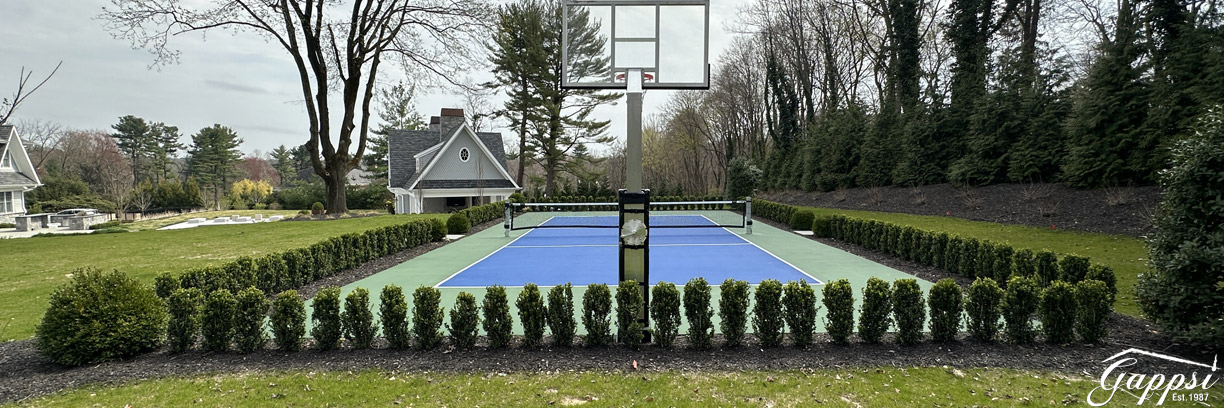
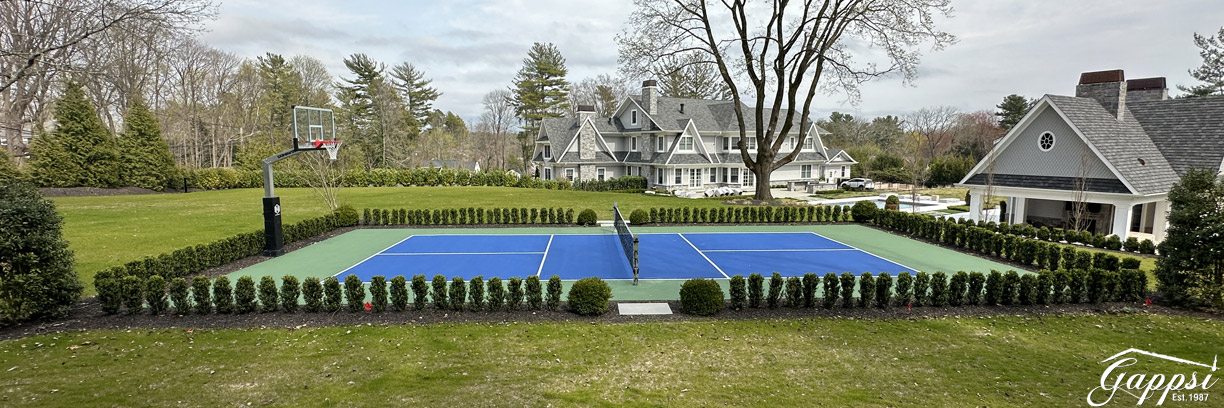
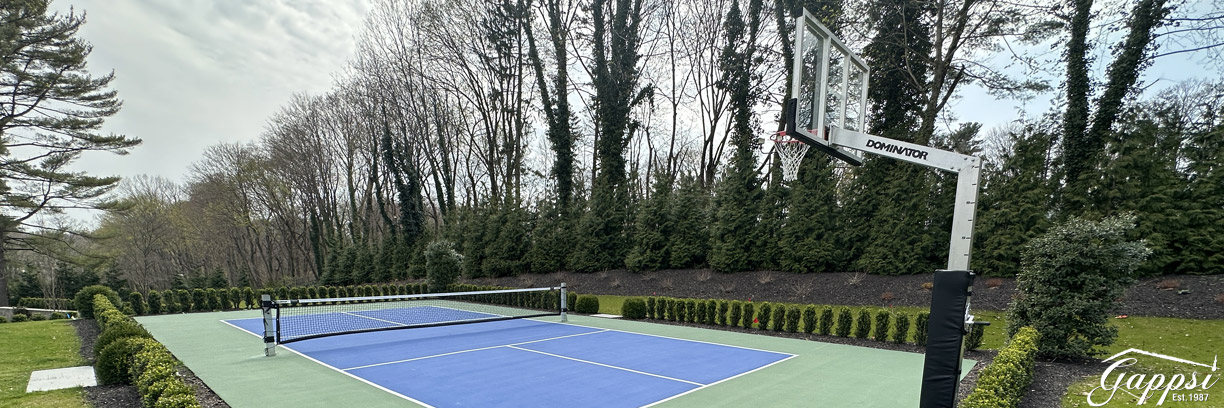
Gappsi recently built a pickleball sports game court in Glen Head NY. The Pickleball court was installed using a recycled concrete base and three and a half inches (3 1/2 inches) of compacted asphalt, then painted with California Sports Surfaces court paint.

We used a dark blue for the Pickleball court area and a dark green for the out-of-bounce area. The court was striped with white lines to finish it.  

We installed an adjustable Dominator multisport court netting. For this application, we adjusted the net for Pickleball. The client wanted the court to be just for Pickleball.  However, the extension can always be added to adjust the netting to be badminton or volleyball.

Our team installed an all-aluminum adjustable Dominator basketball hoop. The Dominator Hoop is a professional-grade, in-ground basketball hoop perfect for your home driveway, backward, playground, or more.

The landscape for the court was designed to resemble an English garden with boxwood edging that was installed all around the perimeter of the Pickleball Sports Game Court.  This is the latest sports game court built by Gappsi in Glen Head located in Nassau County NY.

Pickleball’s Popularity and the Rise of Home Courts

It seems like everywhere you turn, someone is talking about pickleball. What started as a niche backyard game has exploded into a mainstream sport, and for good reason. It’s easy to learn, incredibly social, and provides a great workout without the high-impact strain of sports like tennis or running. This accessibility has fueled its rapid growth, making it a favorite pastime for people of all ages. As its popularity continues to climb, more and more homeowners are looking to bring the fun to their own backyards by building personal courts, creating a convenient and private space for practice and play.

A Sport for Everyone

One of the best things about pickleball is that almost anyone can play. The court is smaller than a tennis court, the paddles are lightweight, and the game’s pace can be as relaxed or as competitive as you want it to be. The USA Pickleball Association has noted a massive surge in the sport’s popularity, and it’s easy to see why. It’s a game that bridges generational gaps, allowing grandparents to play with their grandchildren and friends of varying athletic abilities to enjoy a match together. This broad appeal means that a home with a pickleball court instantly becomes a hub for family fun and social gatherings.

Community and Health Benefits

Beyond being a fun activity, pickleball offers significant health and community benefits. It’s a fantastic way to stay active, improving cardiovascular health, balance, and agility. Having a court at home removes the barriers of travel and scheduling, making it easy to fit in a quick game whenever you have a spare moment. It allows you and your family to engage in a fun, healthy activity right on your property. This convenience fosters a more active lifestyle and creates a natural gathering spot for friends and neighbors, strengthening community bonds one friendly match at a time.

Does a Pickleball Court Increase Home Value? The Great Debate

When considering a major home improvement project, the question of return on investment always comes up. With pickleball courts, the answer isn’t exactly straightforward. While some buyers see a private court as a luxury amenity they’re willing to pay a premium for, others might view it as a maintenance hassle or a poor use of yard space. The debate is active, with valid points on both sides. Ultimately, whether a pickleball court adds value depends heavily on your specific property, your local market, and the preferences of potential buyers.

The Argument for a Value Increase: Appealing to a Growing Market

For many, adding a pickleball court is a smart move. Think of it like upgrading your kitchen or finishing your basement—it’s an investment in your home’s lifestyle appeal. Recreational spaces are attractive features that can make a property stand out. As the sport’s popularity grows, so does the pool of potential buyers who would see a private court as a major perk. A home equipped with a court caters to this expanding audience, which could lead to a faster sale and a higher offer from the right buyer who values health, wellness, and at-home entertainment.

The Counterargument: Why Some Buyers Are Not Interested

On the other hand, a pickleball court isn’t a universally desired feature. Some potential buyers might not play the sport and would prefer a large, open lawn for gardening, a play structure for kids, or even space for a future swimming pool. There’s a real disagreement about whether courts are a net positive for a home’s appeal. For buyers who don’t share the passion for pickleball, the court could be seen as something they’d have to pay to remove, potentially making your home less attractive to them than one with a more traditional backyard.

The Noise Factor and Its Impact on Property Value

One of the biggest complaints associated with pickleball is the noise. The distinct “pop” of the ball hitting the paddle can be a source of irritation for neighbors, especially if games are frequent. This has become a point of contention in many communities. In fact, some real estate experts believe that homes located directly across from busy public pickleball courts could see a decrease in value due to the constant sound. When building on your own property, it’s a crucial factor to consider for maintaining good relationships with your neighbors and preserving the peaceful enjoyment of everyone’s homes.

Return on Investment vs. Personal Enjoyment

When you weigh the pros and cons, the best advice is to build a pickleball court because you and your family will genuinely use and enjoy it. While it might add financial value, its primary return is in the lifestyle enhancement it offers. Don’t expect to recoup the entire cost of installation when you sell your house. Instead, view it as an investment in your family’s health, happiness, and social life. If you get years of fun out of it, the court has already paid for itself in memories and well-being, with any potential increase in home value being a welcome bonus.

Space and Maintenance Considerations

A pickleball court is a significant addition to your property, and it needs to be planned thoughtfully. It’s not just about having enough space for the court itself, but also ensuring it integrates well with your overall landscape. A well-designed court can absolutely enhance the aesthetic appeal of your property, especially with strategic landscaping to create a beautiful, resort-like feel. However, if it’s squeezed into a small yard, it can feel cramped and overwhelm the space. Proper planning with an experienced team ensures the court complements your home rather than detracting from it.

Planning Your Perfect Home Court

Once you’ve decided to move forward, the planning phase is where your vision starts to take shape. This is the time to think about the practical details that will turn a patch of your yard into a professional-quality court. From getting the dimensions just right to choosing the ideal location and surface, each decision plays a role in the final outcome. Careful planning at this stage ensures your court is not only fun to play on but also safe, durable, and perfectly suited to your property and playing style.

Essential First Steps: Dimensions and Orientation

Before you can break ground, you need a solid plan for the court’s layout. This involves more than just marking out a rectangle; it requires thinking about how players will move, where the sun will be, and what kind of experience you want to create. Getting these foundational elements right is key to building a court that you’ll love for years to come. It’s about creating a space that is both functional for gameplay and harmonious with its surroundings, ensuring maximum enjoyment and safety for everyone who plays.

Standard Court Dimensions

A regulation pickleball court measures 20 feet wide by 44 feet long for both singles and doubles play. However, the playing area is only part of the equation. You need to account for the out-of-bounds area, known as the overrun. For comfortable and safe play, it’s recommended to have at least 5-8 feet of extra space on all sides of the court. This brings the total recommended footprint to a minimum of 30 by 60 feet, giving players plenty of room to move without risk of injury.

Proper North-South Orientation

One of the most overlooked but critical aspects of planning an outdoor court is its orientation. Whenever possible, you should position your court so it runs north to south lengthwise. This simple step has a huge impact on playability. A north-south orientation prevents the rising or setting sun from shining directly into a player’s eyes during morning or evening games. It’s a professional tip that ensures you and your guests can play comfortably at any time of day without battling sun glare on every serve and return.

Indoor Court Requirements

If you have the space, an indoor court offers the advantage of year-round play, regardless of the Long Island weather. You can convert a large garage, a barn, or even build a dedicated structure. The key requirement for an indoor court is ceiling height; you’ll want at least 18-20 feet of clearance to allow for lobs and high shots. Proper lighting is also essential to eliminate shadows and ensure good visibility. Finding a style that supports your desired level of play is the next step, whether it’s a simple painted floor or a professional tile system.

Choosing the Right Surface for Your Long Island Home

The surface you choose for your court will have the biggest impact on ball bounce, player comfort, and long-term maintenance. In Long Island, you need a surface that can withstand our varied climate, from hot summers to freezing winters. The most common options are asphalt, concrete, and modular sport tiles, each with its own set of benefits. Your decision will likely come down to your budget, desired performance, and aesthetic preferences. Working with a professional can help you explore the options and select the perfect surface for your home.

### Adding the Finishing Touches: Fencing and Lighting

Once your court surface is ready, the final details will bring your vision to life. Fencing is a popular addition that helps keep the ball in play and creates a polished, professional look for your court. While not always necessary, especially if your yard has natural barriers or plenty of open grass, a dedicated fence defines the space and prevents you from chasing stray shots. At Gappsi, we can help you select from various fencing options that complement your landscape design. If you dream of playing after sunset, installing LED court lighting is a must. This allows for evening matches with family and friends, extending your playing time well into the night. For safety and proper installation, it’s crucial to have a licensed electrician handle the lighting setup.

Breaking Down the Cost of a Home Pickleball Court

Understanding the financial investment is a key part of planning your home pickleball court. The total cost can vary widely based on site conditions, material choices, and added features. Generally, homeowners can expect the project to fall within a certain range, but it’s the specifics that will determine your final budget. The most significant expenses typically involve preparing the ground, pouring the base surface like concrete or asphalt, and applying the final acrylic layers. From there, extras like professional lighting, perimeter fencing, and premium net systems will influence the overall price. Working with a comprehensive design and construction team ensures you get a clear, detailed quote that covers every aspect of the build from start to finish.

Average Investment for a Private Court

So, what’s the bottom line? Building a private pickleball court in your backyard is a significant home improvement project, and the investment reflects that. On average, you can expect the cost to range from $30,000 to $50,000. This range accounts for a standard-sized court with quality materials and professional installation. Factors that can push your cost toward the higher end of that spectrum include extensive excavation or grading work, the addition of retaining walls, high-end surfacing options, and premium accessories. A project manager can help you get a quote tailored to your property’s specific needs and your personal design preferences, ensuring there are no surprises along the way.

A Sample Cost Breakdown

To give you a clearer picture, let’s break down the potential costs for a standard 30×60 foot court. Keep in mind that these are estimates, and your actual costs will depend on your specific project details and material selections. This breakdown helps illustrate where the major investments lie and how different components contribute to the final price tag. It’s a great starting point for budgeting and helps you prioritize which features are most important for your dream court.

Concrete Base

The foundation of your court is critical, and a professionally poured concrete slab provides a durable, long-lasting base. For a 30×60 foot area, the concrete work alone can cost around $9,000. This includes site preparation, forming, and pouring the slab to the correct specifications for proper drainage and a level playing surface.

Permanent Net

While you can use a portable net, a permanent, in-ground net system offers superior stability and a more professional feel. The cost for a quality permanent net, including installation, is typically around $1,000. This is a worthwhile investment for a court that will see regular use.

Fencing

As mentioned, fencing is a functional and aesthetic choice. A standard chain-link or vinyl fence around the court perimeter can cost approximately $5,000. The price will vary based on the height of the fence and the materials you choose.

Professional Surfacing

Applying the acrylic color coating, striping the lines, and ensuring a non-slip texture is a job for specialists. Professional surfacing for a pickleball court often costs around $7,000. This step is what gives your court its classic look and optimal playability.

LED Lighting

For those who want to play at night, installing a proper lighting system is essential. The cost for LED court lighting, including the fixtures, poles, and electrical work by a licensed professional, can be about $7,000. This addition truly maximizes the usability of your court.

Long-Term Care and Maintenance for Your Court

Building a pickleball court is an investment in your home and lifestyle, and like any valuable asset, it requires some care to keep it in top condition. The good news is that modern court surfaces are designed for durability and require relatively minimal upkeep. Regular cleaning to remove leaves, dirt, and debris will prevent staining and keep the surface safe for play. Periodically checking for and addressing any minor issues, such as small cracks or fading lines, will extend the life of your court and ensure it remains a beautiful and functional feature of your property for years to come. With a little attention, your court will be ready for a match whenever you are.

Expected Lifespan of a Well-Built Court

When you invest in a professionally constructed pickleball court using high-quality materials, you can expect it to last for a very long time. A well-built court has an impressive lifespan, potentially lasting anywhere from 10 to 30 years before needing a major resurfacing. The key to this longevity lies in the quality of the initial build—from the properly compacted base to the durable acrylic surface layers. Choosing an experienced builder who understands the nuances of sports court construction ensures that every layer is built to withstand years of play and exposure to the elements, giving you decades of enjoyment.

Seasonal Maintenance for Long Island Weather

Here on Long Island, our four distinct seasons mean your outdoor court will face everything from summer sun to winter ice. The freeze-thaw cycles common in our colder months can be particularly tough on court surfaces, sometimes leading to small cracks over time. It’s a good practice to inspect your court each spring to identify and repair any cracks that may have formed. Gappsi offers professional restoration and sealing services to address these issues and protect your investment. Keeping the surface clean of leaves and debris in the fall will also prevent moisture from getting trapped, which helps minimize winter damage and keeps your court looking its best year-round.

SCHEDULE A MEETING TODAY WITH GAPPSI

View Gappsi’s YouTube Channel for Videos of Pickleball Courts at Home Increase Home Values | Glen Head NY

https://youtu.be/gi-yMYZEH3Y

Frequently Asked Questions

How much yard space do I actually need for a pickleball court? While the official playing area is 20 by 44 feet, you’ll want more room than that for a safe and enjoyable game. We recommend a total footprint of at least 30 by 60 feet. This extra space, called the overrun, gives players enough room to chase down shots without running into a fence or landscaping. A professional can help you assess your property to find the best placement that works with your yard’s unique layout and slope.

So, will a court guarantee an increase in my home’s value on Long Island? There’s no simple yes or no answer to this, as it really depends on the buyer. For a family that loves pickleball, a private court is a massive selling point that could lead to a higher offer. However, a buyer who would prefer a large garden or open lawn might see it as a feature they’d have to remove. The best approach is to build a court because you and your family will get years of enjoyment from it. Think of it as an investment in your lifestyle first; any potential bump in home value is a great bonus.

Which court surface is best for dealing with Long Island’s weather? Each surface has its advantages for our climate. Concrete is incredibly durable and stands up well to our freeze-thaw cycles, making it a long-lasting choice. Asphalt is another popular and weather-resistant option that can be more budget-friendly. For excellent drainage and joint-friendly play, Mateflex court tiles are a fantastic choice, as they handle rain well and individual tiles can be replaced if needed. The right fit really comes down to your budget and how you envision using the court.

My neighbors are close by. How can I minimize the noise? The distinct “pop” of the pickleball is a valid concern in our Long Island neighborhoods. Strategic placement is your best first step—positioning the court as far from your neighbors’ homes as possible makes a big difference. You can also use landscaping to your advantage. Planting a dense row of shrubs or installing a solid fence can act as a natural sound buffer, helping to keep the peace while you enjoy your game.

How long does the whole process take, from planning to playing my first game? Building a court is a multi-step process, and the timeline can vary. The biggest factors are the condition of your site and the type of surface you choose. If your yard needs significant grading, that will add time. An asphalt court can be installed relatively quickly, while a concrete base needs time to cure properly. Generally, you can expect the project to take a few weeks, but a detailed consultation will give you a much more precise schedule based on your specific property.

Key Takeaways

  • Prioritize Personal Enjoyment Over ROI: While a pickleball court can attract the right buyer, its most reliable return is the fun it offers your family. Build a court because you’ll use and love it, and consider any potential increase in home value a welcome bonus.
  • Strategic Design Dictates a Court’s Success: A great court is more than just a slab of concrete. Critical details like a north-south orientation to avoid sun glare, adequate space for safe play, and the right surface material are essential for long-term usability and enjoyment.
  • Budget for the Full Project and Future Care: Plan for the entire scope of the project, from the foundation to finishing touches like fencing and lighting, which typically ranges from $30,000 to $50,000. Remember to also account for simple seasonal maintenance to protect your investment for decades.

Related Articles

Share this page: