


Planning an inground pool on Long Island means looking beyond the shell price. Excavation, access to the backyard, equipment, permits, coping, decking, and water features can all change the final investment, especially on properties with tight lots or difficult soil conditions.
Contact Gappsi through our contact page
In practical terms, fiberglass pool cost commonly falls between $45,000 and $85,000 before more extensive upgrades. While larger pools, challenging installations, heating, lighting, and landscaping can push a project toward $100,000 or more. Those figures are broad national benchmarks, not a quote for a Long Island property, so the right estimate starts with the actual site and the scope you want.
Fiberglass also brings a faster installation timeline and generally requires less maintenance time and chemicals than gunite. Understanding the local price range, then separating shell costs from site work and selected features. Gives you a clearer basis for comparing proposals and planning the backyard you want.
What Does a Fiberglass Pool Cost on Long Island in 2026?
A fiberglass pool cost on Long Island typically starts around $45,000 and can reach $85,000 for the shell and basic installation. Larger pools, difficult excavation, upgraded equipment, and outdoor-living features can push a complete project to $90,000-$120,000 or more. The final number depends less on a single statewide average than on the size of the pool. The conditions of your backyard, and how you plan to use the space.
As a broad industry reference, Latham Pool Products places the average fiberglass pool range at $45,000-$85,000. With additional features and installation complexity capable of pushing the project to $100,000 or more. Review the Latham fiberglass pool pricing guide for its published cost factors.
Regional pricing gives a useful reality check
A 2026 survey of independent fiberglass pool builders in the Thursday Pools dealer network reported standard installation averages in North Carolina. That survey put a small pool near $80,000, a medium pool near $99,286, and a large pool near $112,143. The survey reflects North Carolina installations, not Long Island projects, so these figures should be treated as a regional reference rather than a quote. Still, they show why a large, fully installed fiberglass pool can cost considerably more than the shell-only numbers many homeowners see online. See the Thursday Pools dealer survey.
On Long Island, site access and existing conditions can materially change the budget. A narrow side yard may require smaller excavation equipment or additional labor. Rock, poor drainage, steep grades, retaining walls, utility conflicts, and limited access for delivery can also add work that is not included in a basic pool package. These conditions need to be evaluated before anyone can give a responsible project figure.
What is included in a typical fiberglass pool price?
A basic installed range commonly accounts for the fiberglass shell, excavation, placement, plumbing, backfill, and standard filtration equipment. It may not include every item needed to finish the backyard. Heating, automation, upgraded coping, concrete or paver decking, lighting, fencing, drainage, landscaping, and masonry can substantially increase the total. The design also matters. A compact plunge pool and a large family pool require different excavation, circulation, and finishing specifications.
Gappsi installs fiberglass pools on Long Island and evaluates the pool, property, access, and surrounding design together. That approach helps separate the pool installation cost from the broader backyard construction budget. So you can compare proposals based on the same scope instead of comparing an incomplete package with a finished outdoor-living plan. See Gappsi’s swimming pool construction services or Contact Gappsi through our contact page to discuss your property.
What Factors Drive Fiberglass Pool Pricing in New York?
A fiberglass pool estimate reflects far more than the shell itself. On Long Island, the final fiberglass pool cost depends on the pool package, the property, the required site work, and the finish choices that turn an installation into a usable backyard. Two homes with the same pool model can receive different estimates if one has narrow side-yard access, dense tree roots, shallow bedrock, or a more complicated drainage plan.
The shell, freight, size, and shape
The shell is the starting point, and its price changes with length, width, depth, steps, benches, tanning ledges, and the complexity of the shape. Freight and delivery also matter because a one-piece shell must reach the property and be positioned safely with the right equipment. A larger pool may require more excavation, stone, backfill, water, and labor in addition to the higher shell price. Custom features can improve how the pool functions, but they should be selected around the family’s actual use rather than added automatically.
Excavation and Long Island site conditions
Excavation is one of the most variable parts of a New York pool project. Soil removal, disposal, grading, dewatering, and backfill all affect the budget. Rock, buried concrete, mature tree roots, sloped ground, and limited equipment access can add labor or require specialized work. Trees deserve particular attention during design. Guidance from Texas A&M AgriLife Extension advises avoiding pool locations under trees because roots can damage hard pool structures: site planning guidance. On Long Island, a property visit helps identify these conditions before an estimate is treated as final.
Equipment, coping, decking, and permits
The equipment package may include a pump, filter, heater, automation, salt chlorine generator, and lighting. Heating and automation can extend the swimming season and simplify operation, while lighting changes both nighttime use and electrical requirements. Coping and decking add another major design layer. Natural stone, concrete pavers, porcelain, or other surfaces vary in material cost, preparation, edge detail, and installation labor. Drainage, retaining walls, fencing, planting, and outdoor kitchens may also be part of the broader backyard plan.
Finally, local permits, inspections, code requirements, utility coordination, and engineering needs must be included. Optional features such as heating, specialized lighting, and custom landscaping can increase total project costs by 20% to 50%, according to River Pools and Spas: fiberglass pool pricing factors. A detailed Long Island estimate should separate the shell, site work, equipment, finishes, permits, and options so you can see exactly what is driving the investment.
Fiberglass vs Gunite vs Vinyl: Long-Term Value Compared
The right pool type depends on more than the initial invoice. Installation time, routine maintenance, expected service life, and resurfacing requirements all affect what the project costs to own over many years. A lower starting price can become less attractive if the surface needs frequent attention. While a higher investment may make sense when it delivers the shape, finish, and durability your property requires.
For context, Gappsi builds fiberglass, gunite, and vinyl pools on Long Island. The figures below are planning references, not guaranteed quotes. Access, excavation, engineering, pool dimensions, equipment, finishes, and surrounding hardscape can change the final scope.
| Factor | Fiberglass | Gunite | Vinyl |
|---|---|---|---|
| Upfront cost | Often mid-range, with broader project pricing shaped by size, site work, and features. | Gappsi’s published Long Island baseline is approximately $90,000 to $140,000. | An older published example for a 16×34 pool with concrete walls was about $21,000 to $23,000. |
| Install time | Typically faster after excavation because the manufactured shell arrives ready to set. | Usually a longer construction schedule because the structure is formed and finished on site. | Schedule varies with the wall system, excavation, liner, and surrounding work. |
| Maintenance | Generally requires less chemical maintenance and time than gunite. | Routine water and surface care can be more involved. | The liner and water chemistry require consistent monitoring and care. |
| Expected lifespan | Designed to last for decades with proper maintenance. | Can provide long service life when maintained and periodically renewed. | The liner is a replaceable component, so total ownership depends partly on future liner work. |
| Resurfacing needs | Does not typically require the same recurring resurfacing cycle as gunite. | May require resurfacing as the interior finish ages. | Usually does not involve resurfacing, but the liner may eventually need replacement. |
Fiberglass pool cost is therefore only one part of the decision. Fiberglass can offer a balance of predictable installation, lower ongoing chemical demand, and decades of use. Gunite provides broad design flexibility and a durable concrete structure, but its Long Island baseline reflects a larger initial investment. Vinyl can reduce the starting cost in some designs, although future liner replacement should be included in the ownership plan. The older $21,000 to $23,000 example is useful for context, but it should not be treated as a current universal price.
Features such as heating, lighting, and landscaping can add 20% to 50% to a fiberglass project, according to River Pools and Spas. Compare complete scopes rather than shell prices alone, and ask what each proposal includes for excavation, equipment, permits, drainage, coping, and patio work.
Contact Gappsi through our contact page
What Are the Long-Term Costs of Owning a Fiberglass Pool?
The purchase price is only one part of the fiberglass pool cost. Long-term ownership usually includes water treatment, routine cleaning, electricity for circulation, seasonal heating, and a reserve for equipment repairs. For a typical Long Island backyard, a practical planning range is roughly $1,500 to $4,000 per year for regular operation, before major renovations or unusually high heating use. The actual figure depends on pool size, water temperature, use, cover selection, and how much maintenance the homeowner handles personally.
Where does the annual maintenance budget go?
Chemicals and water care are recurring expenses. Fiberglass surfaces are smooth and nonporous, so they generally require less maintenance chemicals and time than gunite pools, according to Latham Pool. That can reduce brushing, balancing, and chemical demand, although every pool still needs regular testing and adjustment. A reasonable household allowance for chemicals, test supplies, and small cleaning items is often about $400 to $1,000 per year, depending on the season and whether service is included.
Cleaning costs vary more than many homeowners expect. A robotic cleaner may require an upfront purchase but reduce weekly labor. A professional service plan can add approximately $1,000 to $2,500 annually for seasonal visits, depending on frequency and scope. Owners who skim, vacuum, inspect baskets, and test water consistently can often keep this category lower.
How do energy use and equipment affect ownership cost?
The circulation pump runs regularly, while a heater can become the largest operating expense. Electricity for the pump and normal equipment may add roughly $300 to $900 per season. Heating can add several hundred dollars more, especially when the pool is uncovered, kept at a high temperature, or used well into the shoulder seasons. A fitted cover helps limit heat loss and evaporation, which makes the heating budget easier to control.
Set aside an equipment reserve of approximately $500 to $1,500 per year, even when all components are functioning. This is not a yearly bill. It is a way to prepare for eventual replacement of a pump, filter, heater component, salt system, cleaner, or cover. Keeping equipment accessible and following the manufacturer’s maintenance schedule can reduce avoidable failures.
Can planning the site reduce future costs?
Yes. Location decisions affect both maintenance and repair risk. Texas A&M guidance recommends avoiding placement under trees because roots can crack hard pool structures. Trees also add leaves, pollen, and shade-related debris, increasing cleaning demands. A thoughtful layout with service access, suitable drainage, and a practical equipment location can reduce labor over the pool’s life.
Water chemistry also protects the system. Chlorine can degrade under solar ultraviolet radiation, which is why cyanuric acid is used in outdoor pools to help protect chlorine from that degradation. As described in research indexed by the National Institutes of Health. Testing regularly and maintaining the recommended balance supports sanitation and helps protect finishes and equipment. With consistent care, fiberglass pools are designed to last for decades, making maintenance discipline an important part of their long-term value.
What Does the Gappsi Fiberglass Pool Installation Process Look Like?
A fiberglass pool project involves more than placing a shell in a hole. Gappsi approaches the backyard as a complete design-build environment, coordinating the pool, hardscape, planting, outdoor entertaining areas, and visual connection to the home. That approach helps ensure the finished pool feels integrated into the property rather than added as a separate feature.
Consultation, site evaluation, and pool selection
The process starts with a consultation about how your household plans to use the pool, how much space is available, and which features matter most. Gappsi then evaluates the site, including access for equipment, grade changes, soil conditions, setbacks, existing utilities, drainage, and the relationship between the proposed pool and the house.
These details guide the selection of a fiberglass shell size, shape, depth, and entry design. The right shell is not simply the largest model that fits the yard. It must work with the site and leave room for safe circulation, coping, decking, planting, and other outdoor-living elements. Early planning also clarifies how excavation, permits, plumbing, electrical work, and finish materials will affect the total fiberglass pool cost.
Excavation, delivery, and crane placement
After the design and logistics are approved, the installation area is marked and excavated to the required dimensions. The excavation must account for the shell, its support base, plumbing runs, and final elevations. A level, properly prepared base is essential because the shell needs consistent support as it is set and connected.
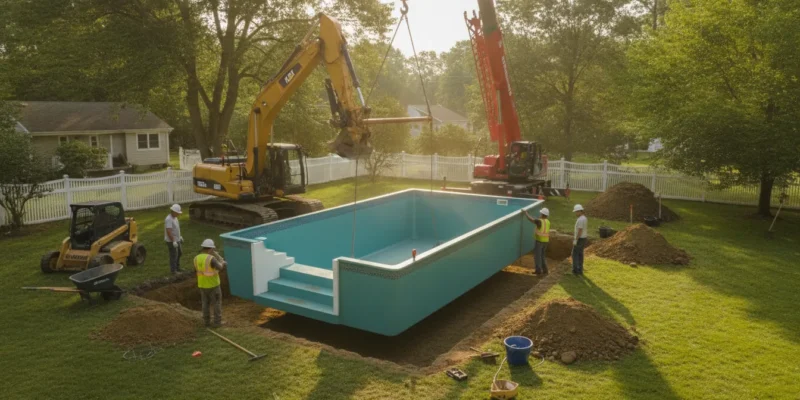
The finished shell is delivered to the property. When access requires it, a crane lifts the shell over a home, fence, or other obstruction and lowers it into the excavation. The installation team checks the pool’s position, level, and elevation before connection work.
Plumbing, equipment, and structural support
Once the shell is placed, the crew connects the circulation plumbing and installs the equipment needed for filtration, sanitation, heating, lighting, or water features included in the design. The pool is filled in a controlled sequence while suitable material is placed around the shell. This coordinated process helps balance the water pressure inside the pool with the support provided by the surrounding backfill.
Fiberglass installation is notably fast once excavation begins. Latham Pool notes that fiberglass pools can often be installed in three to five days after excavation starts. The complete project timeline may be longer when permitting, access preparation, weather, custom decking, or landscaping is involved. Learn more about fiberglass installation timing and cost factors.
Coping, decking, and the finished backyard
With the pool shell and systems in place, Gappsi completes the visible layers that define the space. Gappsi’s pool construction experts install coping at the pool edge, followed by the selected decking or patio surface. Grades and drainage are refined so water moves away from the home and pool structure. The final stage may include planting, lawn transitions, lighting, outdoor kitchens, retaining elements, and other landscape details that make the pool area functional beyond swimming.
The result is a coordinated outdoor-living project, with the pool serving as one part of a larger plan. Design-build coordination is valuable when several trades, materials, and elevations must meet cleanly.
How to Get an Accurate Fiberglass Pool Cost Estimate for Your Backyard
A useful estimate starts with more than the price of a fiberglass shell. The final project total reflects the pool design, the work required to prepare your Long Island property, the equipment you select, and the surrounding deck and landscape. Gather the right information before requesting quotes so each builder is pricing a similar scope.
- Define the pool size and shape you want. Start with the dimensions that fit your backyard, the number of swimmers you expect, and how you plan to use the pool. A compact plunge-style layout will have different excavation, water-volume, and decking needs than a large family pool. Note any preferred entry steps, tanning ledge, bench, or custom shape. A clear design starting point helps the builder explain how shell selection affects the fiberglass pool cost.
- Evaluate excavation needs and site access. A builder needs to understand the property before assigning a dependable installation number. Check the intended location for slopes, retaining walls, rock, drainage concerns, existing structures, and utility lines. Also consider how excavation equipment and the delivered pool shell will reach the backyard. Narrow side yards, fences, overhead wires, or limited staging space can change the labor and logistics. An on-site evaluation is more reliable than an estimate based only on photos or a street address.
- Choose equipment and features. List the systems and features you want included, rather than leaving them as vague allowances. Discuss heating, automation, lighting, a salt chlorine generator, steps, safety features, and any water or energy management equipment. Ask how each selection changes installation and operating costs. Features added later can require additional plumbing, electrical work, or demolition, so including them in the initial scope produces a more useful comparison.
- Request a written, itemized quote. The proposal should identify the shell, excavation, setting and backfill, plumbing, electrical work, equipment, permits, inspections, coping, and decking. It should also state what is excluded, such as difficult soil removal, drainage improvements, fencing, landscaping, or restoration of access areas. An itemized quote makes it easier to distinguish a complete project price from a low initial number that leaves major work unpriced. Confirm the proposed schedule, payment terms, warranty coverage, and allowance amounts in writing.
- Compare several licensed Long Island builders. Compare builders on scope, licensing, experience with local site conditions, communication, and the clarity of their proposals, not just the lowest total. Ask each company to review the same design goals and property constraints. Gappsi can evaluate the backyard in person and explain how the design, site, and selected features shape the estimate. That visit gives you a more accurate number and a clearer basis for deciding which proposal fits your project.
When you prepare these details in advance, the estimate becomes a planning tool instead of a rough shell price. It also gives you a practical way to identify differences between proposals before construction begins.
Before you go, here are the questions Long Island homeowners ask most often about fiberglass pool costs. Contact Gappsi through our contact page if you want a figure tailored to your property.
Frequently Asked Questions
How much does a fiberglass pool cost installed?
A typical fiberglass pool project can fall in the $45,000 to $85,000 range. Larger pools, difficult access, site work, and added features can push the total to $100,000 or more. These figures are a planning range, not a quote for every Long Island property. Your final estimate should account for excavation, the shell, plumbing, equipment, permits, decking, and backyard access. Latham’s fiberglass pricing guide provides the published range.
What factors have the biggest effect on fiberglass pool pricing?
Pool size and depth are major cost drivers. Excavation conditions, soil, access for equipment, plumbing runs, coping, decking, and the filtration and heating equipment selected also matter. Optional heating, lighting, and landscaping can increase a project total by roughly 20% to 50%, according to River Pools and Spas. A site visit is the best way to identify costs that a size-only estimate misses.
Are fiberglass pools cheaper than gunite pools?
They can be, especially when a project benefits from faster installation and lower ongoing chemical and maintenance demands. For context, Gappsi’s published baseline for Long Island gunite pools is $90,000 to $140,000. Fiberglass pricing depends on the same site and design variables, so the right comparison is a complete installed proposal, not the shell price alone.
How long does fiberglass pool installation take?
Once excavation begins, the installation phase can often be completed in three to five days. Permitting, preparation, inspections, weather, decking, landscaping, and other finish work can extend the full project timeline. Latham reports the three-to-five-day figure for fiberglass installation, so ask your builder which parts of the schedule it includes.
Ready to Plan Your Fiberglass Pool?
A personalized estimate helps connect your preferred pool size, site conditions, equipment, and backyard plans to a more useful project budget. Gappsi can discuss your Long Island property and outline the next practical steps for your fiberglass pool project.