


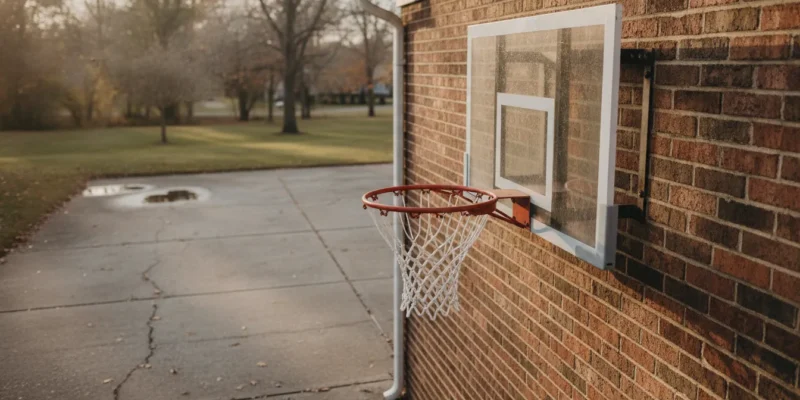
A wall mounted basketball backboard and hoop looks simpler when a yard has no room for a pole and a footing. The mount is only as good as the wall, the clearance, and the surface under the key. ASTM F1882 covers complete residential basketball systems. It does not cover a system mounted to a roof, wall, or ceiling. A house wall is a different job from a freestanding goal.
Request basketball installation help before you pick a mount for a Long Island wall or driveway.
Posted by Gappsi Group, we design and build backyard basketball Sports Games Courts from our Smithtown showroom, and we also sell Dominator aluminum goals for driveways and smaller play areas. This guide stays on the hoop decision. Court size, base work, and surface construction live on the basketball court installation page.
What Is a Wall Mounted Basketball Backboard and Hoop?
A wall mounted basketball backboard and hoop is a backboard, rim, and net fastened to a building instead of a pole. Homeowners use it on a garage or a masonry wall when a driveway is short. The board still needs a 10-foot rim for older players. Younger players need a lower setting when the hardware allows it.
The mount transfers every dunk, rebound, and miss into the building. A freestanding goal puts that load into a buried footing. A wall puts it into studs, masonry, or a header. That is why the product and the wall have to be chosen together. A backboard sold for a pole system is not automatically a wall backboard.
Gappsi’s Dominator glass backboard is a clear example. The product page says it works only with adjustable Dominator hoops. It does not fit the fixed-height system. It cannot be used as a wall mount or as a replacement for another brand. A glass board on a garage is the wrong part.
Should You Choose a Wall Mount or an In-Ground Pole?
Choose a wall mount when the building can carry the load and the play area sits tight against that wall. Choose an in-ground pole when you need the rim out over a driveway or court and you can pour a footing away from the house. The two setups answer different site problems.
| Question. | Wall mounted backboard and hoop. | In-ground pole goal. |
|---|---|---|
| Where does the load go? | Into studs, masonry, or a header. | Into a concrete footing. |
| Best site. | A sound wall with open play in front. | A pad with room for a footing. |
| What it saves. | Yard space. No pole sits in the play area. | The house. Missed shots miss the siding. |
| What it risks. | Cracked framing and pulled fasteners. | A bad footing or a pole in the drive. |
| Height changes. | Only if that wall unit adjusts. | Crank models move from 7 to 10 feet. |
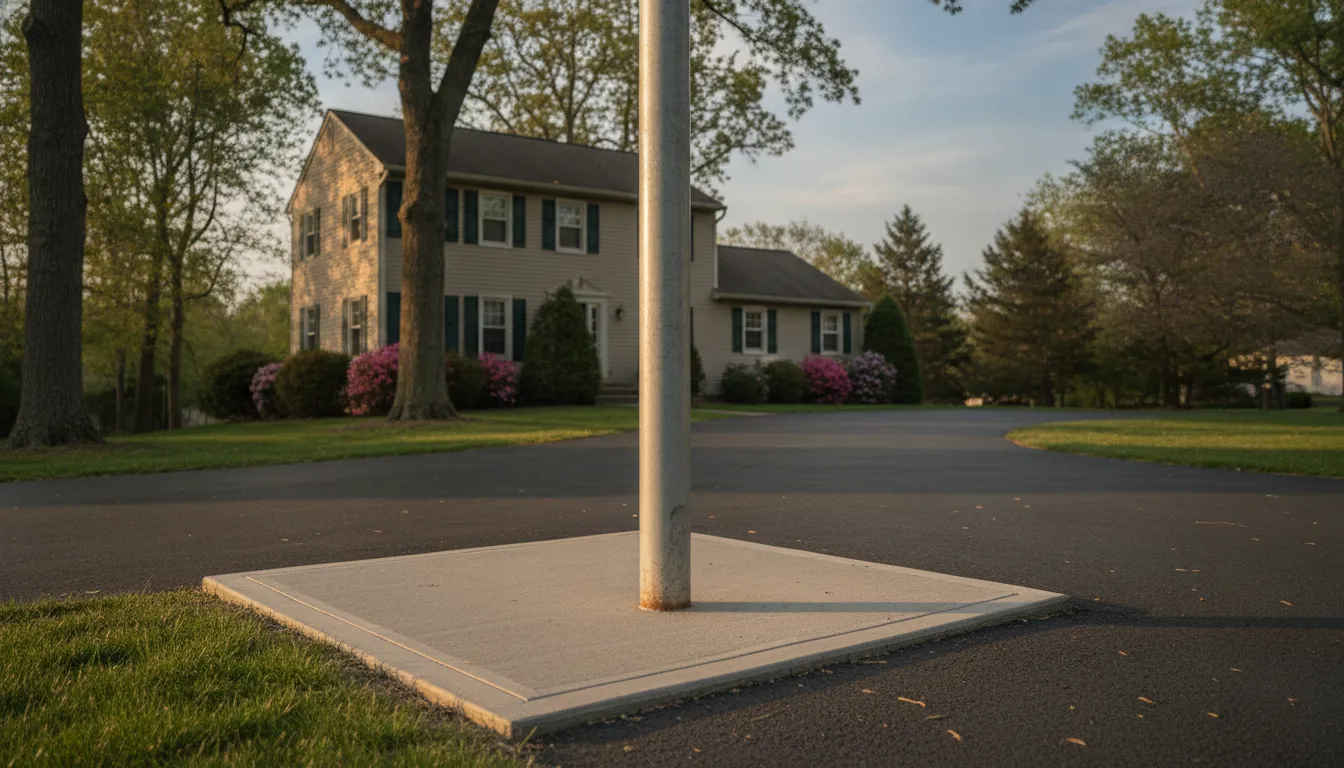
Dominator goals sold through the Gappsi store are pole systems, not wall kits. The Dominator adjustable basketball hoop is built for driveways and smaller play areas. That configuration lists a 54-inch glass backboard and a 2.5-foot overhang.
The Dominator 72 with a shatter-proof aluminum backboard uses 6061 T6 aluminum and stainless hardware. The full system is listed at about 400 pounds. Those weights and overhangs belong on a pole and a footing, not on vinyl siding.
Can Your Wall Carry a Basketball Backboard?
A wall can carry a backboard only when the fasteners reach structure, not just the finish. Vinyl siding, stucco, and a single layer of sheathing are finishes that hide the framing. None of them hold a rim that players hang on.
Wood framing
On a wood-framed garage, the mount has to hit studs or a header, and the manufacturer’s anchor layout has to match that spacing. A board centered for looks can miss the studs. If the layout and the studs do not line up, the wall is the wrong host, even if the siding looks solid.
Masonry
Brick, block, and poured concrete can beat a stud wall when the masonry is sound, but the anchors still have to match what the hoop maker specifies. Hollow block and cracked brick are not a solid wall. Many Long Island homes use brick veneer over wood framing, and veneer is only a face. The load still has to reach the structure behind it.
What not to use
Do not fasten a hoop to a garage door, an unchecked header, a window bay, or an overhang with no backing. Missed shots already beat up door panels, lights, and gutters. Hanging the goal on the door makes that damage certain.
ASTM F3731-24 guides ceiling-suspended and wall-mounted backstops in gyms. It is not a permit to bolt a home kit to any wall. It does show why a permanent wall backstop is treated as structural equipment. The residential rule that leaves wall mounts out is ASTM F1882, the standard for residential basketball systems.
How Much Clearance Does the Hoop Need?
Clearance is the open space in front of, beside, and above the rim. A wall mount steals nothing from the middle of the driveway, but it also cannot move, so a single-car apron may be too short for anything but close-range shots.
- In front: leave a straight run long enough for a layup and a short jumper without stepping into the street or a parked car. A full court is a different project. This check is only about the pad you already have.
- To the sides: keep the rebound zone off windows, light fixtures, and the garage door. A ball that misses the board should hit a wall you are willing to repair, not glass.
- Above: the backboard and any overhang need clear air past the rim height you will actually use. A low soffit or a gutter line can block a 10-foot setup even when the wall looks tall.
- Behind the shooter: fences, pool fences, and planting beds cut the run-up. If the useful space is only a few feet, a smaller adjustable goal on a pole set farther out may play better than a board tight to the house.
Official rim height for older players is 10 feet, while families who share the hoop usually want a lower setting. On the Dominator adjustable pole goals, the rim moves straight up and down from 7 to 10 feet, so the free-throw distance does not change with the height. A fixed wall mount does not give you that unless the wall unit itself adjusts.
Which Playing Surface Belongs Under the Key?
The surface under the key decides how the hoop feels and how long the wall hardware lasts. A smooth, level pad keeps feet and the ball predictable, while a soft or broken surface makes players slip into the wall.
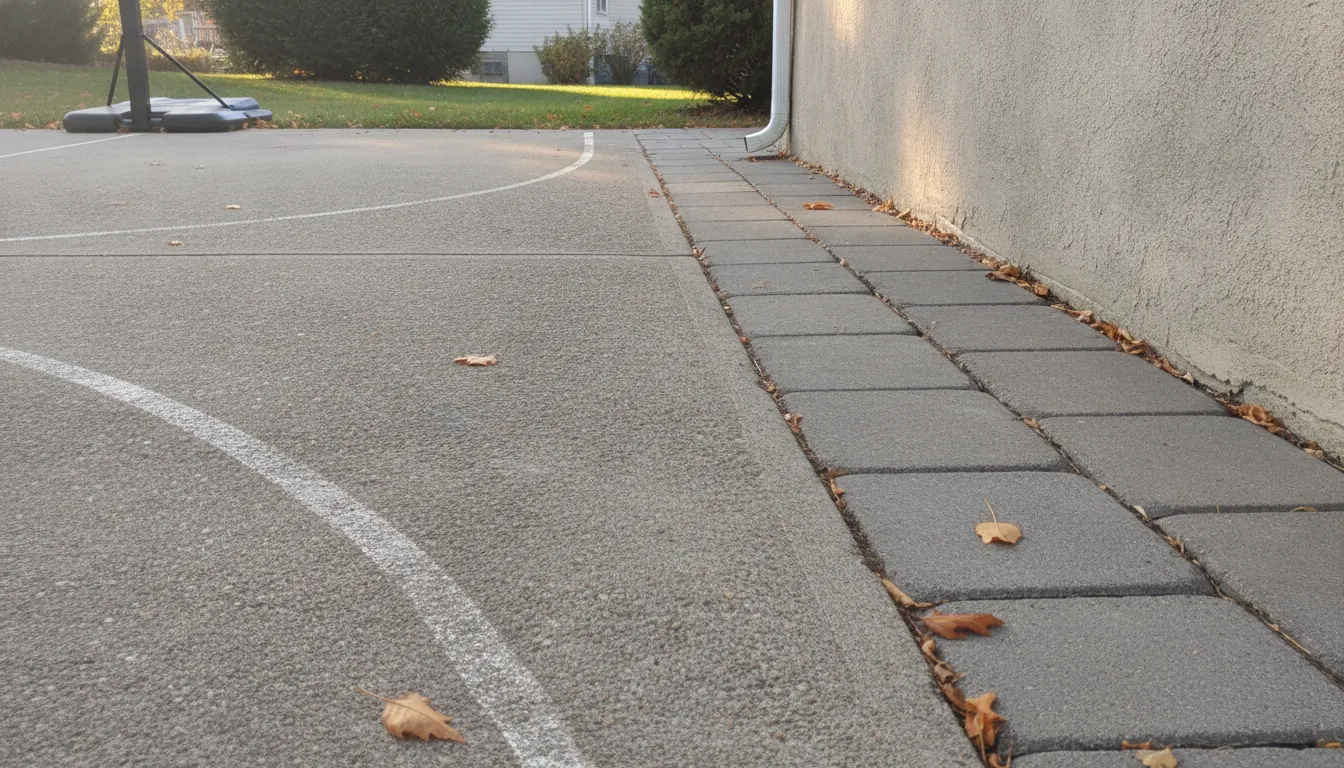
A sound concrete driveway is the usual partner for a garage-wall hoop, and the problems are joints, wide cracks, and a steep slope. Pavers can work when they were set for foot traffic and the base is tight, but loose pavers near the wall become a trip line. Gravel and lawn are poor partners for a wall mount because players slide toward the building.
Acrylic paint on a sound slab is a court finish, not a wall-hoop trick. It changes the ball bounce and the look of the key. It does not fix a short pad or a wall that cannot take the load. Save line layout, color, and tile choices for the court plan.
If the real goal is a lined half court, stop treating the project as a wall-hoop add-on. Gappsi builds basketball Sports Games Courts on Long Island with base and surface choices that include bluestone dust, synthetic turf, clay, snap-sports tile, and crushed marble dust. That work, including half-court sizes such as 20 by 24 feet, is planned on the Long Island basketball court installation page. A wall mounted basketball backboard and hoop can sit beside that court only after the wall and the new surface are designed together.
Pool decks are a separate case. A poolside goal is not a wall mount, and water-edge safety belongs with the pool hoop, not this guide. For a dedicated play surface away from the water, the synthetic turf and Sports Games Courts page covers basketball turf and related court surfaces.
Will a Wall Hoop Fight the Driveway?
Most wall mounted goals go on a garage because the driveway is already the court, and that overlap is also why they fail. The apron has to park cars and host a game at the same time.
Measure the parking stall first, because a single-car garage on a Nassau or Suffolk lot often leaves one car width and a short nose of concrete. If the car door opens into the rebound zone, the hoop will lose as players shoot over the hood and the siding takes the misses.
A pole with an overhang can move the rim off the door while the base stays beside the apron. That is the usual Dominator layout, with the post out of the lane and the arm reaching back over the pad. A wall mount cannot make that trade, so the rim stays where the wall is.
Also look at the grade, because driveways pitch away from the garage so water leaves the door. A strong pitch makes layups run downhill and sends the ball back at the wall. If the only flat ground is a side yard, a small pad there may play better than the garage face. Building that pad is court work, so the hoop choice should wait until the flat area is real.
Night play adds one more conflict. A flood light aimed at the board blinds the shooter and annoys the next house. Put light on the pad, not in the player’s eyes, and keep fixtures out of the rebound zone. Gappsi already plans lighting with outdoor projects, so a hoop that will be used after work should be discussed with the rest of the yard, not added after the fixtures are in.
What Changes After the First Long Island Winter?
Salt, freeze, and wet springs punish both mounts, and a wall bracket that was tight in October can loosen by April if water got behind the anchors. Check the board for racking and the rim for a downward bend. A bent rim is a play problem and a sign the wall took shots it should not have taken.
On a pole goal, look at the footing and the hardware together. Aluminum and stainless steel are why Gappsi sells the Dominator systems for outdoor use, since they resist rust better than a painted steel kit left in road salt. They still need a look each spring for crank operation, pole plumb, and any stain where the post meets concrete.
Do not patch a loose wall anchor by driving a larger bolt into the same hole, because the framing or masonry around a spun anchor is already damaged. That repair is a new anchor layout or a move to a pole. If the siding behind the board is stained or soft, stop using the hoop until the wall is opened.
Keep the playing surface in the same spring check, because heaved concrete at the garage and loose pavers at the wall edge are trip points. Sealing and joint repair belong with Gappsi’s masonry and outdoor work, not with a new net. A hoop on a failing slab will not feel fixed because the board was tightened.
How Should You Plan the Install on Long Island?
Plan the install as a site check, not as a Saturday hardware run, because winter freeze, older garage framing, and tight setbacks on Nassau and Suffolk lots are the usual constraints.
- Name the host. Write down whether the wall is wood frame, solid masonry, or brick veneer. If you cannot tell, do not drill.
- Mark the rebound zone. Stand where the rim would be and note windows, the garage door, gutters, and anything parked in the apron.
- Measure the pad. Record the flat distance in front of the wall and the slope. If the pad is too short, a pole with an overhang may fit better than a board on the house.
- Match the product to the mount. Use a unit made for walls if you stay on the wall. Use a pole goal, such as a Dominator adjustable system, if you move the rim off the building. Do not adapt a glass backboard that the maker says cannot be a wall mount.
- Check town rules. A footing, a new pad, or a court can need a permit even when a small wall bracket does not. Gappsi handles drawings and permit applications for basketball court projects in Nassau and Suffolk Counties.
- Set the surface before the hardware. If the concrete or pavers will be replaced, do that first so the rim height and the anchor layout match the finished grade.
Gappsi has designed outdoor projects from the Smithtown showroom at 1015 West Jericho Turnpike since the showroom opened, and the company was founded in 1987. For a hoop tied to a new or rebuilt play area, look at the whole yard instead of only the bracket.
Request a quote for basketball installation help if the wall, the pad, or both need a site visit.
Frequently Asked Questions
Does ASTM F1882 cover a wall mounted basketball hoop?
No. ASTM F1882 covers complete residential basketball systems, and it does not cover a system mounted on a roof, wall, or ceiling. A wall unit still needs the maker’s wall instructions and a wall that can take the load.
Can I hang a Dominator glass backboard on my garage?
No. Gappsi’s Dominator glass backboard is compatible only with adjustable Dominator hoops. The product page states it cannot be used as a wall mount or as a replacement board for other brands.
Is a concrete driveway enough of a court?
A level concrete driveway can be enough for a practice hoop, but it is not a designed basketball court. Lined play, a new base, and a playing surface are a court project, not a bracket install.
Where can I see hoop options on Long Island?
Dominator goals and backboards are sold through the Gappsi store, and the Smithtown showroom is where homeowners review court materials and other outdoor work. Bring the wall type and a rough pad measurement so the visit starts with the site, not only the catalog.
Contact Gappsi through our contact page to plan a wall mounted basketball backboard and hoop or a full play area.