


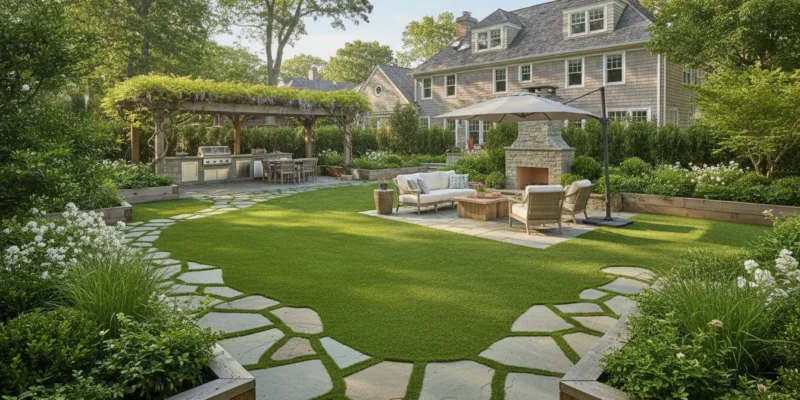
A backyard lawn has to do more than look green. It needs to feel comfortable underfoot, shed rain without staying soggy, meet paver edges cleanly, and hold up around planting beds, pets, and everyday use. That is why the right turf system matters as much as the visible blades.
Contact Gappsi through our contact page
A well-designed synthetic turf backyard starts with lawn-grade fibers, a porous backing, the right infill, and a properly compacted drainage base. Paver borders, restrained planting beds, and carefully finished seams then turn the turf into part of the landscape rather than a surface laid over it.
The best choices depend on how your family uses the space and how the surrounding hardscape moves water. Pile height, backing construction, infill material, edging, and sub-base preparation each affect comfort, drainage, appearance, and service life. Start by separating the needs of a residential lawn from those of a specialized athletic surface, then build the installation around the way your backyard actually works.
What Makes a Backyard Synthetic Turf Lawn Different From Sports Turf?
A backyard lawn and an athletic field may both use synthetic fibers, but they are engineered for different priorities. Backyard synthetic turf is selected to look and feel like a residential lawn, support daily household use, and coordinate with patios, planting beds, and walkways. Sports turf is designed around repeated running, cleat traffic, ball response, and field safety. Treating the two systems as interchangeable can lead to the wrong pile, backing, infill, and maintenance expectations.
Lawn-like appearance instead of field performance
Residential turf is typically chosen for its visual proportion and comfortable hand-feel. A designer can specify different pile heights and fiber densities for a quiet side yard, a children’s play area, a pool surround, or a more heavily used backyard zone. The goal is a consistent green surface with a natural-looking blade profile, not a surface tuned for speed, traction, or ball roll.
Sports systems often use taller, denser fiber assemblies and substantial infill to help the blades stand upright under concentrated athletic traffic. Cornell’s description of infill turf fields notes nylon or polyethylene fibers attached to a porous polyethylene backing. With crumb rubber infill and, in some installations, a polyurethane cushioning pad beneath the backing. Those components serve a field-performance purpose. A residential lawn does not automatically need the same construction or the same amount of rubber infill. Cornell’s synthetic turf overview provides useful background on how field systems are built.
Different backing and infill priorities
For a home, porous backing is important because rain and routine cleaning water need a clear path into the prepared base. Pet areas also benefit from drainage-focused construction that helps reduce the chance of waste and odor remaining at the surface. The backing should be matched to the site, including its soil conditions, drainage plan, and expected use, rather than copied from a sports specification.
Infill affects how turf feels, how well fibers remain upright, and how much heat the surface can retain in direct sun. Crumb rubber can provide cushioning and help maintain fiber uprightness on fields. While sand or silica-based options may be used in place of, or alongside, crumb rubber in other systems. For a residential installation, the selection should account for barefoot comfort, children, pets, shade, sun exposure, and the desired lawn appearance. These details matter more than simply choosing the most athletic-looking product.
Designed as part of the backyard
A residential lawn must finish cleanly against natural stone, porcelain pavers, steps, fences, and planting beds. Proper edge restraint keeps the turf boundary stable and preserves the crisp lines that make the installation look intentional. That integration is one reason to work with a synthetic turf and sports game courts specialist who can separate lawn-grade recommendations from athletic-surface requirements. The right system is the one that fits how your household uses the space, not the one with the most aggressive field specification.
Should You Choose a Synthetic Turf Backyard With Pavers?
A synthetic turf backyard does not have to look like one uninterrupted field of green. Pairing turf with a paver patio, walkway, or defined seating area creates useful zones while keeping the overall landscape cohesive. The contrast between soft-looking turf and the firm texture of stone or porcelain gives the yard more structure. Especially around outdoor kitchens, fire features, pool areas, and transitions from the house.
Start by deciding how people will move through the space. A paver path can connect a rear door to a patio or pool without forcing foot traffic across the entire lawn. A larger paved terrace can hold dining furniture, while turf remains available for play, lounging, or pets. The most successful layouts treat each material as part of one plan rather than adding pavers randomly after the turf area has been designed.
Contact Gappsi through our contact page
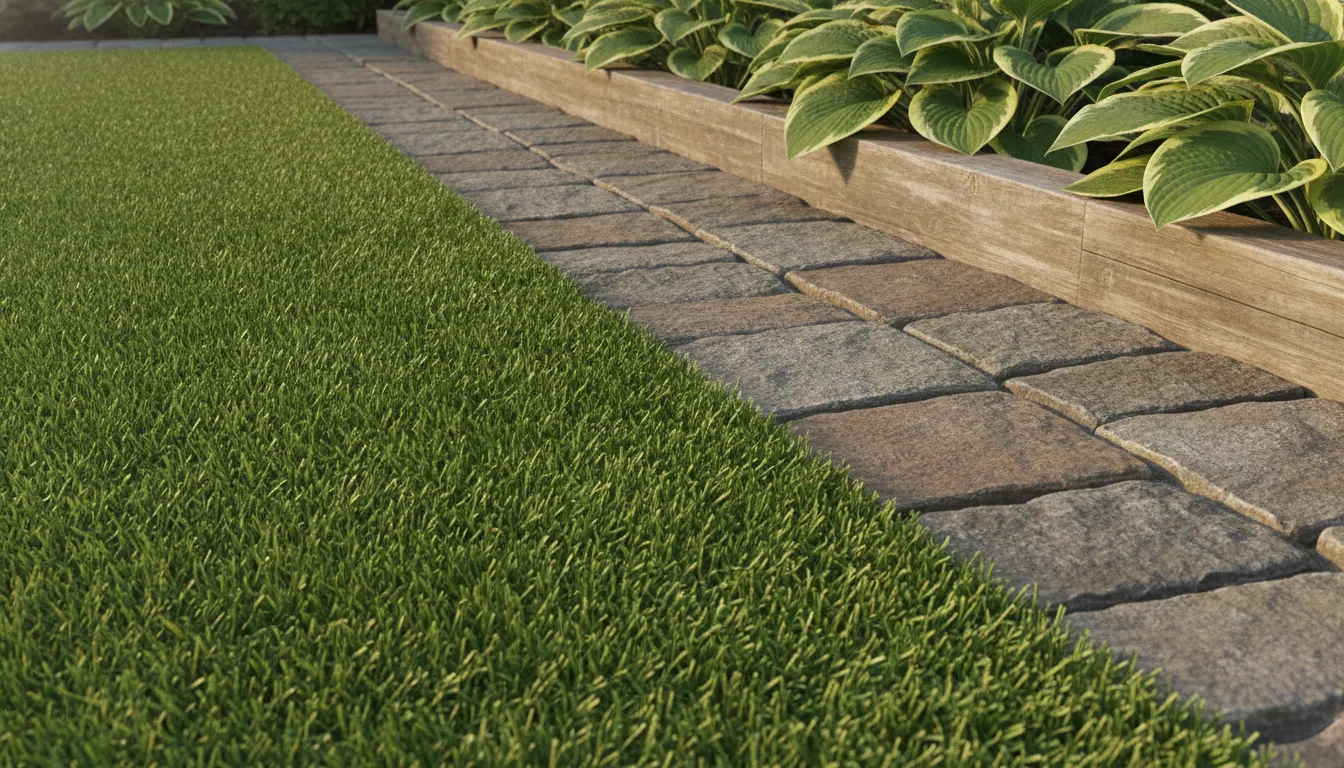
Use pavers to define how the backyard functions
Paver patios are practical anchors for seating and dining because they provide a stable surface under tables, chairs, and grills. Walkways can be sized around actual use, such as carrying food from the kitchen or moving between a patio and a pool. Natural-stone pavers bring variation in color and texture, while porcelain pavers can create a more uniform architectural appearance. Review the available porcelain and natural stone pavers to compare material directions before finalizing the layout.
Plan the boundary before installation
The transition between turf and pavers needs more than a visually straight cut. Specialized edging separates the materials, helps maintain stability, and keeps the turf from migrating into the hardscape. Edge restraints may use pressure-treated wood, composite material, or another durable system selected for the site. The choice depends on the paver thickness, soil conditions, drainage plan, and the desired finished line.
A well-defined edge also makes maintenance simpler. Leaves and soil can be cleared from the pavers without pulling at the turf perimeter, and the boundary is easier to inspect over time. Curved edges can soften a large patio, while straight edges often suit a formal walkway or contemporary planting design. In either case, the base beneath each material must be prepared so the pavers remain level and the turf does not settle unevenly beside them.
Before choosing the final pattern, consider water movement, furniture placement, sun exposure, and the route from the home into the yard. With those details resolved, turf and pavers can provide separate functions while reading as one intentional outdoor living space.
Which Backing and Infill Choices Suit a Backyard Lawn?
A backyard lawn needs more than green fibers. The backing must move water into the prepared base, while the infill helps support the fibers, shape the way the surface feels, and influence how much heat it holds in direct sun. Synthetic turf systems commonly use fibers attached to a porous polyethylene backing, with infill worked between the fibers for support and cushioning. Cornell’s synthetic turf guidance describes this basic material structure.
For a synthetic turf backyard, specify the system around how the space will be used. A play lawn, a dog run, and a mostly decorative side yard do not place the same demands on the surface. Infill also needs to be distributed correctly. Without adequate coverage, heavy foot traffic can cause fibers to mat or lie down prematurely.
| Infill | Feel | Heat | Drainage | Best for |
|---|---|---|---|---|
| Crumb rubber | Resilient and cushioned. | Can retain heat and may produce odor in hot conditions. | Depends on the backing and base beneath it. | Active play areas where cushioning and fiber support are priorities. |
| Silica sand | Firm, stable, and natural underfoot. | Can feel warmer in direct sun. | Works with a properly porous system. | General lawn areas that need weight and fiber stability. |
| Acrylic-coated pet infill | Controlled, low-dust feel. | Often selected when odor and surface comfort need attention. | Pair with pet-friendly porous backing. | Dog runs and lawns where waste drainage and odor management matter. |
How does the backing affect drainage?
A porous backing allows water to pass through the turf rather than collecting at the surface. That design only works when the layers below it are prepared to receive and move the water. A typical synthetic turf drainage system may use an 8- to 12-inch gravel-and-sand sub-base with drains, according to Cornell’s reference on synthetic turf construction. The exact base and outlet plan should reflect the site’s slope, soil, existing drainage, and proximity to structures.
Pet areas deserve particular attention. A specialized porous backing can help waste liquids drain through the surface and reduce odor buildup. But it does not replace regular removal of solid waste or appropriate rinsing. Ask the installer to explain the full drainage path instead of treating the backing as a stand-alone solution.
How does infill change feel and fiber performance?
Crumb rubber is associated with cushioning and helps keep fibers upright. Sand or silica alternatives can be used instead of, or together with, crumb rubber to support fiber performance and address heat-management preferences. The infill choice can change the feel underfoot and the surface’s heat retention characteristics in sunny conditions. Coverage and grooming matter as much as the material itself, because evenly distributed infill helps protect the lawn’s shape over time.
There is no universal best infill. Review the expected foot traffic, pets, shade, irrigation runoff, and the amount of direct afternoon sun before choosing. A qualified installer can match the infill to the backing and base so the lawn drains. Feels appropriate, and remains visually upright rather than selecting a material in isolation.
How to Integrate Synthetic Turf With Planting Beds
The transition between turf and planting beds should look intentional from every angle. A straight, stable boundary keeps mulch, soil, and leaves from spreading onto the lawn while stopping turf edges from drifting into the bed. It also gives the landscape a finished framework, especially where a synthetic turf backyard meets natural stone, shrubs, ornamental grasses, or seasonal color.
Start by setting the bed shape before the turf is installed. Broad curves can soften a large lawn, while simpler geometric lines complement paver patios and other hardscape. The edge should follow the design rather than trace small irregularities in the soil. Once the line is established, the installer can excavate and prepare both surfaces without leaving a narrow strip of unstable material between them.
Choose an edge restraint that holds the line
Composite or metal edging creates a clean separation between the turf and planting bed and helps prevent the turf from migrating into the soil. These materials are useful where a slim, discreet profile matters. In other designs, a pressure-treated wood or composite edge restraint provides a more substantial boundary and helps maintain the integrity of the installation. The restraint should be anchored securely and set at an appropriate height so it does not become a trip hazard or interfere with mowing adjacent natural areas.
Edging also protects the visual transition. Without a defined boundary, loose soil can work into the turf backing, and bed material can wash across the lawn during heavy rain. Specialized edging is commonly used to separate landscape materials and support stability at the joint. Gappsi’s landscape services can help coordinate that edge with the surrounding hardscape and planting plan.
Allow space for roots and seasonal growth
Do not press turf directly against aggressive or spreading plants simply to maximize the green area. A narrow buffer zone, filled with decorative stone or another defined material, gives roots and stems room to develop while making maintenance easier. Where plantings have invasive or vigorous root systems, an appropriate root barrier can help prevent intrusion beneath the turf and disruption at the edge. The barrier should be selected and installed as part of the bed construction, not added after roots have already reached the lawn.
Plan for the mature width of shrubs and perennials, not just the size of the nursery containers. Keep irrigation emitters aimed at the planting bed rather than the turf edge and shape the grade so water drains away from the boundary instead of carrying soil onto the lawn. With a stable restraint, a practical buffer, and room for root growth, the planting bed and turf read as one landscape while remaining easier to maintain independently.
Drainage: Why Proper Base Preparation Matters
The surface you see is only one part of a successful synthetic turf backyard. Beneath it, the installation needs a stable, free-draining foundation that moves rainwater away from the lawn instead of allowing it to collect between the turf and soil. This substructure is especially important on Long Island, where heavy storms. Compacted soils and flat backyard grades can quickly turn a poorly prepared lawn into a muddy or uneven area.
Build the base to move water away
A typical synthetic turf drainage system uses an 8- to 12-inch gravel and sand sub-base, along with drainage channels or sideline drains where the site requires them. Cornell’s synthetic turf guidance identifies this combination as a common approach for managing water beneath turf surfaces: Cornell turf drainage guidance. The exact depth depends on existing soil, slope, anticipated use, and local site conditions. A qualified installer should evaluate those factors before excavation rather than applying one depth to every backyard.
After unsuitable soil is removed, the crushed stone base must be spread in controlled lifts and compacted thoroughly. Compacted crushed stone creates a firm plane for the turf while limiting settlement, soft spots, and irregular depressions. Proper base preparation is also central to long-term stability and service life, not just to the appearance on installation day. If the aggregate is loose or uneven, foot traffic and weather can gradually create low areas where water and debris collect.
Pair a porous backing with a planned drainage route
Most synthetic turf systems use a porous backing that allows water to pass through the finished surface. Cornell describes synthetic turf fibers attached to a porous polyethylene backing, which helps water move into the prepared base rather than remaining on top. That backing cannot solve a drainage problem by itself. Water still needs a path through the aggregate and away from the installation.
Depending on the property, that path may include a gentle finished slope, perforated drainage pipe. Channel drains along a hardscape edge, or a connection to an approved drainage area. Sideline drains can be useful where runoff concentrates beside a patio, retaining wall, or property boundary. The objective is to prevent ponding, waterlogging, and mud, while protecting nearby pavers, planting beds, and the home’s foundation from redirected runoff. Drainage is a critical consideration because the system must manage both water passing through the turf and water arriving from surrounding surfaces.
For a backyard with pets or frequent activity, careful drainage design also helps keep transition zones cleaner after rain. The right base, backing, and outlet work together. A turf product placed over an unstable or poorly drained surface may look finished at first. But it cannot compensate for missing excavation, inadequate compaction, or an outlet that has nowhere to carry collected water.
How Long Does a Synthetic Turf Backyard Last?
A well-designed synthetic turf backyard can have a useful life of 20 years or more when the turf is made for outdoor use, installed over a stable base, and maintained routinely. The material alone does not determine how long the lawn performs well. Site preparation, drainage, seam work, edge restraints, fiber quality, and infill maintenance all affect whether the surface still looks even and functions comfortably years after installation. This is why longevity should be evaluated as a complete landscape system, not simply as a product warranty.
What protects the turf from everyday wear?
Backyard turf experiences concentrated traffic around patio doors, outdoor kitchens, play areas, pool decks, and pathways. A properly joined installation keeps adjoining sections aligned and helps minimize visible seams and tripping hazards as the surface is used over time. Seams should be secured carefully, with the turf stretched and joined so the sections do not separate or develop raised edges. This detail matters most where people move between pavers, planting beds, and the lawn.
Fiber selection also influences appearance. Outdoor turf with UV-resistant fibers is engineered to resist fading from ultraviolet exposure, helping the color remain consistent through sunny seasons. That does not mean the surface is unaffected by weather or neglect. Debris, heavy traffic, poor drainage, and inadequate maintenance can shorten the period when the lawn looks its best. The installation should therefore match the backyard’s actual use, rather than treating every area as identical.
How does infill help synthetic turf last longer?
Infill supports the fibers and helps them remain upright under foot traffic. If infill becomes uneven, frequently used areas can begin to look flattened or matted before the turf itself has reached the end of its useful life. Maintaining even infill distribution is therefore an important part of protecting the lawn’s appearance and feel. Periodic brushing or professional servicing can redistribute material where traffic has displaced it.
The appropriate infill depends on the setting and the performance goals. Sand or silica-based options may be used in place of, or alongside, other infill materials to support fiber performance and address heat considerations. Cornell’s synthetic turf guidance describes infill as part of a larger system that includes fibers and a porous backing, rather than as an isolated surface layer: review the turf construction guidance. With sound seam joining, UV-resistant fiber, proper drainage, and consistent infill care. A synthetic turf backyard can remain a durable, usable part of the landscape for two decades or longer.
Caring for Your Synthetic Turf Backyard and Pets
A synthetic turf backyard is not maintenance-free, but its routine care is straightforward. Remove leaves, twigs, and other organic debris before they settle into the fibers. Periodic sweeping also helps prevent moisture-trapping buildup that can encourage algae, particularly in shaded or damp areas. Use a stiff, non-metal brush and work against the direction of the fibers so the lawn keeps a natural, upright appearance.
- Remove leaves and organic debris before they settle into the fibers.
- Brush periodically, working against the fiber direction to keep blades upright.
- Rinse pet-use zones and inspect seams, edges, drains, and edging.
Brushing also redistributes infill, which helps support the fibers under regular foot traffic and reduces premature matting. Pay special attention to walkways, play areas, and the routes your family and pets use most often. If a section begins to look flat, targeted brushing can restore its appearance, but persistent matting may indicate that the infill level or installation needs professional attention. Research from Cornell describes infill as a material placed within the fibers, where it contributes to surface performance and fiber support: Cornell’s synthetic turf guidance.
What makes synthetic turf suitable for pets?
For homes with dogs, drainage and odor control should be considered during design, not after installation. A pet-friendly porous backing allows liquid to pass through the turf rather than remaining trapped at the surface. A properly prepared base and an appropriate drainage path are equally important. Solid waste should still be removed promptly, followed by a rinse when needed. These simple habits help keep the lawn more comfortable for pets and reduce odor buildup around frequently used areas.
Choose the turf system, infill, and base together. Infill affects how the surface feels and can influence heat retention and odor in sunny conditions. Sand or silica-based options may be used instead of, or in combination with, crumb rubber, depending on the intended use and design goals. This matters because synthetic turf can retain more heat in direct sunlight than natural grass, an honest tradeoff for homeowners considering a sunny yard. Provide shaded rest areas, use umbrellas or shade structures where appropriate, and check the surface temperature before encouraging pets to spend extended time on it. See landscaping synthetic turf for the broader system options.
How much lawn maintenance can you eliminate?
Unlike natural grass, synthetic turf requires no mowing, fertilizer, or pesticide applications. It also eliminates routine irrigation, which can reduce residential landscape water use. You will still need occasional cleaning, brushing, and inspection around seams, edges, drains, and pet-use zones. A maintenance plan should also include checking that edging remains secure and that leaves do not accumulate along low-flow areas.
The goal is not to ignore the lawn. It is to replace repetitive weekly chores with occasional, purposeful care that protects drainage, keeps fibers standing, and maintains a cleaner backyard for people and pets.
Contact Gappsi through our contact page
Frequently Asked Questions
Is synthetic turf a good choice for a backyard?
It can be a practical choice for play areas, shaded sections, and high-traffic paths where natural grass struggles. A porous backing allows water to pass through, while the selected pile height and fiber density can be matched to how the space will be used. It also removes routine mowing, fertilizing, and pesticide applications.
How should synthetic turf connect to pavers and planting beds?
Use a defined edge restraint, such as composite, metal, or pressure-treated wood edging, wherever turf meets another material. A properly secured boundary keeps the turf from shifting and creates a deliberate transition. Around planting beds, include a buffer or root barrier to reduce the chance of invasive roots reaching beneath the turf.
What drainage preparation does a backyard turf installation need?
The turf surface is only as reliable as the base below it. A compacted crushed-stone base supports stability, and the drainage design should direct water away from low areas instead of allowing ponding. Synthetic turf systems commonly use an 8- to 12-inch gravel and sand sub-base with drains, although the appropriate build-up depends on existing soil and site conditions. Source: Cornell University.
How long can synthetic turf last in a backyard?
Outdoor turf can last 20 years or more when the product is suited to the site, the seams and edges are installed correctly, and routine maintenance is performed. Periodic sweeping removes debris, while redistributing infill helps fibers remain upright in busy areas. UV-resistant fibers also help the color withstand prolonged sun exposure. Source: Cornell University.
Ready to Plan Your Synthetic Turf Backyard?
A thoughtful installation can bring the turf, pavers, planting beds, and drainage into one cohesive backyard design. Gappsi can help you evaluate the site conditions and choose details that fit how you want to use the space.
Schedule a consultation for your synthetic turf backyard installation: