


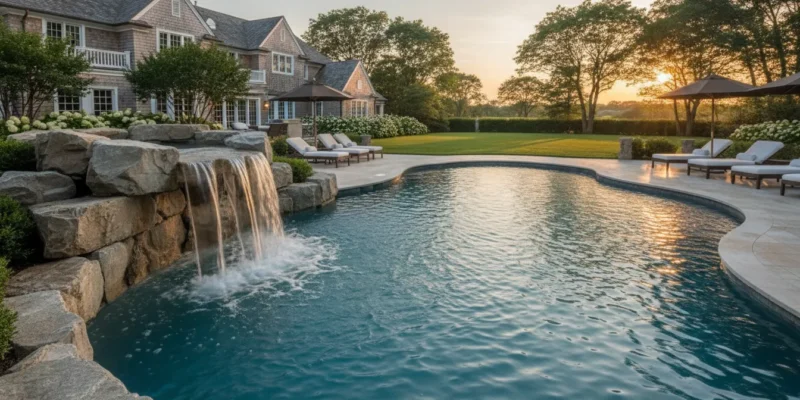
A water feature can change how a pool looks, sounds, and feels without taking over the entire backyard. The right design connects moving water with the pool, surrounding stonework, planting, and the way your family uses the space.
Contact Gappsi through our contact page
A pool waterfall can serve as a visual focal point, add the sound of moving water, and create a more intentional transition between the pool and landscape. The best result depends on scale, water flow, materials, placement, and proper coordination of pumps and plumbing.
For Long Island homeowners, that planning matters. A natural-rock spillway may suit a garden-inspired setting, while a clean sheet fall can complement contemporary paving and architectural lines. Gappsi uses design-build experience and 3D visualization to evaluate those choices before installation, including how the feature will work with gunite or vinyl construction. The first decision is not which feature looks most impressive, but how it will support the way you want to use your backyard.
Why Add a Pool Waterfall to Your Backyard
A well-designed waterfall changes how a backyard feels before anyone enters the water. The movement, sound, and texture create a stronger connection between the pool, patio, planting beds, and surrounding hardscape. Instead of treating the pool as a separate rectangle, Gappsi can use a pool waterfall as a focal point that helps the entire outdoor space feel more intentional.
Moving water can make the pool area more relaxing. The steady sound of a cascade may soften the noise of nearby streets, neighbors, or outdoor equipment. It also gives the space a natural rhythm that can make quiet afternoons, evening swims, and time spent beside the pool feel more private. Adjustable flow can let homeowners choose a gentle spill or a stronger cascade when they want more sound and movement.
The feature can also support an active, restorative backyard routine. A waterfall does not replace exercise or medical care, but a pool provides a low-impact setting for movement. Mayo Clinic notes that aquatic exercise is gentle on bones, joints, and muscles, while research indexed by PubMed describes aquatic exercise in fitness and rehabilitation settings. A review in the National Library of Medicine also discusses hydrotherapy for musculoskeletal rehabilitation. The waterfall adds atmosphere to that experience, helping the pool feel more like a therapeutic retreat than a basic recreational feature.
Visual interest is another practical benefit. Natural boulders, river stone, a gunite ledge, or a clean sheet of water can become functional art in the landscape. The feature remains visible when the pool is not in use, especially when its shape is coordinated with planting, retaining walls, pavers, and evening lighting. A thoughtfully integrated water feature can strengthen curb appeal and contribute to the perceived value of an outdoor living area. Although resale outcomes depend on the property and the quality of the overall installation.
Gappsi approaches the waterfall as part of the complete pool design, not as an attachment added at the end. Its design-build team can coordinate the feature with the pool structure, circulation equipment, deck materials, and landscape layout. Homeowners comparing options can review these swimming pool water feature ideas before deciding whether a rock cascade, sheer descent, or another water effect fits their yard.
A pool waterfall is worth considering when you want sound, movement, and a defined visual anchor in one feature. The right scale and placement matter more than adding the largest possible cascade.
Contact Gappsi through our contact page
Types of Pool Waterfalls and Water Features
The right feature depends on the pool’s architecture, the surrounding hardscape, and the kind of movement you want to see and hear. A modern pool waterfall may use a narrow stainless-steel opening for a clean sheet of water, while a natural design can layer boulders and river stone to resemble a mountain stream. Other features create upward movement, illuminated arcs, or a quiet visual accent without a large cascade.
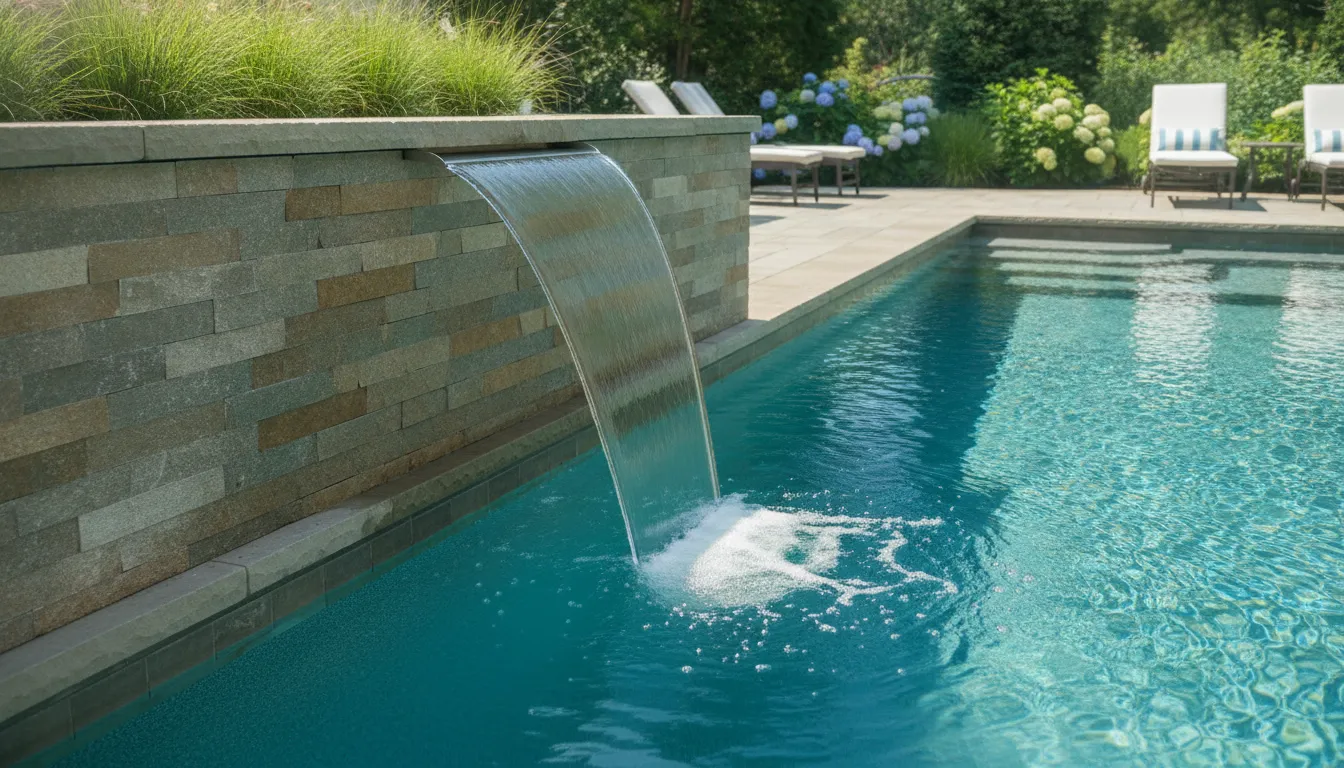
Gappsi’s design-build team can coordinate the structure, plumbing, pump, lighting, and finish as one system. That matters because a feature is not only a visual element. Its flow rate, landing point, operating controls, and relationship to the pool deck all affect how it performs.
| Type | Look | Best For | Key Note |
|---|---|---|---|
| Sheer descent | A smooth, narrow sheet of falling water | Contemporary pools, raised walls, and spas | Creates a defined edge and can be paired with LED lighting. |
| Rain curtain | A uniform veil of water from a linear opening | Minimalist designs and broad visual effects | Its clean, sheer appearance suits a sleek pool environment. |
| Grotto or rock waterfall | Layered stone, boulders, and irregular cascades | Naturalistic yards and resort-inspired landscapes | Boulders and river stone can mimic a mountain stream. |
| Deck jets | Several smooth streams arcing from the deck | Family pools and animated perimeter accents | Typical arcs reach about 4 to 5 feet, depending on design and flow. |
| Bubblers | Gentle upward plumes of water | Tanning ledges and shallow areas | Add movement without the volume of a larger cascade. |
| Fountains | Vertical or rounded sprays | Standalone focal points and formal layouts | Can be sized to complement, rather than dominate, the pool. |
| Water bowls | Water spilling from a raised vessel | Geometric walls and structured patios | Provides a strong architectural accent with a compact footprint. |
| Laminars | A clear, glass-like arc of water | Modern pools and nighttime displays | They can reach about 6 to 8 feet and maintain a precise arc when properly designed. |
The distinction between natural and modern features is not absolute. A stone spillway can use concealed LED lighting, and a sleek sheer descent can pour from a wall faced with natural stone. LED illumination highlights moving water after sunset, while adjustable flow lets homeowners change the sound and intensity for swimming, entertaining, or quieter evenings. Gappsi can also evaluate whether a feature should pour into the main pool, an attached spa. Or a tanning ledge, then design the surrounding surfaces to support safe use and limit splashout.
For more design direction, review these swimming pool water feature ideas or explore Gappsi’s examples of a sheer descent water feature.
How Much Does a Pool Waterfall Cost?
The cost of a pool waterfall depends less on a single feature label and more on the design decisions behind it. A short, simple spillway added to an existing pool is a different investment from a large natural-rock structure with multiple cascades, integrated lighting, and dedicated equipment. For that reason, a responsible estimate should be presented as a general investment range after the feature has been designed, rather than as an exact price that may not fit the property.
On Long Island, Gappsi’s published baseline for a complete gunite swimming pool build is $90,000 to $140,000. A waterfall is only one component of that larger project, so its feature-only cost should not be confused with the cost of building the pool itself. When a waterfall is being added to an existing pool, the scope may also include modifications that would not apply during new construction.
- Feature size and shape: A narrow sheet fall or compact spillway generally requires less structure and water volume than a wide cascade, raised wall, grotto, or multi-tiered rock formation.
- Material selection: Natural stone, boulders, and river rock involve different preparation and installation requirements than cast concrete. Stainless steel components can create a clean, contemporary edge, but fabrication and finish details affect the budget.
- Pump and plumbing: The pump must deliver the intended flow without excessive noise, splash, or strain. Larger features may require dedicated plumbing, additional drains, structural support, and engineering review.
- Lighting and controls: LED lighting adds an evening dimension, while automation can schedule operation and adjust when the feature runs. These upgrades add to the initial scope but can make the system easier to manage.
Operating cost matters as well. Energy-efficient waterfall pumps can reduce the cost of running the feature, especially when paired with timers or automation that prevents unnecessary operation. Proper sizing is important because an oversized system may use more energy than the design requires, while an undersized pump may fail to produce the intended flow.
A well-designed waterfall can also contribute to the property’s outdoor appeal by creating a strong focal point and improving the character of the poolscape. That potential property-value return is not guaranteed and should not be treated as a dollar-for-dollar payback. The better approach is to choose a feature whose scale, materials, sound, and maintenance requirements make sense for the home. Gappsi can evaluate the pool, surrounding hardscape, and equipment needs before preparing a project-specific scope.
Where to Place a Pool Waterfall for Best Effect
Placement determines whether a waterfall feels like an intentional part of the pool or an accessory added afterward. Start by considering how people use the space, where the feature will be visible from the house, and how its sound will carry across the yard. A well-planned feature can also improve water movement. As water returns to the pool, it helps distribute sanitizers and reduce stagnant zones, provided the pump, plumbing, and circulation plan are properly sized.
For many Long Island backyards, the most direct option is a spillway that pours into the main swimming area. This creates a clear focal point and lets swimmers enjoy the sound and movement from inside the pool. The waterfall can also be positioned along a raised bond beam, retaining wall, or elevated natural-stone formation so it connects visually with the surrounding patio and landscape. Gappsi’s waterfall builders on Long Island case study shows how a moss rock design can be integrated into a broader outdoor setting.
Should the Waterfall Pour Into the Pool, Spa, or Tanning Ledge?
The receiving area changes both the experience and the scale of the installation. A cascade into the main pool creates a prominent visual anchor. A spillway from a raised spa adds movement while reinforcing the spa’s separation from the swimming area. A smaller flow into an attached tanning ledge can provide a gentler effect for shallow-water lounging without the volume or drop of a large rock waterfall. These options can be combined, but each requires coordinated elevations and plumbing so water reaches the intended basin without excessive turbulence.
Keep the landing point close enough to the receiving water to control splashout and water loss. A high drop, strong flow, or narrow landing zone can send water onto the deck, increase evaporation, and create a wet path around the pool. Flow controls and correctly selected pump capacity allow the effect to be adjusted for quiet evenings or more active entertaining. The design should also include non-slip decking around areas likely to receive spray. Textured stone, concrete, or another slip-resistant surface is safer than a smooth finish where bare feet and water meet.
Finally, evaluate sightlines from the kitchen, seating areas, and interior rooms. A waterfall should contribute to the full landscape composition, not only look attractive from one end of the pool. Review additional Long Island poolscapes for examples of how pool edges, patios, planting, and water features can work together as one backyard plan.
How Do Water Features Integrate with Gunite and Vinyl Pools?
The pool shell and liner material influence how a water feature is designed, supported, and connected to circulation. A gunite pool gives the builder more freedom to mold a raised wall, grotto, custom spillway, or integrated bench into the structure. A vinyl-lined pool can also support an attractive feature, but the installation usually relies on carefully selected surface-mounted or bolt-on components, such as spillways, bubblers, or a compact sheer descent. In either case, the feature should be planned with the pool, deck, drainage, and landscape rather than added as an afterthought.
Water movement begins with the equipment plan. Pump sizing and flow rates must match the width, height, and style of the feature. A narrow sheet fall needs a different flow pattern from a broad rock waterfall. Larger features may require dedicated plumbing, structural preparation, and engineering so the system delivers a consistent effect without creating excess splashout or placing stress on the pool wall. Adjustable valves can give homeowners practical control over the sound and appearance. From a quiet sheet during conversation to a stronger flow when the pool is being used as a focal point.
Material selection also affects how the feature fits the property. Natural stone, river rock, and hardscaping can make a gunite grotto or rock waterfall feel connected to surrounding patios and planting beds. A clean stainless steel or stone-faced sheer descent can create a more architectural transition from the coping into the water. Gappsi’s sheer descent water feature work illustrates how the edge detail and spillway shape contribute to the overall design.
- Design the complete setting. A professional 3D design integrates the feature with the pool shape, sightlines, hardscape, planting, lighting, and available equipment space. This is where the team can compare a molded gunite grotto with a vinyl-pool spillway or bubbler.
- Prepare the structure. Gunite features can be formed as part of the pool construction, with proper support, waterproofing, coping, and access for service. Vinyl installations need liner-safe details and a mounting approach that protects the liner and wall assembly.
- Plan the plumbing. The installer determines pipe routes, return locations, valves, drains, and service access. A larger pool waterfall may need separate plumbing instead of sharing an undersized return line.
- Size the pump and setup. Flow requirements are matched to the feature’s dimensions. Adjustable controls allow the homeowner to customize the water volume and reduce unnecessary pump demand when full flow is not needed.
- Install the finish materials. Stone, tile, metal, coping, and surrounding deck surfaces are fitted to manage water contact and complement the existing hardscape. Non-slip surfaces are especially important where splash may reach the deck.
- Test and fine-tune the system. Before completion, the team checks the flow pattern, splashout, level transitions, drainage, valves, lighting, and equipment operation. Adjustments at this stage help the feature run evenly and look intentional from the main viewing areas.
Pool Waterfall Maintenance and Winterization
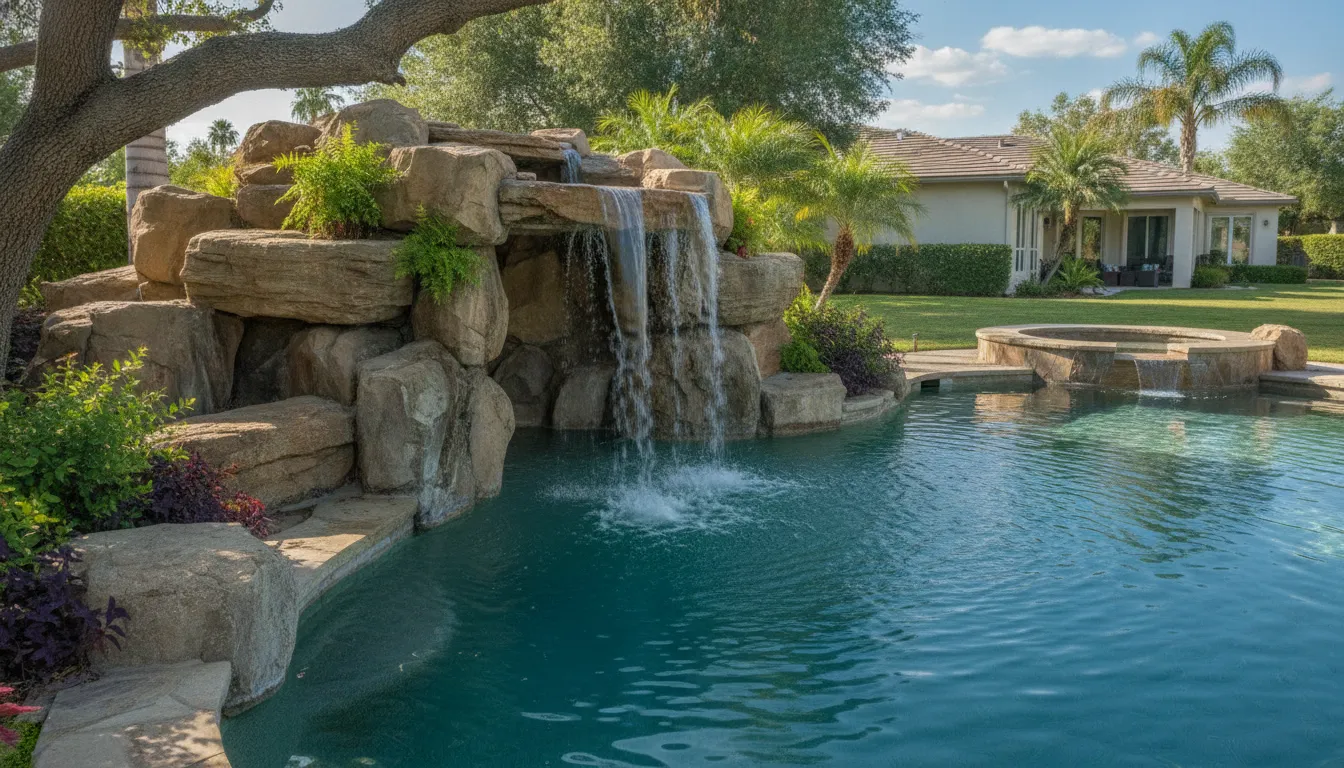
A waterfall stays attractive and dependable when its care is treated as part of the pool’s routine, not as a separate decoration. Start by removing leaves, twigs, and other debris from the basin, spillway, rocks, and catch points. Periodic brushing and surface cleaning also help limit algae growth, which can discolor stone and make the moving water look cloudy. The exact cleaning schedule depends on surrounding trees, weather, and how often the feature runs.
Because the feature typically shares water with the pool, maintenance also depends on the central filtration and disinfection system. Test the water according to your pool-care schedule and keep the chemistry balanced for the entire circulation system. Gappsi’s guidance notes that regular testing and chemical balancing are essential for both the pool and the feature. This approach supports clear water and helps distribute sanitizer through areas that might otherwise become stagnant. The CDC also emphasizes proper circulation and disinfection when operating aquatic facilities: review its pool operation and maintenance guidance.
Automated controls make daily operation easier. A timer can run the waterfall during the hours you use the backyard, then shut it off when the pool area is empty. Scheduling reduces unnecessary pump runtime while preserving the sound and visual movement you want. If the pump has adjustable flow, you can also select a quieter, lower-volume setting for ordinary circulation and increase the effect when entertaining.
Cold weather requires a separate plan in Long Island and other freezing climates. Before sustained freezing temperatures arrive, the feature should be shut down, drained, and prepared according to the equipment design. Associated plumbing and pump systems must be winterized so trapped water does not freeze, expand, and damage pipes, fittings, or equipment. Large rock features may also hold water in concealed channels, so winterization should cover the full assembly rather than only the visible spillway. Have the installer or pool professional identify drain points and confirm the correct restart procedure in spring.
Thoughtful maintenance protects the stonework, pump, plumbing, and water quality at the same time. Gappsi can account for access, drainage, controls, and seasonal protection when designing or servicing a feature.
Contact Gappsi through our contact page
Contact Gappsi through our contact page
Frequently Asked Questions
Can I add a waterfall to an existing pool?
Often, yes. The design depends on the pool structure, available space, equipment pad, plumbing access, and the intended location. A smaller sheet fall or bubbler may require less infrastructure than a large rock feature. Gappsi can evaluate the pool and surrounding hardscape, then use 3D planning to coordinate the feature with the deck, landscape, and existing circulation system.
How much do pool waterfalls cost?
There is no single price because the investment changes with the feature’s size, stone or finish, pump, plumbing, lighting, and installation conditions. A simple sheet fall and a boulder-and-river-stone waterfall represent different scopes. The most useful estimate comes from a design review that defines the desired water effect and the work required to integrate it.
Are pool waterfalls worth it?
For homeowners who want more than a swimming area, a waterfall can add movement, sound, and a clear focal point to the backyard. It can also support water circulation when properly designed. The feature is most worthwhile when its scale, flow, maintenance needs, and style fit the pool and landscape rather than being added as an isolated decoration.
What maintenance does a pool waterfall require?
Plan to clear debris, clean surfaces, monitor water chemistry, and check the pump and plumbing as part of regular pool care. Automatic controls can schedule operating times, while colder Long Island weather requires draining and winterizing the feature’s plumbing and equipment. Proper circulation and disinfection should be maintained whenever the feature is operating, consistent with CDC pool-operation guidance.
Ready to Plan Your Pool Waterfall?
A well-planned water feature can bring movement, sound, and a clear design focal point to your pool area. Gappsi can help you discuss the right waterfall style, placement, plumbing, and materials for your pool build. Contact Gappsi through our contact page to talk through your pool waterfall or water feature project.