Pickleball Sports Game Courts with Out of Bounce Netting System | Queens, N.Y

View Gappsi’s YouTube Channel for Videos of Pickleball Sports Game Courts with Out of Bounce Netting Systems | Queens, N.Y

When building a pickleball sports game court with out of bounce netting system, selecting the right surface material is essential for playing at the highest level. The surface affects the court’s playability, safety, and maintenance.

Surface Material and Construction

The choice of surface material greatly affects the court’s playability and maintenance. Asphalt and concrete are the most common materials used for pickleball courts, each with advantages and disadvantages. Asphalt is more affordable and offers a softer surface, while concrete provides a more durable and low-maintenance option. Regardless of the material chosen, it’s essential to ensure a smooth finish to prevent injuries and enhance the playing experience.

Asphalt is a popular choice for pickleball courts due to its durability and cost-effectiveness. It provides a hard, smooth surface that is ideal for fast-paced games.

Asphalt courts can withstand heavy use and weather conditions, making them a long-lasting option.
pickleball-sports-game-courts-with-out-of-bounce-netting-system-queens-n.yAsphalt Pickleball Sports Game Court Pros:

  • Durability: Asphalt is highly durable and can last many years with proper maintenance.
  • Cost-effective: Compared to other surface materials, asphalt is relatively inexpensive.
  • Low Maintenance: Asphalt courts require minimal maintenance, usually limited to occasional cleaning and resurfacing.

Asphalt Pickleball Sports Game Court Cons:

  • Hard Surface: The hardness of asphalt can be tough on players’ joints, especially during extended play.
  • Heat Absorption: Asphalt absorbs heat, making the surface hot and potentially uncomfortable during sunny days.

Concrete is another durable and long-lasting surface material for pickleball courts. It provides a hard, smooth playing surface similar to asphalt but with a few distinct differences.

Concrete Pickleball Sports Game Court Pros:

  • Longevity: Concrete courts can last for decades if properly maintained.
  • Smooth Surface: Concrete provides an even and consistent playing surface.
  • Stability: Concrete is less likely to develop cracks or deformities than asphalt.

Concrete Pickleball Sports Game Court Cons:

  • Cost: Concrete is more expensive to install than asphalt.
  • Hard-on Joints: Like asphalt, the hard surface of concrete can be tough on players’ joints.
  • Maintenance: While concrete is durable, any cracks that do develop can be more challenging to repair.
pickleball-sports-game-courts-with-out-of-bounce-netting-system-queens-n.y-1Pickleball Sports Game Courts with Out of Bounce Netting System Queens, N.Y.

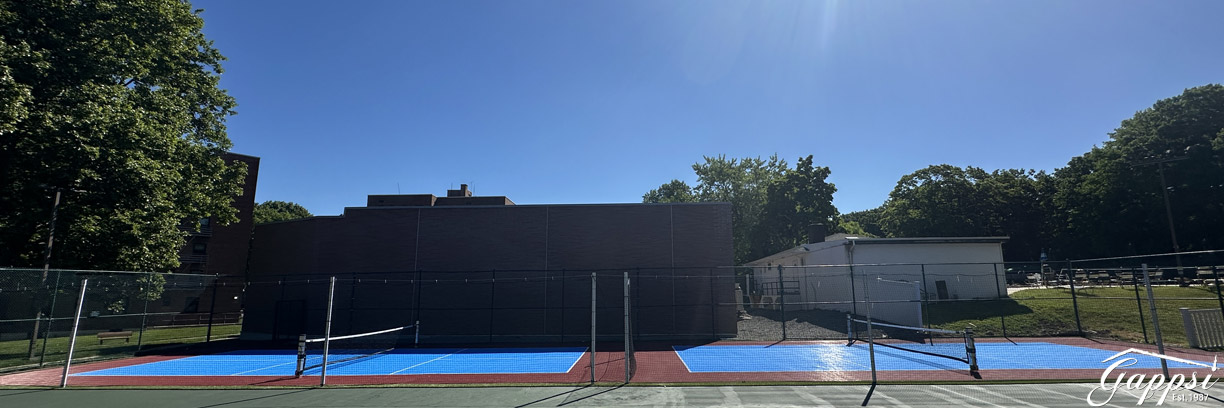
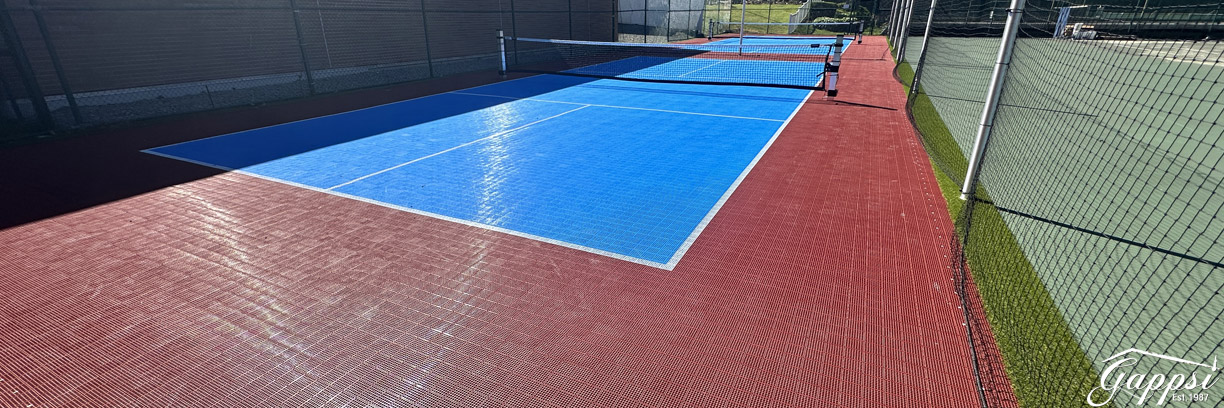
In our recent project in Queens, N.Y., we installed two pickable courts over the existing asphalt tennis court area with two other tennis courts left existing.

We used part of the existing tennis courts and installed Mateflex tiles over the asphalt to build two pickleball sports game courts. The Mateflex tile features a narrow gauge rib system for quick drainage, high traction, and good ball bite (less skid), which is ideal for tennis court resurfacing. This is comparable to using a narrow gauge racquet string. Even after many years of wear and tear, these ribs will maintain the same width and, therefore, the same playing speed.

Each Mateflex tile has 32 individual interlocks and surrounding modules for superior court integrity. The interlocking tile is firm for a stable playing platform and reinforced for exceptional strength and longevity, which is necessary for any tennis or pickleball court design.

Why Choose Mateflex Sport Game Court Tiles

  • Experience – Matéflex has provided high-quality solutions since 1974 as the oldest American modular tile manufacturer.
  • Quality – We won’t settle for anything less than the highest standards for materials and manufacturing. We supervise our molding process, so we always control quality.
  • Performance – Our products are engineered to enhance comfort and performance and will show in your players’ games.
  • Safety – Matéflex products were developed with injury prevention in mind.
  • Durability – Protect your investment by choosing long-lasting flooring products.
  • Ease – Every Matéflex product was designed to be portable, low-maintenance, and cost-effective.
  • Service – We provide outstanding support from design to installation and throughout the life of your court.
  • Comfort – We provide outstanding support from design to installation and throughout the life of your court.

Pickleball Court Lines and Marking

The client chose maroon red for the outer court perimeter and royal blue for the pickleball insert.  In addition, we installed out-of-bounce netting with aluminum poles to separate the two courts to help contain the balls within each court.  

Sports netting, also known as ball stop netting, keeps balls in play and out of spectator areas to protect players, spectators, and property. Netting provides players an extra layer of safety, allowing them to play confidently. It also keeps balls from flying into areas where spectators could be injured. Netting prevents balls from traveling into areas that could cause damage and aids in maintaining consistent play.  Sports game court netting also keeps the balls within the boundaries, ensuring fair competition.
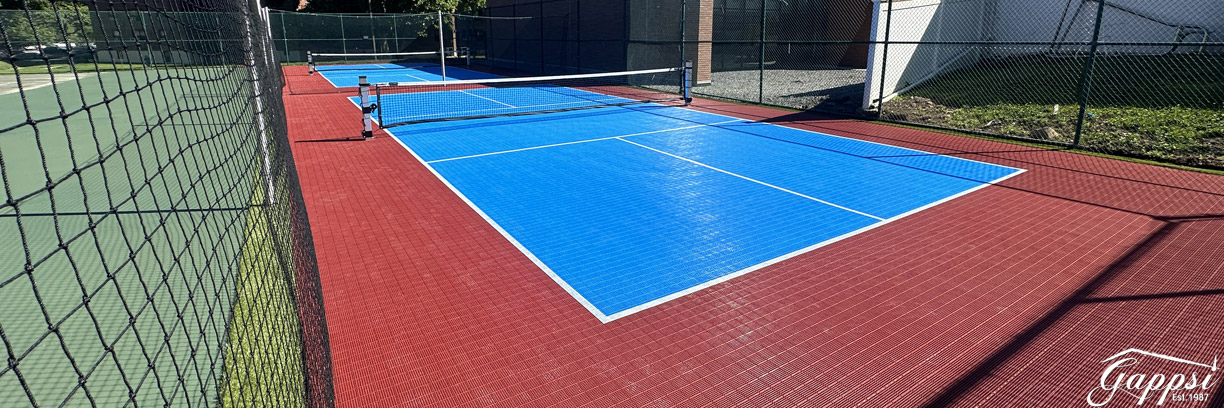
pickleball-sports-game-courts-with-out-of-bounce-netting-system-queens-n.y-2Out-of-bounds netting can be custom-built to fit any size space and is made from durable materials that can withstand heavy impacts and harsh weather conditions.

Pickleball sports game court netting by Dominator was installed, which can also be extended higher for playing a volleyball game.  

Synthetic Turf for Sports Game Court Fringe

Our team installed synthetic turf fringe all around the court. It is also a visual border as a transition from the Mateflex polypropylene tile to the lower asphalt base.

The second tennis court will eventually be remodeled into a new tennis court, or we might put pickable courts sideways. The clients will use this for now and decide whether to keep the old tennis court or add more pickable courts and possibly a putting green. This is the latest sports game court installation done by Gappsi in Queens, NY. 

SCHEDULE A MEETING TODAY WITH GAPPSI

Share this page:

Convert an Old Tennis Court to a Multisport Game Court

Your backyard should be a place for connection, laughter, and making memories. An unused tennis court often feels like wasted potential—a large, empty space waiting for a new purpose. When you decide to convert old tennis court into a multisport game area, you’re not just updating your property; you’re creating a destination for family fun. It becomes the go-to spot for weekend pickleball tournaments, after-school basketball games, and neighborhood get-togethers. This article will show you how to plan a conversion that brings everyone together, creating a versatile and welcoming space for years of enjoyment.

old-tennis-court-conversion-to-multisport-courtCheck out our recent tennis court conversion to a multisport game court that has been revitalized!  This is an old tennis court in Leisure Knoll in Ridge Long Island NY. The entire court is being remodeled and converted into a multisport game court. Our team at Gappsi will first start with pressure washing the tennis court.  This process reveals many potholes, allowing water to sit.  This often leads to further concrete cracking or foundation structural issues. Puddled areas, or low spots, can also be a trip hazard if they have sunk enough to affect the players’ footing.
Old Tennis Court Conversion to Pickleball 

As we prepare the courts to re-level the potholes the tennis courts’ netting is removed first. The new tennis court is built using synthetic turf. This method of tennis court construction is a new process here in the United States, but it has been used in Italy and Europe for many years.  Synthetic turf reduces the need for constant maintenance due to cracking and delamination of hard concrete or asphalt courts. Due to the drainage capabilities of synthetic turf, there is less puddling and damage to the courts. Also, there is less downtime due to inclement weather when it occurs.   

Pickleball has been the fastest-growing sport in America for the past three years.  We are going to split the old tennis court in half. On one side will be 3 Pickleball Courts, and a putting green, with the other half a tennis court. 

The multisport game courts will use polypropylene tiles and synthetic turf for the putting green. This is a major transformation for the tennis court area.   Our team are renovation experts.  We understand the importance of minimizing the destruction of the surrounding areas.   Leisure Knolls had an existing fence and landscaping surrounding the courts which were utilized as we maintained minimal destruction during the renovation process.

old-tennis-court-conversion-to-multisport-court1Multisports Game Courts in Ridge NY

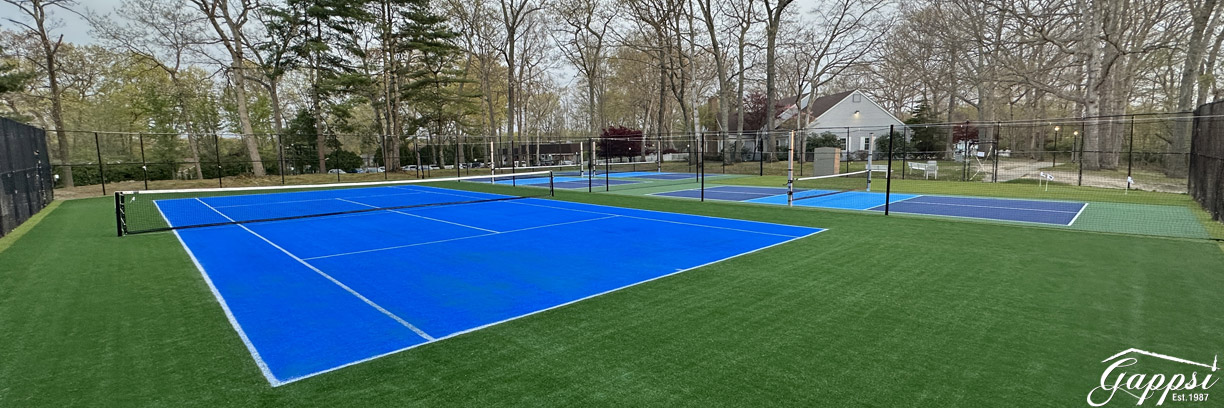
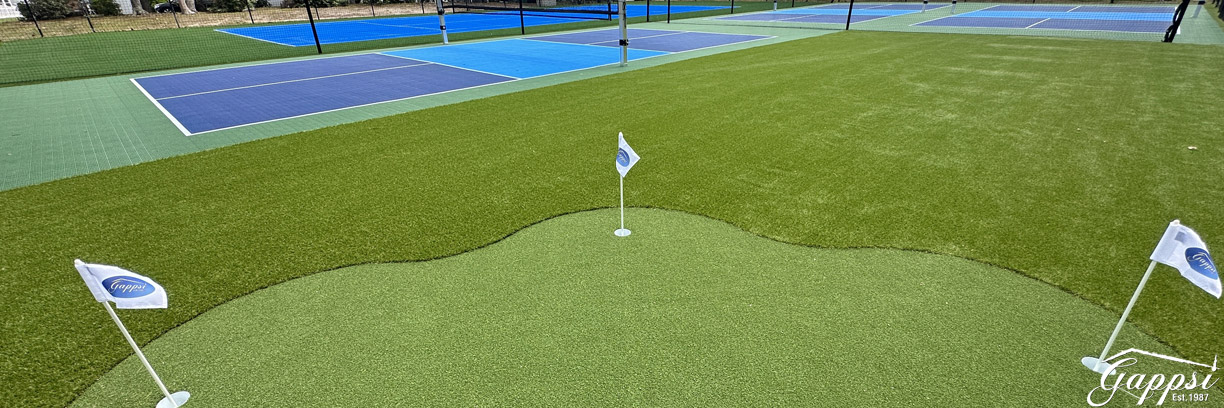
Just like magic, we converted the two old tennis courts into an all-new sports game court area for the Leisure Knolls community.  In addition to the 3 pickleball courts and tennis court, we installed a putting green in the back corner and an all-new synthetic turf area for the kids to play on.

Our installation included Mateflex sports tiles for the surface of the courts. Once in place, this sophisticated, state-of-the-art system of cross ribs affords a completely flat play surface that puts a spring into every step, improves comfort on the court, reduces fatigue and leg stress, and heightens play. Super-fast drying time after rainfall gets your athletes back on the court quicker and the low-glare surface keeps their focus on the game. All courts are not created equal. For the best possible modular flooring solutions for your professional, commercial, or home pickleball court, trust Gappsi.

old-tennis-court-conversion-to-multisport-court2Our team used a dark blue and a lighter blue tile with white stripes for the pickleball court inserts. In the remaining area, we used a dark green tile and surrounded all the courts with a synthetic turf fringe. Each court has a multisport netting installed, which is adjustable for different sports played on the courts.  A player can use the space to play pickleball, badminton, or volleyball simply by adjusting the net for the game.
The Advantages of Converting an Existing Court

That old, cracked tennis court in your backyard doesn’t have to be an eyesore. Instead of letting it fall into disrepair, you can transform it into a vibrant, multi-use space for your family and friends. Converting an existing court is a fantastic way to modernize your property and adapt to new interests, like the booming popularity of pickleball or creating a versatile area for basketball and other activities. This approach not only breathes new life into an underused part of your yard but also comes with some significant practical benefits that make it an appealing option for many homeowners on Long Island. By repurposing the existing foundation, you’re choosing a sustainable and efficient path to creating the backyard of your dreams.

Think about the possibilities: a single tennis court can be converted into multiple pickleball courts, a basketball court, or even a combination of games. At Gappsi, we’ve seen firsthand how these transformations can completely revitalize a property. The process involves assessing the current court’s condition, making necessary repairs, and then applying a new, high-performance surface tailored to your chosen sports. Whether you’re interested in synthetic turf or modular tiles, the result is a beautiful, functional, and durable game court that will provide years of enjoyment. It’s about making the most of what you already have and turning it into something truly special.

Cost and Time Efficiency

One of the most compelling reasons to convert an existing court is the significant savings in both money and time. Building a new sports court from the ground up is a major undertaking that involves excavation, foundation work, and often, navigating local permits, which can lead to unexpected delays and costs. By repurposing your old court, you bypass many of these steps. This streamlined approach means a much quicker turnaround, allowing you to enjoy your new pickleball or basketball court sooner. It’s a smart, practical solution that minimizes disruption to your property while maximizing your investment, giving you a brand-new recreational space without the timeline and expense of a full-scale construction project.

Planning Your Perfect Court Conversion

Once you’ve decided to give your old court a new life, the planning phase is where the magic really begins. A thoughtful approach ensures your new space is not just playable, but perfectly suited to how your family and friends will use it for years to come. It’s about creating a destination in your own backyard. Let’s walk through the key considerations for designing your ideal court.

Designing for Family and Friends

A great court conversion goes beyond simply painting new lines. Think about how you want to use the space. Are you a family of avid pickleball players, or do you want flexibility for multiple sports? A standard tennis court offers enough room for up to four pickleball courts, perfect for hosting friendly tournaments. It’s also crucial to plan for enough space around the perimeter. This “out-of-bounds” area is essential for player safety, allowing for comfortable movement. A professional design for your game court will account for proper dimensions and flow, ensuring everyone can play their best.

Adding Comfort and Accessibility Features

To make your new court a true backyard destination, consider features that enhance comfort and safety. The playing surface is the foundation. A high-quality, slip-resistant surface with shock-absorbing properties improves playability and reduces stress on joints. Beyond the court, think about amenities that invite people to stay. Adding benches, proper lighting for evening matches, and a shaded area like a small pergola can transform the space into a social hub. Ensuring clear, accessible pathways to the court also makes it more welcoming for guests of all ages and mobility levels.

Considering Fences and Barriers

Fencing is a practical necessity for any game court, keeping balls in play and preventing them from rolling into your garden beds. For sports like pickleball, which can be noisy, you might also want to think about barriers that help manage sound and block wind. This creates a more pleasant playing environment for you and your neighbors. There are many options available, from classic chain-link to modern designs that blend with your landscape. The right fencing and netting solution provides security and defines the playing area, completing your backyard entertainment space.

Understanding Court Dimensions and Layouts

Before you can bring your dream multisport court to life, it’s essential to get familiar with the numbers. Understanding the standard dimensions for different sports helps you visualize what’s possible in your space and make informed decisions about the layout. Whether you’re converting an old tennis court or starting from scratch, knowing the exact footprint for each game is the first step in creating a functional and fun recreational area. This knowledge ensures that your final court not only fits your property but also provides an authentic playing experience for every sport you want to include. It’s all about matching your vision to the practical requirements of the space you have.

Standard Court Specifications

Every sport has its own specific court size, and these dimensions are key to proper play. A tennis court, for example, offers a large canvas that can be adapted for several other games. When you see the measurements side-by-side, it becomes clear how you can layer different layouts or divide a larger area to accommodate multiple activities. Here’s a quick breakdown of the standard court sizes for some of the most popular backyard sports. Having these figures on hand will help you plan your project with confidence and clarity, ensuring every line and boundary is perfectly placed for gameplay.

Tennis Court: 78 ft x 36 ft

A standard tennis court measures 78 feet long by 36 feet wide, which includes the alleys for doubles play. This generous size makes it an ideal candidate for conversion into a multipurpose space that can host a variety of sports, from pickleball to basketball.

Pickleball Court: 44 ft x 20 ft

Significantly smaller than a tennis court, a pickleball court is 44 feet long and 20 feet wide. Its compact size is one of the main reasons for the sport’s booming popularity, as it can fit into many backyards with ease and requires less ground to cover during play.

Badminton Court: 44 ft x 22 ft

A badminton court is nearly identical in length to a pickleball court at 44 feet, but it’s slightly wider at 22 feet to accommodate doubles play. This makes it another great option for combining with other court layouts, especially if you’re a fan of racquet sports.

Half-Basketball Court: 42 ft x 50 ft

While a full court is 84 by 50 feet, a half-court is a more common and practical choice for residential spaces, measuring 42 feet by 50 feet. This provides ample room for shooting hoops and playing half-court games with friends and family.

Maximizing Your Space: How Many Courts Can Fit?

Now that you have the dimensions, you can start to see the possibilities. The most common scenario we see is converting a single, underused tennis court into a vibrant hub for multiple activities. Because of their smaller size, you can typically fit up to four standard pickleball courts within the footprint of one tennis court. This simple change transforms the area into a more versatile and social space that caters to different interests and skill levels. A professional team can help you create a layout that maximizes every square foot, ensuring proper spacing and flow between games. At Gappsi, we specialize in designing and building custom turf and game courts that make the most of your available space.

The Technical Steps of a Tennis Court Conversion

Transforming an old tennis court into a vibrant multisport area involves more than just painting new lines. The process requires careful preparation and technical expertise to ensure the final result is safe, durable, and ready for years of fun. Here’s a breakdown of the key steps involved in a professional court conversion.

Preparing the Existing Surface

A great court starts with a solid foundation. The first step is to thoroughly clean and assess the existing surface. As our team at Gappsi has seen on many projects, pressure washing the tennis court often reveals hidden issues like potholes where water can sit, which can lead to concrete cracking or other structural problems. These puddled areas and low spots aren’t just an eyesore; they can be a serious trip hazard for players. Before any new surface can be applied, it’s essential to restore the court by patching cracks, leveling low spots, and ensuring the entire base is stable and properly graded for drainage.

Resurfacing and Applying New Lines

With a smooth and stable base, the court is ready for its new surface. First, the old, faded tennis court lines must be removed or covered to create a clean slate. This is the perfect time to resurface the entire court, giving you a fresh, uniform finish for the new game lines. While traditional acrylic surfaces are an option, many homeowners are now choosing advanced materials like interlocking sport tiles or synthetic turf. These systems provide superior shock absorption, better drainage, and require less maintenance. Once the new surface is in place, the court is carefully marked and painted with crisp, accurate lines for pickleball or any other sports you plan to play.

Marking the Non-Volley Zone (“The Kitchen”)

For those converting a court specifically for pickleball, marking the non-volley zone is a critical detail. Commonly known as “the kitchen,” this is a seven-foot area extending from the net on both sides of the court. A distinct line parallel to the net marks its boundary. This zone is fundamental to pickleball strategy, as players are not allowed to hit the ball out of the air (a volley) while standing inside it. Ensuring the kitchen’s dimensions are precise is key to authentic gameplay, which is why professional application is so important for creating a true-to-spec court.

Adjusting the Net and Posts

The final technical step is modifying the net to fit the new game’s regulations. A pickleball court is narrower than a tennis court, so you’ll need to move the net posts to fit the 20-foot width. The net height also needs to be lowered, as a pickleball net sits at 34 inches in the center, compared to 36 inches for tennis. For maximum flexibility on a multisport court, installing an adjustable net system is the ideal solution. This allows you to quickly and easily change the net height for different games, whether you’re setting up for pickleball, badminton, or low-net volleyball.

Ensuring Safety and Long-Term Use

When you’re transforming an old tennis court, the goal is to create a fun, functional space that your family and friends can enjoy for years. A big part of that is making sure the court is not only beautiful but also safe and durable. Thinking about safety from the start helps prevent injuries and ensures everyone has a good time. At the same time, choosing materials built for the long haul means you’ll spend less time on upkeep and more time playing. It’s about making a smart investment in your home and your family’s enjoyment, creating a court that stands up to countless games and the changing seasons on Long Island.

Choosing the Right Surface Material

The surface you choose is the foundation of your new game court, impacting everything from player safety to how long the court will last. While traditional asphalt or concrete courts have been the standard, modern materials offer incredible advantages. These newer options are specifically engineered for sports, providing better performance and requiring far less maintenance. When you select a surface, you’re not just picking a color; you’re deciding on the feel of the game, the level of safety for players, and the amount of work you’ll need to put in down the road. It’s a critical decision that defines the quality of your entire court conversion project.

Slip-Resistant and Shock-Absorbing Surfaces

Player safety should always be the top priority. Modern court surfaces, like the polypropylene tiles we use at Gappsi, are designed with this in mind. They feature slip-resistant textures to prevent falls and have built-in shock-absorbing qualities that are easier on the joints. This state-of-the-art system uses a cross-rib design to create a perfectly flat playing surface that adds a little spring to your step, which helps reduce leg stress and fatigue during long matches. This means you can play longer and more comfortably. Plus, these surfaces are designed to dry quickly after it rains, so you can get back to your game faster without worrying about slick, puddled areas.

Tennis Court Sports Game Turf

For the tennis court flooring, we installed synthetic turf. The sports turf used is specifically made for tennis courts.  Synthetic turf reduces the need for constant maintenance due to cracking and delamination of hard concrete or asphalt courts. Artificial grass tennis courts require little to no maintenance compared to natural grass surfaces, which require continual care of watering, mowing, and fertilizers. Synthetic grass tennis courts provide a softer and even playing surface, for your feet and joints! Our highly durable synthetic grass tennis courts allow you to enjoy the game of tennis year-round with the fast-drying turf.

Made from a special blend of fiber, Gappsi’s synthetic grass courts provide a safe, family-friendly surface that brings tennis back to how it was played for the better part of a century. It can be installed over any sound base including:

  • An existing tennis court that has been cleaned and sealed
  • A concrete or asphalt slab
  • A crushed stone aggregate base – ideal for areas with impervious surfacing laws

Artificial grass tennis courts will not crack or split like traditional hard court surfaces. For homeowners and facility operators who are tired of the short lifespans of traditional hard court surfaces, Gappsi’s artificial grass tennis courts offer an effective alternative to building or resurfacing a tennis court.

We used a dark blue turf with a blue infill for the tennis court inlay. The surrounding area is synthetic turf with green infill. We installed one foot wide of taller turf as a fringe to define the sports game courts and enhance the fenced area.

old-tennis-court-conversion-to-multisport-court4Synthetic Turf – Artificial Grass – Fake Grass

This synthetic turf is manufactured in Italy and Gappsi is a supplier and installer of sports game courts with synthetic turf. We divided the courts with an out-of-bounce netting. This netting is primarily used to prevent the balls from going across one court to another. This is Gappsi`s multisport design and construction for the Leisure Knoll in Ridge NY.

We believe tennis-to-pickleball court conversion is a positive development for the sport and local clubs.  They add value to our local communities. For those who want complete court construction, we offer a variety of surfaces and amenities that will supply years of enjoyment for pickleball or tennis players. We provide the same great color combinations that are available for tennis courts.

For clients interested in adding a pickleball court to their sports amenities or want to add pickleball court lines to existing tennis courts for maximum value and usage from court space, contact Gappsi today!

The Importance of Regular Maintenance

Even though modern surfaces like synthetic turf and polypropylene tiles are designed to be durable and reduce upkeep, they aren’t entirely maintenance-free. Think of regular care as protecting your investment. A simple routine of sweeping away leaves, debris, and dirt will keep your court looking pristine and ensure the surface performs as it should. This small effort prevents buildup that can affect drainage and playability over time. Consistent cleaning is key to making sure your new multi-sport court stays in top shape for years of family fun, preserving its look and feel from day one.

Beyond aesthetics, regular maintenance is crucial for safety. Small issues like clogged drains can lead to puddles, which not only damage the surface over time but can also create dangerous trip hazards. Addressing minor problems early on is far more cost-effective than dealing with major repairs down the road. Proactive upkeep ensures your court remains a safe and enjoyable space for everyone. For homeowners who want to ensure the longevity of their investment, professional cleaning and sealing can prevent wear and tear, keeping your court ready for action season after season.

More Than Just Pickleball: Other Sports to Consider

While the pickleball craze is undeniable, converting an old tennis court opens up a world of possibilities that go far beyond a single sport. Think of it as transforming an underused patch of asphalt into a vibrant hub of activity for your entire family and neighborhood. The real magic lies in creating a versatile, multi-sport court that caters to a wide range of interests, ages, and energy levels. Instead of just one game, you can have a dedicated space for everything from fast-paced team sports to classic, leisurely yard games. This approach is not only a smart way to update your property but also an incredible way to maximize your outdoor space. In fact, you can fit as many as four pickleball courts in the footprint of a single tennis court, which shows just how much potential is waiting to be unlocked.

Creating a space that everyone can enjoy is the ultimate goal. Imagine your kids and their friends playing a game of basketball after school, followed by a family shuffleboard tournament on the weekend. By designing a court with multiple games in mind, you’re not just adding a feature to your home; you’re building a backdrop for years of memories. At Gappsi, we specialize in designing and constructing custom synthetic turf and game courts that are tailored to your family’s favorite activities. We can help you map out a layout that seamlessly integrates several sports, ensuring you get the most out of your investment and your backyard.

Popular Options for Multi-Sport Courts

When you decide to revitalize your court, you’re making a smart choice to meet the growing demand for a variety of recreational activities. As experts note, converting old tennis courts is an affordable way to update facilities to accommodate popular sports like basketball, futsal, and soccer alongside pickleball. This versatility ensures your court will be a popular spot for years to come. The key is to think about how your family and friends will use the space. Do you have aspiring athletes who need a place to practice, or are you looking for a fun zone that encourages everyone, from toddlers to grandparents, to get outside and play together? The beauty of a multi-sport court is that you don’t have to choose.

Basketball, Futsal, and Soccer

For families with a passion for high-energy team sports, incorporating basketball, futsal, or soccer is a fantastic option. A standard tennis court provides ample room for a half-court basketball setup, complete with a professional-grade hoop. You can also add markings for futsal or a small-sided soccer pitch, creating the perfect arena for friendly matches and skill drills. These additions turn your backyard into a training ground and a neighborhood hangout spot, encouraging active play and healthy competition. With durable, all-weather surfaces and clear, professional lining, your court can easily handle the action while looking sharp.

Shuffleboard, Four-Square, and Hopscotch

A truly great multi-sport court offers something for everyone, and that includes classic games that bring all generations together. Consider adding permanent lines for shuffleboard, four-square, or even a colorful hopscotch grid. These games require minimal equipment but provide hours of entertainment, making them perfect for family gatherings and casual afternoons. As noted by court specialists at VersaCourt, including fun options like these ensures your space is welcoming and engaging for all ages. It’s a simple way to add another layer of fun to your backyard, creating a space where everyone feels included in the action.

SCHEDULE A MEETING TODAY WITH GAPPSI

View Gappsi’s YouTube Channel for Videos of Tennis Court Conversion to Multisport Game Court Ridge NY

https://youtu.be/ZYJ6w-U0Ne8

Frequently Asked Questions

My old tennis court has a lot of cracks and low spots. Can it still be converted? Absolutely. It’s very common for older courts to show their age with cracks, potholes, and uneven areas. The first step in any conversion project is a thorough assessment and preparation of the existing surface. We address these issues by professionally cleaning the court, patching all the cracks, and leveling any low spots to ensure a stable and perfectly graded foundation before any new surface is installed. A worn-out court is usually the perfect canvas for a transformation.

How long does a typical tennis court conversion take? The timeline for a conversion is much shorter than building a court from scratch because we’re using the existing foundation. While the exact duration depends on the condition of your current court and the scope of the project, most conversions are completed relatively quickly. This streamlined process means less disruption to your yard and lets you start enjoying your new game court much sooner than you might think.

What are the main differences between synthetic turf and sport tile surfaces? Both are excellent, low-maintenance choices that offer huge advantages over traditional asphalt. Synthetic turf provides a classic, soft feel underfoot that is gentle on the joints and offers a consistent ball bounce. Interlocking sport tiles, on the other hand, provide a slightly firmer surface with exceptional drainage and a bit of spring in your step. The choice often comes down to your personal preference for aesthetics and the specific sports you plan to play most often.

Do I have to stick to just pickleball, or can I include other games? You can absolutely include other games! That’s the best part of a conversion. A standard tennis court offers a large space that can be designed to accommodate multiple sports. We can easily line the court for pickleball, basketball, and badminton. We can even incorporate fun, permanent markings for games like shuffleboard or four-square, creating a versatile activity hub that has something for every member of the family.

What kind of maintenance is required for a new multisport court? Modern surfaces like synthetic turf and sport tiles are designed to be incredibly durable and require minimal upkeep. The most important task is simply keeping the court clean. Regularly clearing away leaves, dirt, and other debris with a broom or leaf blower will prevent buildup and keep the surface safe and playable. This small amount of routine care is all it takes to protect your investment and ensure your court looks and performs its best for years.

Key Takeaways

  • Think Beyond a Single Sport: Your old tennis court has enough space for multiple activities. Plan a versatile layout with pickleball, basketball, or even a putting green to create a fun zone that everyone in the family can enjoy.
  • A Quality Court Starts from the Ground Up: The success of your project depends on the foundation. Ensure the existing base is properly repaired and leveled before choosing a modern, shock-absorbing surface like synthetic turf or sport tiles for a safer, longer-lasting court.
  • Plan for the Complete Experience: A great court is more than just a playing surface. Incorporate practical features like proper lighting for evening games, comfortable seating, and the right fencing to turn your court into the go-to spot for family and friends.

Related Articles

Share this page:

Pickleball Courts With Painted Asphalt

Pickleball-Courts-With-Painted-Asphalt2Pickleball Courts With Painted Asphalt or Concrete both provide an acceptable base for the courts. Make sure to review surfacing requirements before having the base installed, as there are recommended specifications for slope, drainage, surface finish, and overall construction.

A better court equals better and safer play. These guidelines are based on collected feedback from fellow members of the pickleball community, and while your situation may differ, we offer these as a starting point for those looking to get the most out of their court and their game.

We can provide you with free estimates for Pickleball court construction & resurfacing throughout Long Island New York. Pickleball has been around for quite a few years but has recently become one of the fastest-growing sports in the country. Backyard pickleball courts are a great investment for families and friends to enjoy and have a much smaller footprint than tennis courts. Contact us today and we can perform a site visit to see if a backyard pickleball court can be built within your available space.

Do You Have A Pickleball Court And Need Resurfacing?

The process of surfacing a pickleball court varies, and may include the application of a resurfacing material and/or a cushioned material, in addition to paint for color and texture and line-striping the court boundaries. Some jobs, such as repurposing tennis courts for pickleball, may only require line-striping.

Pickleball court resurfacing should be done every 4 to 8 years, depending on a variety of factors. Overall traffic, or usage, of the sports game courts, is the main factor. However, proper construction, slope, and drainage of the pickleball courts are also very important to the longevity of the slab and pickleball court surfaces. Gappsi is experienced in resurfacing larger Pickleball court facilities with multiple courts. These are ideal for tournaments, leagues, or park systems with a large demand for pickleball. Converting tennis or basketball courts to pickleball courts is also an option if there is more demand for pickleball courts. However, we recommend adding blended lines in another color to existing courts and keeping the existing sports lines. This way you make the most of your real estate and can play all sports in the same area.

Pickleball-Courts-With-Painted-Asphalt-&-Basketball-CourtsSurface Preparation Is Key To Successful Resurfacing

The pavement surface must be cleaned entirely of dust, dirt, and debris. Repair of pavement surface defects, depressions, and cracks should be completed prior to application. All repairs must be flush and smooth to adjoining surfaces for best results. New asphalt must cure 30 days and new concrete must cure 28 days prior to application. It is recommended that any uncoated/bare surface receive one or more coats of TCS Court Resurfacer as required by surface roughness and porosity to provide a smooth, dense underlayment for the application of color coatings. Concrete surfaces should have a light broom finish or a similar roughened texture.

Interested In Cushioned Pickleball Court Surfaces?

We can also install cushioned pickleball court surfaces. You can have a premium, softer playing surface for reducing shock on the joints and body. The system consists of multiple coats of rubber-filled acrylic coatings to produce cushioned padding beneath the colored surfaces.

The acrylic resurfacer is important for courts that intend to add a cushion layer. Without the resurfacing acrylic, the rubber wants to pile up instead of grabbing onto the texture below, and the rubber in the cushion product will fill the voids so the surface won’t feel as cushioned.

Cushioned pickleball courts are created by applying multiple layers of acrylic with small rubber granules using a soft rubber squeegee. To ensure even application, we recommend pouring out the cushion product in relatively small amounts to prevent piles of rubber at the end of the squeegee pull. After spreading the cushion acrylic, Gappsi recommends being gentle while scraping any high spots.

You Do Not Have A PickleBall Court – Plan Your Sports Game Courts

If you are constructing a pickleball court from start to finish, one of the first considerations will be the size and layout of the court.
Pickleball courts measure 44 feet long and 20 feet wide, including the court’s boundary lines. The USAPA Rule Book recommends a minimum total playing surface of 30 by 60 feet, though 34 by 64 feet is preferred. Anytime multiple courts will be nearby, fencing between the courts is important to protect players on other courts.

Just as with other sports game courts, it is ideal to orient the court north-south to limit the sun obstructing players’ vision and the impact of shadows on the court surface.

Coloring The PickleBall Sports Game Courts

The color coating USAPA recommends 100 percent acrylic paint for outdoor courts.  The color is typically applied with a minimum of two coats. Pickleball courts are smaller and are often used for doubles so there’s more wear because the players are always scuffing the same little boxes. It may be worth adding an extra coat to extend the life of the surface.

Although tennis courts tend to be painted blue or green, the USAPA says pickleball courts can be painted any color as long as it contrasts with the lines of the court.

You want to choose a color that contrasts with the color of the pickleballs.  Pickleballs are most often yellow, orange, or lime green. Generally, colors opposite from each other improve contrast. For example, if the balls are yellow, paint the court blue.

Multiple Pickleball Courts North Hills Country Club Nassau County NY

Pickleball-Courts-With-Painted-AsphaltGappsi installed three pickleball sports game courts including a basketball court at North Hills Country Club located in Nassau County NY. This is an addition to their sports complex of tennis courts and golf courts. We utilized an asphalt base, primed, and painted the courts with asphalt paint. The courts were painted blue and color striped with white lines as well as the surrounding area in green. Our team installed 24 x 24 squared Nicolock Pavers for the patio. For the basketball court, we used asphalt primed and painted in black. The keys were colored blue and striped with white. For all surrounding areas, we installed synthetic turf, which will make this enclosed area maintenance-free. The clients are very happy; this is a beautiful installation by Gappsi. 

SCHEDULE A MEETING TODAY WITH GAPPSI

VIEW OUR VIDEO OF PICKLEBALL COURTS WITH PAINTED ASPHALT

Share this page:

Considerations for Pickleball Court Construction in Nassau & Suffolk Counties, NY

pickleball-sports-game-court

Pickleball has been growing in popularity for a few years now. It has more than 4.8 million players throughout the U.S., making it the fastest-growing sport in the country. This sport is so popular because it’s easy to play and oh-so-fun! Today, many Americans are looking into pickleball court construction so that they can add it to their backyard. Gappsi constructs all types of custom residential and commercial pickleball courts in Nassau & Suffolk Counties, NY!

Are you looking into building a pickleball court in your backyard? Do you wish to construct a pickleball court at your country club, school, or recreational center? If yes, this guide is for you. Let’s explore what goes into constructing pickleball courts in Nassau County and Suffolk County!

What Is Pickleball?

Pickleball is essentially a paddleball sport that is a mix of table tennis, tennis, and badminton. It started as a backyard creation in 1965 when a bunch of friends could not find a shuttlecock to play badminton. It involves two or four players who use solid wood paddles. They hit a polymer ball that has 26-40 round perforations, similar to a whiffle ball, over an affixed net.

Thanks to the popularity of pickleball in the U.S., Gappsi has ample experience in pickleball court construction in Nassau & Suffolk Counties. We provide our clients with several surfaces and base materials for pickleball courts, including synthetic turfs, bluestone dust, clay, and crushed marble dust. We design our pickleball courts to fulfill your goals.

Pickleball Court Construction Considerations

Now that you know what pickleball is, let’s explore some considerations for constructing a pickleball court!

How Much Room Will You Need for a Pickleball Court?

If you wish to add a pickleball court to your property, you must ensure you have enough room for seamless pickleball court construction. With that said, Gappsi has built pickleball courts in areas where the space was smaller than a regular court. Ideally, a pickleball court is supposed to be the same size as a doubles badminton court. An official pickleball court measures 20×44 feet. The same court is used for singles and doubles play.

Pickleball Court Contractor on long Island NYYou will also have to leave some room on the sides and ends of the playing field for running off the court after playing a ball. That is why the entire court should measure at least 24×54 feet. However, if you have ample space and want to play to the most athletic level possible, go for a pickleball court that measures 30×60 feet. Moreover, if you’re setting up the court indoors, leave at least 18-20 feet of height between the net and the light fixtures.

The net height of pickleball courts is 34 inches in the middle and 36 inches on the sidelines. The stripes on the court are similar to that on a tennis court. It features a 7-foot non-volley zone situated at the front of the net (known as the kitchen.) A pickleball court also has right and left service courts. At Gappsi, you can get a new court constructed for pickleball or have your existing badminton or tennis court converted. We can also alter your current basketball court into an asphalt pickleball court.

Property-Related Considerations

When choosing a location for your pickleball court, you must consider the property’s offset requirements. Note the property lines and specific town requirements. The distance from your neighbor’s property line is based on zoning laws you don’t want to break. The court orientation should be from north to south to account for the sunrise and sunset. Your pickleball court should also have a 1% slope to ensure proper court drainage. So, you will need to understand water flow on, under, and around the court. Based on the flow, you might require additional drain installation.

At Gappsi, we offer a thorough consultation before constructing pickleball courts in Nassau & Suffolk Counties. We will discuss your vision and court specifications to ensure optimal performance, aesthetic value, and durability. So, do you need an indoor or outdoor pickleball court? Our construction specialists will provide a seamlessly designed custom solution that works for your property.

Pickleball-Court-Contractor-on-long-Island-NYLighting

You will need lights if you plan to use the pickleball court for late-night matches with friends and family. Lighting for pickleball courts follows a standard format. All courts should feature two 1,500-watt light poles. Each of them should be 18-20 feet high and center-mounted, at least 2 feet back from the court. This lighting will be enough to help you enjoy an evening or nighttime game of pickleball.

Fencing for the Court Perimeter

Fencing is essential to pickleball court construction as it keeps the ball within the playing area. It also offers security to the players and spectators. You can choose from multiple fencing varieties. With that said, fencing made from durable wire is the most common. It allows everyone to see into and out of the playing area. Moreover, a wire fence enables light and air to pass through easily. We can guide you toward suitable fencing options for your pickleball court in Nassau & Suffolk Counties.

Net Considerations

At Gappsi, we will also discuss the net system that will work best for your court. The market has different types of pickleball poles and netting systems with varied characteristics. For instance, outdoor poles are designed to withstand outdoor elements. A complete outdoor pickleball net system features two poles, one outdoor net, sleeves, and one ratchet. We will discuss your requirements and guide you toward a net system that best suits your needs.

Setting Up Your Pickleball Court

Now that you know everything that goes into a pickleball court construction, we’d advise you to seek professional help for constructing one. At Gappsi, we have experience building custom sports game courts, including pickleball courts in Nassau County & beyond. Whether you want a pickleball court for your home use or a commercial property, such as a school, recreation center, or club, we can design and build your pickleball court up to code. Schedule your appointment today!

Share this page: