


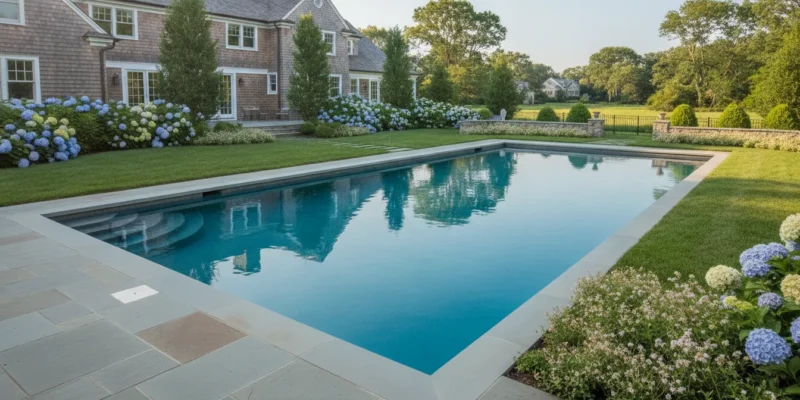
Pool dimensions can look abstract until you compare them with the space behind a Long Island home. An Olympic pool is built for regulated competition. A residential pool is shaped around the property, intended use, deck, equipment, and local planning requirements.
If you are asking how long is an olympic swimming pool, the standard long-course distance is 50 meters, or approximately 164 feet. A full competition pool is commonly described as 25 meters wide and at least 2 meters deep, although a 50-meter length alone does not confirm every Olympic standard. Competition pool guidance also accounts for lanes and the surrounding setup.
That scale is far beyond what most homeowners need for recreation or lap swimming. Understanding the measured length, width, and depth first makes it easier to compare competition specifications with a practical residential design for a Nassau or Suffolk property.
How Long Is an Olympic Swimming Pool?
An Olympic swimming pool is 50 meters long, which is approximately 164 feet. In swimming terminology, this is a long-course-meter pool. A swimmer traveling from one end to the other covers 50 meters, while two lengths equal 100 meters. That measured distance is the key answer to the question, how long is an Olympic swimming pool?
Contact Gappsi through our contact page
The 50-meter measurement refers to the pool’s length, not the entire property or competition complex. The water basin itself is commonly described as 50 meters long and 25 meters wide.
A full Olympic competition venue also needs space for lane systems, starting blocks, timing equipment, swimmer circulation, officials, spectators, locker rooms, mechanical systems, and other support areas. Those features can make the overall facility substantially larger than the rectangle containing the water.
It is also important to distinguish a 50-meter pool from a pool that meets every requirement for international competition. A long-course training pool may be 50 meters long but have different depth, lane arrangements, equipment, or technical specifications. Published pool guidance identifies a minimum depth of 2 meters for a standard Olympic-sized pool, while competition facilities must also meet detailed measurement and operational requirements. The World Aquatics competition regulations govern those standards.
For homeowners, the practical takeaway is that Olympic length describes a very specific scale. It does not mean that a residential pool needs to be 164 feet long to support exercise or lap swimming. A shorter design can still provide a useful swim lane, especially when the layout, depth, entry points, and equipment match the way the pool will be used. Site dimensions, property setbacks, the planned pool deck, equipment access, and space for circulation all matter before selecting a length.
On Long Island, homeowners may be comparing a large competition-style concept with a more typical residential layout. Gappsi’s knowledge base includes a 16 by 34 foot vinyl liner pool example, illustrating how different residential proportions can be from an Olympic basin. The right size depends on the yard, household activities, maintenance expectations, and the balance between swimming area and the rest of the backyard.
What Are the Standard Olympic Pool Dimensions?
Length is only one part of an Olympic pool’s design. A full competition layout also accounts for width, water depth, lane geometry, and open water outside the racing lanes. These dimensions give swimmers consistent conditions and help officials measure races accurately.
The pool is commonly described as 25 meters wide and at least 2 meters deep. Its 10 lanes are typically 2.5 meters wide each. The center eight lanes are used for racing, while the two outside lanes provide buffer space that can reduce the effect of waves rebounding from the pool walls. This arrangement is why a 50-meter pool is not automatically a complete Olympic-standard venue. A long-course pool may have the correct length but differ in width, depth, lane count, or competition equipment.
| Feature | Common specification | Why it matters |
|---|---|---|
| Pool width | 25 meters | Creates room for the full lane layout and outside buffers. |
| Minimum depth | 2 meters | Provides the required water depth for a full competition configuration. |
| Total lanes | 10 | Includes eight racing lanes and two outside buffer lanes. |
| Lane width | 2.5 meters | Gives each swimmer a defined racing corridor. |
| Racing lanes | Eight center lanes | Separates active competition from the outside wave-buffer lanes. |
For formal events, measurement precision also matters. World Aquatics competition regulations permit a length tolerance of plus 0.010 meters and minus 0.000 meters when automatic timing panels are installed. In practical residential planning, homeowners usually do not need competition tolerances or ten lanes. The useful lesson is to define the intended activity first, then size the pool and surrounding deck for that purpose.
How Much Water Does an Olympic Pool Hold?
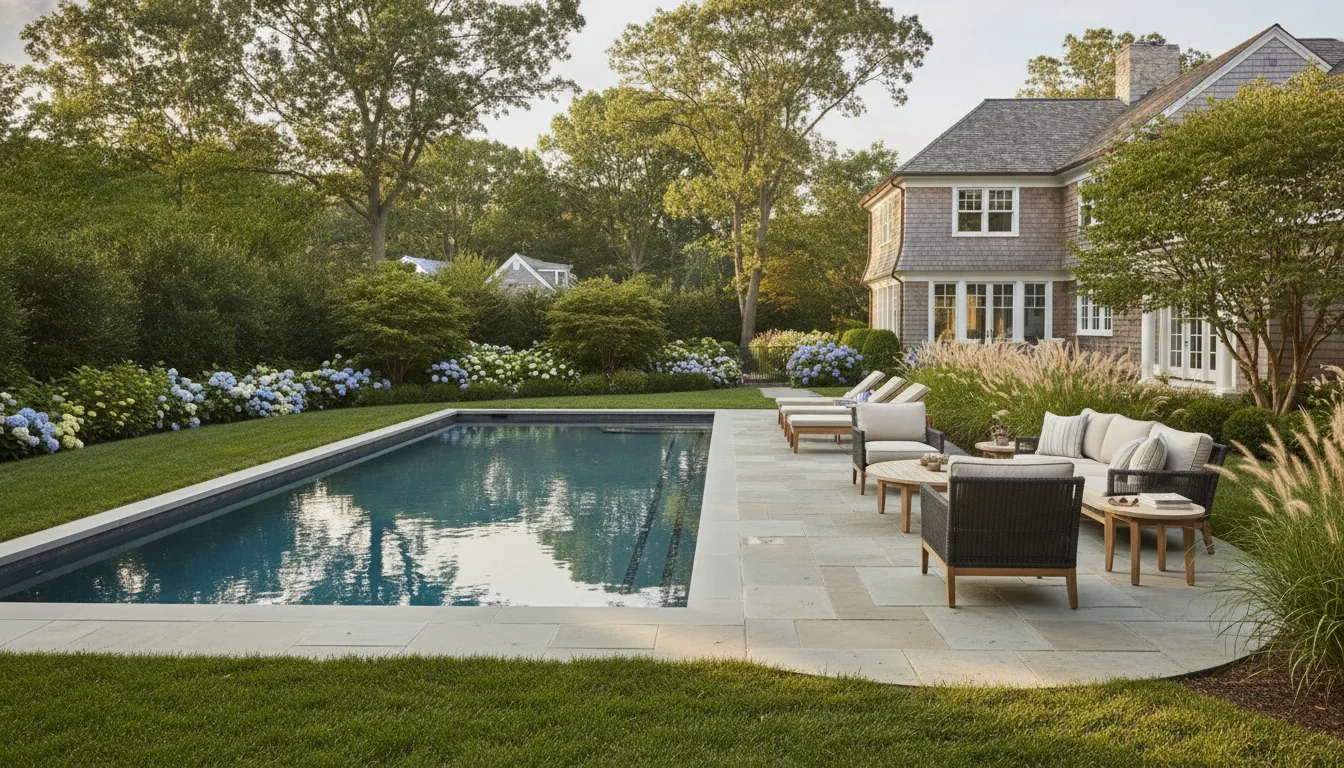
A standard example uses a pool that is 50 meters long, 25 meters wide, and has an average depth of 2 meters. That rectangular volume works out to approximately 2.5 million liters of water, or about 660,000 gallons. The estimate is useful for understanding the scale of an Olympic pool, but it is not a universal capacity for every pool described as Olympic-sized. Pool volume depends on the facility’s geometry and intended use.
Depth has a direct effect on capacity. A wider or deeper configuration holds substantially more water. For example, a 50-by-30-meter pool with a 3-meter depth can contain approximately 4.5 million liters. Those figures assume a relatively consistent depth and simplified rectangular geometry. A pool with sloped areas, varying depths, steps, ramps, gutters, or other built-in features will have a different volume than a simple length-by-width-by-depth calculation suggests.
Training pools and international competition venues are not identical
A training pool may be 50 meters long while using different depths, accessories, and technical features than a venue built for international events. In other words, the length alone does not establish that a pool meets every competition requirement. International facilities also account for precise measurement, lane configuration, timing equipment, and other operating specifications. World Aquatics rules, for example, set tight length tolerances when automatic timing panels are installed, with an allowed tolerance of plus 0.010 meters and minus 0.000 meters. World Aquatics competition regulations provide the governing details.
For a homeowner, the practical lesson is that water capacity should be calculated from the actual design rather than borrowed from an Olympic comparison. The final dimensions, average depth, bottom profile, steps, benches, and water features all affect the amount of water a residential pool requires.
How Does an Olympic Pool Compare With a Residential Pool?
The main difference is scale and purpose. A full Olympic pool is built around competition standards, while a residential pool is sized around the property, intended use, circulation space, and the homeowner’s design goals. That means there is no single universal residential pool size to compare with an Olympic pool.
| Pool type | Typical length | What it means |
|---|---|---|
| Olympic long-course pool | 50 meters, about 164 feet | Designed for long-course competition and high-level training. A 50-meter length alone does not confirm every Olympic standard. |
| Short-course meters pool | 25 meters | Half the length of a 50-meter pool, so swimmers complete more lengths for the same distance. |
| US short-course yards pool | 25 yards, about 22.86 meters | Common in United States high school, college, and competitive swimming. It is shorter than a 25-meter pool. |
| Residential pool | Varies by property and design | Planned for recreation, entertaining, exercise, landscape integration, and available yard space rather than one competition standard. |
For a swimmer, the length changes the experience. Two lengths of a 50-meter pool equal 100 meters, while a 25-yard pool requires more turns over the same workout distance. At home, however, a shorter pool may provide a better balance between swimming space and the rest of the backyard. The design may need room for steps, shallow areas, coping, a deck, equipment access, and safe circulation around the water.
Long Island homeowners should also separate the pool shell from the complete project footprint. A recorded Gappsi example of an average-sized Long Island pool measures 16 by 34 feet. Which is dramatically smaller than an Olympic facility but can still support recreation and regular exercise. You can review more context about average-sized swimming pool planning before deciding how much yard area to dedicate to water.
Material choice affects the available design options as well. Gappsi designs and installs gunite, vinyl liner, and fiberglass pools, each with different construction characteristics and shape considerations. A site-specific plan for Long Island pool design services can account for the lot, setbacks, desired activities, deck layout, filtration, heating, and permitting instead of forcing a competition-size template onto a residential property.
What Should Long Island Homeowners Consider When Planning Pool Size?
An Olympic pool is built around competition requirements, while a residential pool should be sized around the property and the way your household will use it. Homeowners in Nassau and Suffolk County should evaluate the complete outdoor space, not just the water area. These steps can help establish a practical starting point before choosing a shape or construction method.
- Define how the pool will be used. Decide whether the priority is family recreation, entertaining, exercise, children’s play, or a combination of activities. A household that wants regular lap swimming may value a longer, straighter layout. A family focused on conversation and water play may benefit more from usable shallow areas, steps, seating, or a shape that leaves room for gathering. The goal is not to reproduce competition dimensions. It is to create enough water area for the intended activities without sacrificing the rest of the backyard.
- Measure the usable yard area and review setbacks. The property lines are only the beginning. The design must account for the house, existing structures, grades, drainage, access routes, easements, and required clearances. A larger pool can reduce space for planting, seating, play areas, and circulation around the water. Site conditions can differ substantially between Nassau and Suffolk properties, so an on-site evaluation is more reliable than estimating from a rough backyard measurement.
- Plan the deck, coping, and circulation with the pool. The pool shell is one part of the finished project. Decking and coping affect the footprint, entry points, furniture placement, maintenance access, and how people move between the house and the water. Choosing these materials and edge details early helps prevent a pool from appearing to fit on paper while leaving too little functional space around it. A custom Long Island pool design can coordinate the pool layout with the surrounding outdoor living areas.
- Reserve space for equipment and service access. Filters, pumps, heaters, controls, and related systems need an appropriate location that supports maintenance without disrupting the yard. Equipment placement can also influence plumbing runs, noise considerations, and the final pool shape. Review inground pool equipment planning before finalizing dimensions, rather than treating the equipment area as an afterthought.
- Coordinate permits and the complete design before construction. Pool size, placement, access, drainage, electrical work, fencing, and site conditions may all affect the planning process. A coordinated design-build approach can bring together site evaluation, 3D design, architectural or engineering drawings, material selection, permit assistance, and installation planning. Gappsi provides pool design and installation support for homeowners throughout Nassau and Suffolk Counties, including gunite, vinyl liner, and fiberglass options. Reviewing these decisions together makes it easier to select a pool size that fits both the property and the project requirements.
Can a Residential Pool Be Designed for Lap Swimming?
Yes. A residential pool can support lap swimming without copying the footprint of a competition facility. The design question is how you plan to use the water. A homeowner who wants regular straight-line exercise may value a longer, narrower basin. Someone who wants swimming plus family recreation may prefer a shape that preserves a clear swimming path while leaving room for steps, seating, or play.
Start with usable straight length rather than the total outside dimensions. The path should remain clear of steps, benches, tanning ledges, and other features that interrupt each turn. Even a shorter pool can work for conditioning when the layout lets you swim continuously or use a swim jet for resistance. Swim jets create an adjustable current, allowing a swimmer to remain in place while working against the flow. They can be useful when the property cannot accommodate the length a homeowner initially imagines.
Shape, depth, and circulation matter
A rectangular pool usually provides the most direct route for repeated lengths. A custom gunite design can also incorporate an offset, attached spa, or wider activity zone, but those additions should not narrow the primary swimming lane. Vinyl liner and fiberglass pools offer other design and installation considerations, including the shell or wall system and the available shape options. The right choice depends on the site, the desired layout, and how much flexibility the project requires.
Depth should match the intended activities and the pool’s planned features. Lap swimming alone does not automatically require competition depth. The final profile should account for entry points, circulation, equipment, safety requirements, and any diving or recreational elements. These decisions are connected, so changing the shape or depth can affect the deck, coping, filtration, heating, and overall use of the yard.
For context, a recorded Long Island example is a 16 by 34 foot vinyl liner pool. But that should be treated as one project example, not a universal residential standard. A site evaluation can identify the practical straight length after setbacks, deck space, equipment access, and permitting requirements are considered. Gappsi’s Long Island pool design services can help Nassau and Suffolk County homeowners compare these tradeoffs before selecting a layout.
How Can Gappsi Help With Long Island Pool Planning?
The difference between a competition pool and a residential pool becomes useful when it guides better decisions for your property. Gappsi starts by discussing how you expect to use the pool, then considers the available yard area, desired shape, deck space, equipment location, setbacks, and permitting requirements. That process helps Nassau and Suffolk County homeowners compare an Olympic-length concept with a pool sized for recreation, entertaining, exercise, or a combination of uses.
Choosing the pool structure and surrounding materials
Gappsi designs and installs gunite, vinyl liner, and fiberglass swimming pools. A gunite pool offers broad flexibility for custom shapes and dimensions. A vinyl liner pool uses concrete walls with a replaceable liner, while a fiberglass pool uses a prefabricated shell with established size and shape options. The right choice depends on the site, layout, finish preferences, and the type of pool experience you want to create. You can also review fiberglass pool size options before narrowing the design.
Planning also includes the parts that make the pool function as part of the yard. Gappsi can coordinate pool decks and surrounds, coping, lighting, heaters, filters, water features, slides, diving boards, and swim jet systems. Equipment placement matters when comparing a large pool footprint with a more compact design, so it should be considered alongside the basin rather than added at the end. The inground pool equipment planning guide provides additional context.
From concept to construction planning
Once the goals and site conditions are understood, Gappsi can develop a 3D design and prepare architectural or engineering drawings. Those visuals make it easier to evaluate how the pool, coping, deck, landscaping, and outdoor living areas work together. The process can also include material selection, proposal development, permit expediting, and installation support. Homeowners who want to explore the design-build approach can review Gappsi’s Long Island pool design services or the custom Long Island pool design guide.
Frequently Asked Questions
How long is an Olympic swimming pool in meters?
A full Olympic competition pool is 50 meters long, or approximately 164 feet. That measurement describes the race length, while the complete facility also includes width, depth, lanes, timing equipment, and deck space.
Is an Olympic pool 50 meters or yards?
Olympic pools are measured in meters, not yards. A 50-meter pool is also called a long-course-meter pool. In the United States, many school and college competitions use 25-yard short-course pools, which are about 22.86 meters long and require more turns.
Is 25 yards an Olympic pool?
No. A 25-yard pool is shorter than both a 25-meter pool and a 50-meter Olympic-length pool. It can be a practical format for residential lap swimming or local training, but it does not meet the basic length description of an Olympic pool.
What is the depth of an Olympic swimming pool?
A full Olympic pool is commonly described as at least 2 meters deep. Actual competition requirements can also address measurement tolerances, water temperature, lane layout, and other technical features.
A 50-meter pool is not automatically an Olympic-standard venue.
What is a practical pool size for a Long Island home?
There is no single best residential size. A documented Long Island example is a 16-by-34-foot vinyl liner pool, but your ideal dimensions depend on the yard, setbacks, deck, equipment, intended activities, and permitting requirements. A site-specific design can balance swimming space with usable backyard space.
Ready to Plan the Right Pool Size?
The right residential pool balances how you want to swim and relax with your property’s available space, layout, and permitting requirements. A focused planning conversation can help you compare dimensions, materials, equipment, and surrounding features before design decisions are finalized. Call Gappsi to discuss pool size, layout, and planning for your Long Island property: Contact Gappsi through our contact page.