


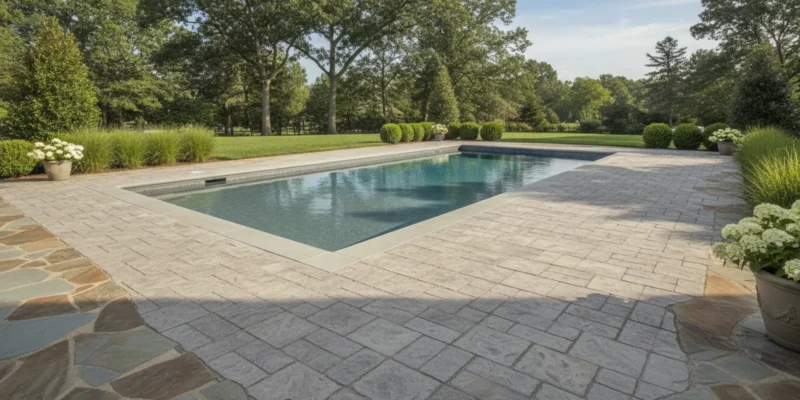
Pool deck resurfacing cost depends on more than the visible finish. For Long Island homeowners, a useful estimate starts with the deck’s condition, drainage, material choice, and preparation needs. The goal is to understand what work is included, then compare proposals that address the same conditions and desired result.
Contact Gappsi through our contact page to discuss your pool deck
There is no single price that fits every pool area. A contractor needs to inspect the deck and define the scope before a number is meaningful. A worn finish over a sound base differs from a deck with movement, water issues, or deteriorated edges. This guide explains how to assess those differences without assuming every surface needs the same treatment.
What affects pool deck resurfacing cost on Long Island?
Start by separating the visible finish from the work beneath it. The proposed price can change with the deck’s size and shape, current material, access, removal and disposal, repair needs, and details where the deck meets the pool and yard. Ask for the work behind each part of the estimate to be described, rather than relying on a single per-area figure.
- Area and layout: A larger deck uses more material and labor. Curves, narrow passages, steps, borders, and irregular shapes can add measuring and installation work.
- Existing surface: Concrete, pavers, and natural stone need different preparation and transitions. A surface that can remain may require less removal than one that is loose or extensively damaged.
- Base condition: Settlement, widespread cracks, loose units, or soft areas may need repairs before a new finish is appropriate.
- Drainage and elevations: The plan should account for water flow, the pool edge, and whether doors, steps, or walks constrain finished height.
- Access and protection: A tight route, nearby planting, pool equipment, or finished walls can affect moving materials and protecting the site.
- Connected features: Coping, drains, steps, fences, and neighboring patios may be included or excluded. Their boundaries should be written down.
Two estimates can differ because one includes removal, disposal, and base preparation while another covers only the new finish. Ask each contractor to define those items, identify assumptions, and note what may require a change if concealed conditions appear. A cost discussion is most useful when the proposed sequence is clear: what comes off, what stays, what gets repaired, and what new surface is installed.
Compare defined work, not just totals. If a quote gives a broad label such as resurfacing without explaining preparation, ask for a written breakdown before treating it as comparable to a more detailed proposal. A low number may reflect a narrower scope rather than a lower cost for the same work.
Review Gappsi’s swimming pool services and discuss the pool-area project scope
How does the site assessment shape pool deck resurfacing cost?
Walk the area and record what you see in several locations. Note cracks, uneven sections, loose pavers, worn joints, chipped edges, and places where water remains after rain. Check transitions between the deck and coping, steps, doors, or adjoining walks. A symptom in one corner may call for a different response than movement across the whole deck.
Take overview and close-up photos, including after rainfall if pooling is a concern. Mark approximate dimensions and identify the most-used sections. These observations do not replace an inspection, but they help you describe the project and ask focused questions. Avoid treating a new top layer as an automatic fix for an underlying problem.
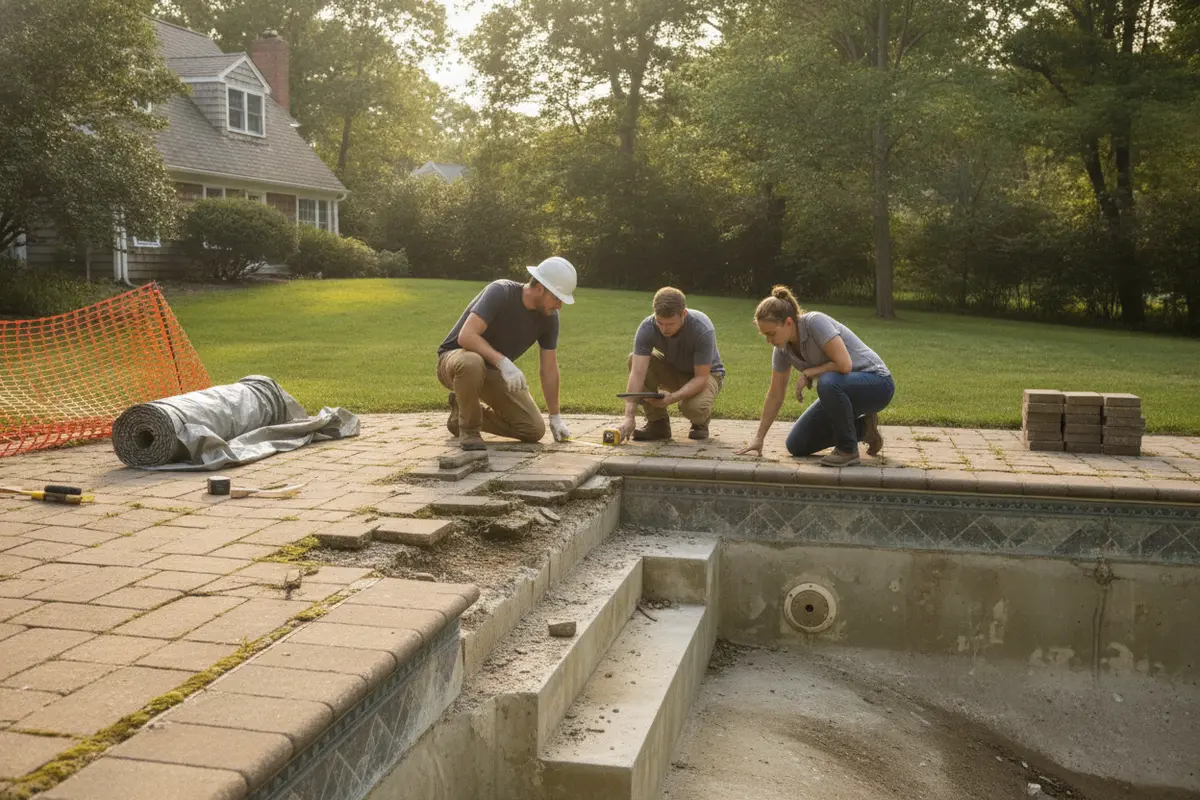
A useful assessment should say what can remain, what needs repair, and what should be removed. It should explain how the work will protect the pool, nearby structures, and equipment. To gather ideas for linking the deck to an outdoor gathering space, browse Gappsi’s pool patio examples and patio projects. Use these pages to identify preferences, not as a substitute for evaluating your site.
It also helps to ask the assessor to distinguish what is observed from what is recommended. For example, a crack is an observation; the cause and appropriate repair are questions that need evaluation. Similarly, water left after rain is a symptom. Its explanation could involve a low spot, a drain, or the way nearby surfaces meet. Keep notes for each location so that proposed work can be tied to a specific condition.
Which surface options should you compare?
Material selection affects appearance, maintenance expectations, and installation details. Compare samples near the house, coping, and landscape, because colors and textures can look different outdoors than on a screen. Ask what preparation each option needs and how it will meet drains, steps, and the pool edge.
| Option | What to examine | Questions for the scope |
|---|---|---|
| Concrete resurfacing | Existing concrete condition and finish choice | Can the base remain, and what repairs are needed first? |
| Concrete pavers | Pattern, joint detail, and edge restraint | How will the base, border, and transitions be handled? |
| Natural stone | Stone selection, layout, and surface characteristics | How will stone meet coping, steps, and drainage features? |
| Porcelain pavers | Product suitability and installation system | What support and edge details does this location require? |
This comparison is a starting point, not a specification. Suitability depends on the site and installation method. Ask for the exact product and finish to appear in writing, along with installation and care guidance. If porcelain is on your shortlist, browse porcelain patio examples and porcelain tile projects.
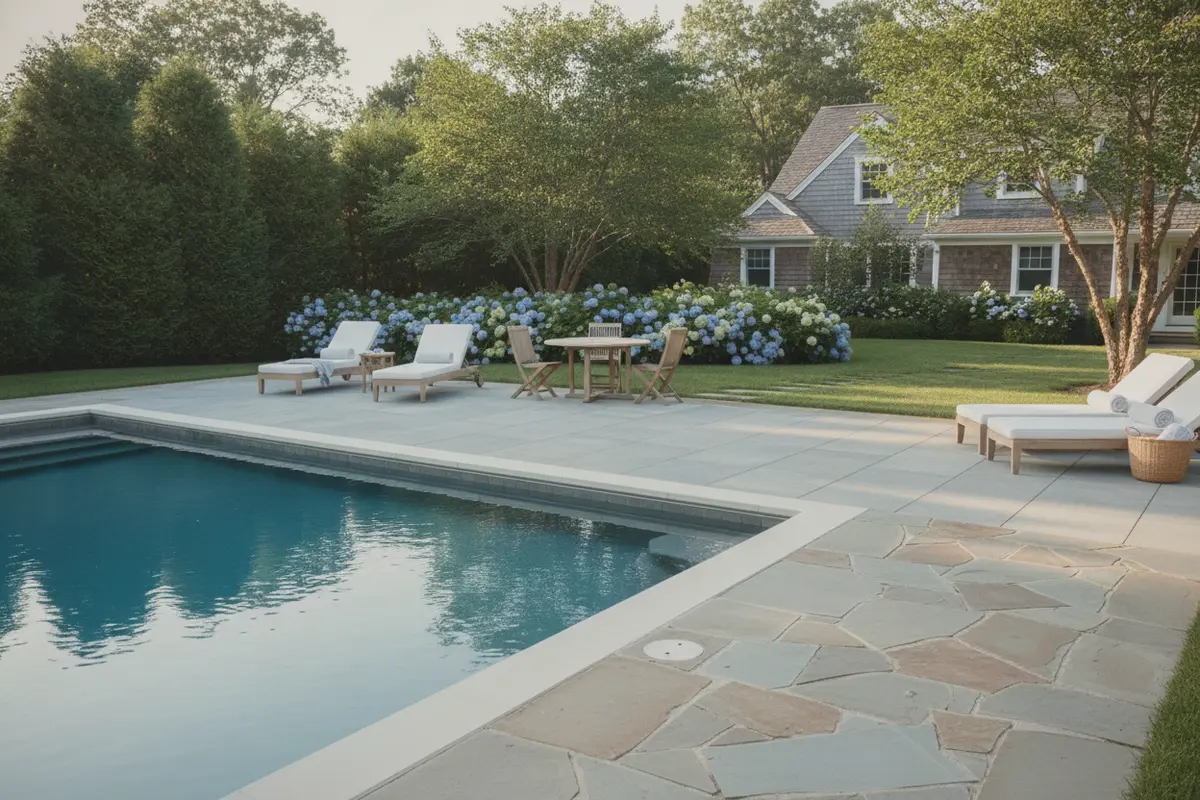
Think through how a sample will look next to existing elements. A warm-toned stone can read differently beside a cool-colored pool coping or a shaded wall. Look at samples in daylight and in the areas where people will use the deck. Ask about surface texture and cleaning guidance, and confirm that the material is intended for the proposed installation system. Do not assume that products with similar names use the same base or edge details.
How should drainage and transitions be planned?
Surface selection is only one part of a usable deck. Water needs a planned route, and the new surface must meet nearby features at workable elevations. Ask the project team to identify the direction of drainage and explain whether existing drains, slopes, or low spots will change.
Consider a practical example: water collects near one set of steps after a storm, while the rest of the deck drains normally. The proposal should identify whether the issue may come from a localized low area, a blocked drain, or a broader slope problem. The response and amount of work depend on inspection. Do not assume that a finish alone will correct the source.
Transitions deserve equal attention. A thicker surface can affect how the deck meets coping, a threshold, a gate, or a neighboring walkway. Ask whether those edges are included and how they will be finished. If they are excluded, identify who will address them and when, so the project does not stop at an unclear boundary. A drawing or marked-up photo can help make the start and stop points easier to understand.
For general information about rainwater and environmental issues, see the U.S. Environmental Protection Agency. At the property level, ask where runoff will go and whether the proposed slope or drainage detail could direct water toward a house, neighboring area, or low spot. The contractor should consider downspouts, planting beds, drains, and paved areas nearby when discussing elevations. The scope should say what drainage work is included and what remains unchanged.
What should a resurfacing proposal include?
A useful written proposal lets you see exactly what the quoted work covers. It should define the area, material, preparation, repair assumptions, disposal, and important edge conditions. Before accepting a proposal, check each of these items:
- Project boundary: Identify the included deck sections and where work stops. A marked sketch helps when the area wraps around planting or structures.
- Removal and preparation: Ask what is removed, how the remaining surface will be prepared, and what happens if concealed conditions appear.
- Repairs: Separate known repairs from allowances or work that requires approval if discovered later.
- Product details: Record the material, color or finish, pattern where relevant, and installation method rather than relying on a broad label.
- Water and elevations: Describe the drainage approach and how the surface will meet coping, steps, drains, and adjacent walks.
- Protection and cleanup: Ask how the pool, equipment, planting, and nearby finished surfaces will be protected and how debris will be handled.
- Inclusions and exclusions: Clarify coping, fencing, pool equipment, landscaping, and other connected work.
- Decision process: Find out how unexpected conditions will be documented, priced, and approved before additional work proceeds.
For context about how a pool area can fit into a yard, browse Gappsi’s pool remodeling topics, hardscaping projects, and backyard examples. Use these pages to prepare questions about nearby features while keeping the estimate focused on your property and requested work.
When reviewing a proposal, check that product choices and construction details are specific enough to understand. If a proposal says repairs are included, ask which repairs and in what locations. If it includes an allowance, ask what that amount covers and how a difference would be handled. If coping, steps, or drains are excluded, ask whether the new surface can still meet them as planned and who is responsible for the connection.
When might resurfacing not be enough?
A surface-only approach may not address widespread movement, a failing base, or persistent drainage trouble. The contractor should explain whether repairs can be localized or whether more complete removal and rebuilding should be considered. That judgment depends on site conditions, not a general rule based on one crack or a particular material.
Look for a clear explanation of the observed issue and proposed response. If a section is uneven, ask whether the plan corrects the underlying cause or only covers the visible difference. If a crack is present, ask whether it is isolated, moving, or associated with a larger condition. A written scope should distinguish confirmed work from contingencies.
A deck project can also raise decisions about coping, access, steps, or patio layout. Consider whether connected work belongs in the same project to avoid an unclear boundary or mismatched finish. Review Gappsi’s pool-area planning examples if you are considering a broader plan.
How can you compare estimates fairly?
Put proposals side by side and compare the same details. A lower number may cover only installation of a finish, while another may include removal, preparation, and disposal. Verify the measured area, named product, repair assumptions, drainage work, edge details, and exclusions.
- Does each estimate describe the same work area?
- Are removal, preparation, repairs, and disposal included?
- Is the selected product identified clearly?
- Are coping, drains, stairs, borders, and transitions addressed?
- Does the proposal explain its drainage plan?
- Are unknown conditions and approval steps explained?
If the scopes do not match, request a written explanation or revised proposal. Keep your priorities visible: comfortable circulation, a coordinated appearance, and a plan that responds to the existing deck rather than concealing a problem. A fair comparison is not just totals; it is defined work and clear assumptions.
A simple comparison sheet can make gaps visible. For each proposal, write down the square footage or marked area, material, preparation, repairs, drainage plan, transition details, cleanup, and exclusions. Put “not specified” where the proposal is silent rather than assuming the work is included. Ask the contractors to clarify those lines before comparing totals. This does not force every proposal to use the same approach, but it lets you understand what each price represents.
How can you prepare for a site discussion?
Before requesting an estimate, gather practical details. Measure approximate dimensions, take overview and close-up photos, and note where water collects or surfaces feel uneven. List materials you are considering, what you want to preserve, and adjacent work you may want to discuss. You do not need a finished design before asking questions.
During the discussion, walk the site together and point out each concern. Ask the contractor to distinguish observations from recommendations. If you have multiple estimates, bring the scopes rather than just totals. This makes it easier to identify whether differences involve material, preparation, repair allowances, or project boundaries.
After the visit, review the written proposal while the conversation is fresh. Confirm that verbal clarifications appear in the document, especially around drainage, coping, repairs, and exclusions. If something remains unclear, ask before work begins. Clear notes reduce the chance of different expectations about what the project includes.
How can you set priorities when the budget is limited?
When the project needs phasing, distinguish conditions that affect function from choices that are primarily about appearance. Start by asking whether the base is sound, water moves as intended, and boundaries at the pool edge and steps can be completed properly. Those answers help establish what belongs in the initial scope.
Next, identify decisions that could reasonably wait, such as extending the deck into an additional seating area or coordinating a separate patio feature. Ask whether a later phase would disturb new work. If so, define the final layout now even if connected improvements are not completed at once. A phased plan should specify a clean stopping point and the materials or elevations needed to connect future work.
For example, a homeowner might prioritize repairing a settled section and renewing the main circulation path, while postponing decorative planting changes. Another property might need drainage attention before a finish is selected. These are not universal prescriptions; the site assessment determines what is feasible. Compare clearly defined scopes rather than a vague reduced version of a larger proposal.
When you ask what can wait, consider both the immediate condition and the sequence of work. A feature that is mainly decorative may be easier to defer than work that determines finished elevations or water flow. Ask whether a future phase would require removing or disturbing the surface now being installed. The answer can help you choose a practical stopping point without assuming every desired improvement must happen together.
Contact Gappsi through our contact page to discuss your pool deck scope
Frequently Asked Questions
Can a pool deck be resurfaced without replacing the whole deck?
Sometimes. Whether the existing surface or base can remain depends on its condition and the selected installation method. An assessment should identify repairs and explain the limits of surface-only work.
Does deck size determine the entire cost?
No. Area matters, but preparation, access, material, drainage, and edge details can also change the scope. Compare complete written proposals rather than relying on area alone.
Should coping be included in a resurfacing project?
That depends on its condition and how it meets the planned surface. Ask whether coping is included, excluded, or needs separate work, and ensure the transition is addressed in the proposal.
What information should I prepare before requesting an estimate?
Share approximate dimensions, photos of problem areas, preferred materials, and concerns about water, movement, or access. A site visit is needed to confirm actual conditions and scope.
Can a new surface fix water that collects on the deck?
Not necessarily. The cause may involve a low area, slope, drain, or another site condition. Ask for the suspected cause and proposed correction to be explained before choosing a finish.
Posted by Gappsi Group
Plan a pool deck resurfacing conversation
A clear description of existing conditions, materials, preparation, drainage, and transitions makes estimates easier to compare. Contact Gappsi through our contact page when you are ready to discuss the scope for your property.