


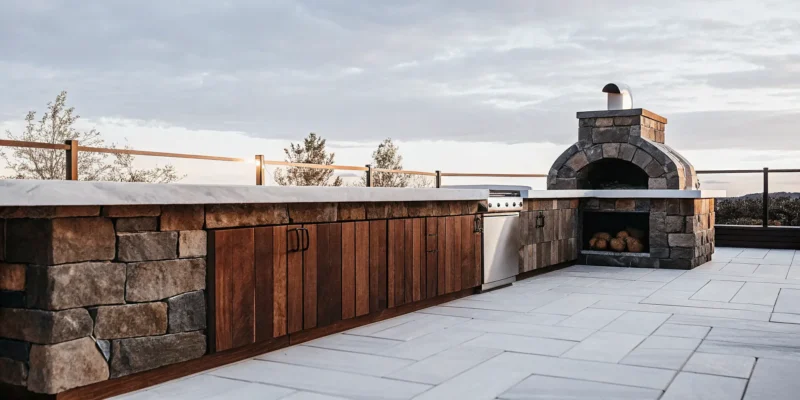
Designing a custom outdoor pizza oven installation Long Island project requires more than stacking firebrick. It demands precision engineering, an understanding of refractory materials, and a build sequence that accounts for thermal expansion, moisture migration, and frost heave. Gappsi has delivered this level of masonry craftsmanship since 1987, and our Smithtown showroom lets you touch every stone before it goes into your backyard.
Ready to start your custom outdoor pizza oven installation Long Island project? Call (631) 543-1177 or visit our Smithtown showroom for a free design consultation.
A custom outdoor pizza oven installation Long Island combines refractory firebrick, castable insulation. And a reinforced concrete base to build a permanent cooking structure that reaches 800-900 degrees Fahrenheit. Wood-fired domes use a 62-63% arched curvature for even heat distribution, while gas models rely on a modulated burner for instant ignition. Proper engineering includes frost-proof footings below the Long Island frost line and a waterproof thermal break between the base and the cooking floor.
This guide walks through every decision you will face: masonry methods, fuel choice, site engineering, permit requirements, and design integration. Each section draws on real installation experience across Nassau and Suffolk County projects.
Custom Outdoor Pizza Oven Installation Long Island: What Makes a Custom Masonry Oven Different from a Prefabricated Kit?
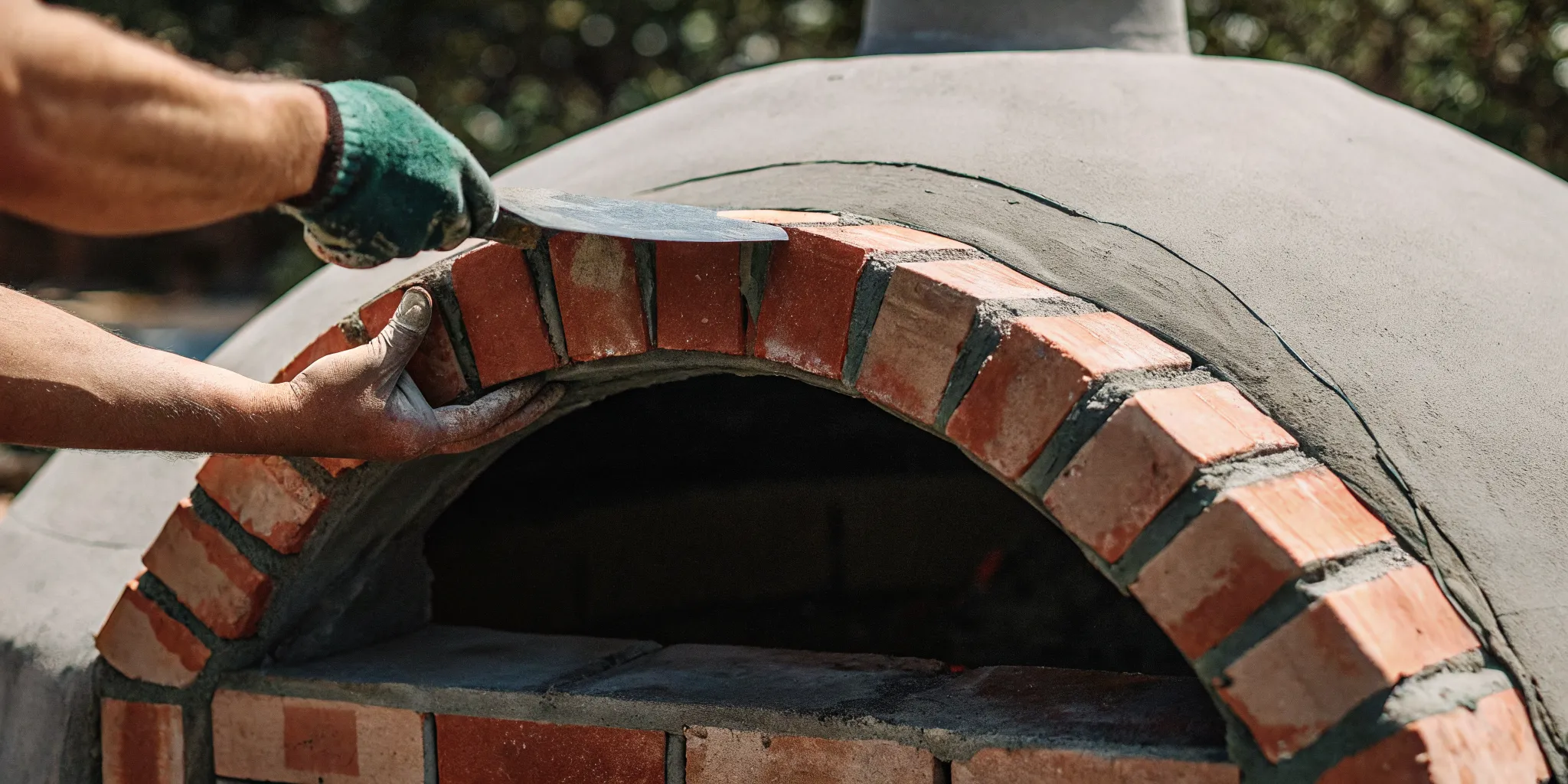
Prefabricated oven kits sold at big-box stores are cast from lightweight refractory cement with wall thicknesses of roughly 1.5 to 2 inches. They work, but they radiate heat quickly and lack the thermal mass needed for overnight heat retention. A custom masonry dome built by Gappsi uses 4.5-inch-thick firebrick inner walls backed by a 2-inch layer of ceramic blanket insulation and an outer shell of natural stone or clay brick. This three-layer system absorbs heat through the day and radiates it well past midnight. Letting you roast vegetables at 10 p.m. on the same fire that baked pizzas at 5 p.m.
Custom builds also fit the specific dimensions of your outdoor kitchen island rather than forcing your countertops to wrap around a fixed box. Our 3D design process maps every course of brick before the first stone is cut.
Refractory materials that matter
The grade of firebrick dictates dome longevity. Low-duty firebrick (C216) works for decorative surrounds but spalls under direct flame contact. Medium-duty (C216 with higher alumina content) resists thermal cycling up to 2,460 degrees Fahrenheit. For the cooking floor, we specify high-duty fireclay (C401) or kiln-fired pizza deck tiles that survive direct flame lick without cracking. The mortar between each brick is a calcium aluminate refractory cement, not standard portland-based mix, because portland calcines and crumbles above 500 degrees. The dome mortar joint thickness is held to 1/16 inch to minimize shrinkage cracking during the initial curing burn.
How Do Wood-Fired and Gas Pizza Ovens Compare on Long Island?
Every custom outdoor pizza oven installation Long Island starts with a fuel decision. Wood-fired ovens deliver a smoke-kissed crust and dramatic heat. But they require a 60- to 90-minute preheat window and a chimney draft that clears 8 to 12 feet above the cooking surface. Gas ovens ignite in minutes and hold any temperature between 300 and 900 degrees with a thermostat-controlled burner, making them practical for frequent midweek cooking.
- Wood-fired (Giotto model): Reaches 900 degrees on the dome floor. Requires cured hardwood (moisture below 20%) and produces 2-3 cubic feet of ash per month. Best for the homeowner who treats cooking as a weekend ritual.
- Gas-powered (Drago model): Heats in 20-30 minutes with a 60,000 to 90,000 BTU stainless steel burner. Zero ash, zero smoke, zero chimney cleaning. Best for the family that wants pizza night every Tuesday without logistics.
- Dual-fuel hybrid: A single dome with a removable burner tray. Use gas for quick weeknight meals and wood for weekend entertaining. Gappsi builds these with two independent vent paths to prevent gas burner interference with the wood flue.
| Feature | Wood-Fired (Giotto) | Gas-Powered (Drago) |
|---|---|---|
| Peak Temperature | 900+ degrees Fahrenheit | 900 degrees Fahrenheit |
| Preheat Time | 60-90 minutes | 20-30 minutes |
| Heat Retention After Shutdown | 6-8 hours | 1-2 hours |
| Fuel Cost Per Month | $80-$150 (seasoned hardwood) | $40-$80 (natural gas/propane) |
| Flue Cleaning Required | Every 3-6 months | Annual inspection only |
| Best For | Weekend entertaining, artisan baking | Daily use, convenience cooking |
Gappsi carries both models in the Smithtown showroom. You can see them fired up during your visit and taste the difference before committing.
What Site Preparation Does a Permanent Brick Oven Need on Long Island?
A masonry oven weighs 3,000 to 8,000 pounds fully constructed. That weight rests on a reinforced concrete slab that must extend below the frost line, which on Long Island sits 30 to 36 inches deep. A floating patio slab without frost-proof footings will shift during freeze-thaw cycles, and that shifting cracks the dome. Our site-prep protocol follows a specific load-bearing sequence.
- Soil test and compaction. We dig to undisturbed subsoil, test the bearing capacity (minimum 2,000 psf), and compact a 6-inch layer of 3/4-inch crushed stone as a capillary break against ground moisture.
- Reinforced concrete footing. A 6-inch slab with #4 rebar on 12-inch centers, poured 32 inches deep to clear the frost line. The concrete mix uses 4,000-psi air-entrained concrete for freeze-thaw resistance.
- Concrete masonry unit base. Hollow 8x8x16 CMU blocks filled with grout and rebar cells create the pedestal. This cavity can house gas lines, storage drawers, or a wood bin.
- Thermal break layer. A 1-inch calcium silicate board sits between the CMU base and the cooking floor, preventing heat from wicking into the concrete and causing differential expansion.
- Vermiculite insulation pour. Around the dome we pour loose vermiculite or ceramic blanket insulation before the outer stone veneer goes on. This keeps the exterior surface temperature below 130 degrees for safety.
Skipping any of these steps leads to cracked mortar within the first winter. Our team has built through 38 Long Island winters and knows exactly where the frost line changes between Nassau and Suffolk jurisdictions.
What Permit and Fire Safety Rules Apply to Outdoor Ovens on Long Island?
Township requirements vary across Long Island, but every municipality enforces the International Residential Code and the International Mechanical Code for outdoor cooking appliances. A custom outdoor pizza oven installation Long Island must comply with three code families: the IRC for structural loads and setbacks. The IMC for exhaust and clearances, and local zoning for property-line offsets.
Setback and clearance rules
- Property line offset: Most towns require 5 to 10 feet from the oven structure to the property line. Huntington and Smithtown require 10 feet; Babylon and Islip allow 5 feet with a fire-rated wall.
- Combustible wall clearance: The oven body must sit 24 inches from any wood siding, deck railing, or vinyl fence. A noncombustible backsplash (stone or metal) can reduce this to 12 inches.
- Chimney height: The flue outlet must extend 2 feet above any roof peak within 10 feet horizontally. For a one-story home, this typically means a chimney rising 10 to 12 feet from the cooking floor.
Fuel-specific safety requirements
Gas ovens require a licensed plumber to install the gas line, a sediment trap, and a manual shut-off valve within 6 feet of the oven. The burner must have a thermocouple flame-sensing system that kills gas flow within 10 seconds of flame failure. Wood-fired ovens need a stainless steel chimney liner rated for continuous 1,000-degree service and a spark arrestor cap with 1/2-inch mesh to prevent ember escape.
Gappsi handles permit expediting as part of the build. We have existing relationships with building departments across Nassau and Suffolk and know which towns require engineered drawings stamped by a New York State architect for oven structures over 200 square feet.
How to Design a Backyard Kitchen Island Around Your Pizza Oven
The oven should not be an afterthought tacked onto a prebuilt island. A successful built-in outdoor kitchen design places the oven where the cook can reach the prep sink, the refrigerator, and the serving counter without walking more than three steps. Gappsi maps this work triangle during the 3D design phase, accounting for door swings, traffic paths, and prevailing wind direction for smoke management.
Workflow zones to plan for
- Prep zone: 36 to 48 inches of uninterrupted counter space adjacent to the oven opening. Granite or soapstone handles the heat radiating from the oven face better than marble.
- Storage zone: Drawers under the prep counter for peels, brushes, and infrared thermometers. A dedicated wood bin next to a wood-fired oven keeps the fuel dry and within arm’s reach.
- Serving zone: A landing area on the opposite side of the oven where finished pizzas rest before slicing. LED soffit lighting above prevents drops during evening parties.
- Cleanup zone: A deep utility sink with a pull-down sprayer for scraping peels and washing hands without carrying grease into the house.
Gappsi integrates these zones into a unified masonry shell using the same stone or veneer across the entire structure. The result looks like one continuous piece of architecture, not a pizza oven dropped into a hole in a counter.
How to Maintain a Masonry Pizza Oven on Long Island
Seasonal weather on Long Island exposes outdoor ovens to freeze-thaw cycles, salt air near the coast, and heavy rain. A few maintenance habits extend the structure’s life past 30 years.
- After each use: Sweep ash and food debris from the cooking floor. Do not use water to clean a hot oven floor, thermal shock cracks firebrick instantly.
- Monthly: Inspect the chimney cap and spark arrestor for bird nests or debris. Salt air from the South Shore accelerates corrosion on standard stainless steel; we spec 304-grade stainless for coastal installations.
- Before winter: Apply a breathable masonry sealer to the exterior stone if installed in a freeze-thaw zone. Sealant keeps water from penetrating the outer veneer and freezing behind the stone face.
- Annually: Have the gas burner assembly serviced by a licensed technician. Check the thermocouple, the gas regulator diaphragm, and the orifice size if you convert from propane to natural gas.
Gappsi offers an annual maintenance program that covers chimney sweeping, sealant reapplication, and burner inspection for all ovens we install.
Frequently Asked Questions
How much does a custom outdoor pizza oven installation cost on Long Island?
Costs for a custom outdoor pizza oven installation on Long Island range from $5,000 for a basic gas model to $20,000 or more for a full wood-fired masonry dome integrated into a custom kitchen island. The price depends on stone selection, foundation engineering, chimney height, and site access. Gappsi provides itemized quotes after the 3D design phase so you see exactly where every dollar goes.
Can I install a wood-fired pizza oven in a small backyard?
Yes. Gappsi builds compact models like the Giotto that fit patios as small as 10 by 12 feet. Clearance from the house and property lines still applies, but a well-designed small installation uses vertical space through a tall chimney rather than horizontal spread. Our 3D planning shows every clearance dimension before construction begins.
Does a permanent outdoor pizza oven need a building permit on Long Island?
Most Nassau and Suffolk County towns require a building permit for any permanent masonry structure with a gas line or chimney over 6 feet. Wood-fired ovens always need a permit because the flue penetrates the roof line or extends above the structure. Gappsi handles permit filing and works directly with local building departments to expedite approvals.
How long does a custom masonry pizza oven take to build?
A typical custom outdoor pizza oven installation Long Island takes 4 to 6 weeks from groundbreaking to final fire-up. Foundation curing adds 7 to 10 days before any brick goes down. The dome itself takes 5 to 7 working days for a two-mason crew. Gas-line rough-in happens concurrently with the foundation pour to keep the timeline efficient.
What is the best stone for an outdoor pizza oven surround?
For the outer veneer, we recommend natural cleft bluestone for its slip resistance and low porosity, or full-thickness Pennsylvania fieldstone for a rustic look. Manufactured stone veneer works well in covered structures but absorbs moisture in open rain exposure. Gappsi stocks 20-plus natural stone options at the Smithtown showroom for hands-on selection.
Ready to Design Your Custom Outdoor Pizza Oven on Long Island?
Gappsi has been building custom masonry ovens across Nassau and Suffolk County since 1987. Every oven starts with a conversation at our 10,000-square-foot Smithtown showroom, where you can touch the stone. See the models fired up, and review 3D renderings of your own backyard. Call (631) 543-1177 or visit 1015 West Jericho Turnpike, Smithtown, NY to begin your custom outdoor pizza oven installation Long Island project.