


.
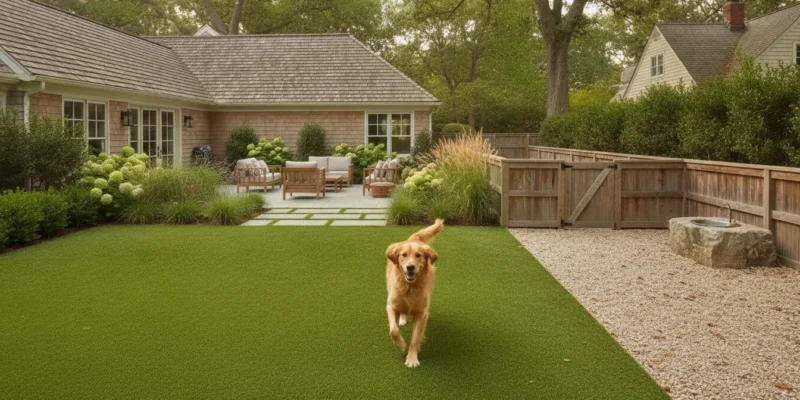
A dog-friendly backyard is easier to maintain when the surface, base, drainage path, and cleanup routine are planned together. Artificial turf is not simply a layer of green blades placed over an existing lawn. On Long Island, the right design must account for soil conditions, rain, urine flow, solid-waste removal, summer sun, and how the area connects to fencing, patios, and planting.
Contact Gappsi through our contact page
The best artificial grass for dogs is part of a complete system. It includes a properly prepared base, permeable backing, planned drainage, durable seams and edging, access for rinsing, and a realistic maintenance routine. Performance depends on site design, installation, product selection, sanitation, and heat management, so an odor-free or cool surface should never be assumed.
Whether you are planning a small dog run in Nassau County or a larger pet area in Suffolk County. Start by defining what the installation must handle every day. That begins with the turf surface and the layers beneath it.
What should artificial grass for dogs include?
A residential pet area should be planned as a complete surface and drainage system, not selected by blade appearance alone. The turf surface is only one part of the installation. A practical setup also accounts for the backing, compacted base, grading, drainage path, seams, edging, and access for routine cleaning. These details matter whether you are converting a small side yard in Smithtown or planning a larger dog run elsewhere in Nassau or Suffolk County.
The turf surface and backing should be appropriate for regular pet use and matched to the intended area. Pet-specific turf is available, but the right selection depends on how the space will be used. How much direct sun it receives, and how it connects to the rest of the backyard. Under the blades, a suitable backing needs to support water movement through the system. A permeable backing can allow urine to pass through, but it does not remove the need for proper grading, a suitable base, and an outlet or dispersal plan.
The base and drainage path are just as important as the finished turf. Ground preparation and topsoil grading help establish a stable surface and direct water where it belongs. The installation plan should consider existing soil, low spots, nearby structures, and whether water can disperse without collecting beneath the turf. Gappsi’s landscape division handles grading, drainage, irrigation, planting, and turf integration, which is useful when the pet area must work with the entire property. Homeowners can review the broader Long Island landscape design and construction scope when planning these connections.
Edges, seams, and transitions also deserve attention. Secure edging helps define the area, while properly planned seams reduce visible breaks and potential catch points. A dog run may transition to pavers, planting beds, a patio, or natural lawn. Those transitions should be comfortable to cross and positioned so they do not interfere with gates, mowing, irrigation, or cleanup.
Finally, include sanitation access in the design. Solid waste still requires prompt removal, and the surface may need rinsing or system-specific cleaning. Leave enough room to reach the area with a hose and cleaning tools. A full yard or constructed dog run can be designed around these needs. A portable potty mat may be convenient for a temporary use, but it does not solve property-wide grading, drainage, fencing, or access concerns. For a long-term residential project, those site decisions should be made before the turf is ordered.
How does drainage prevent dog-urine odor?
Odor control starts below the visible blades. In a properly designed system, permeable backing allows liquid to move through the turf rather than remain on the surface. A compacted, properly graded base then provides a path for that liquid to disperse or reach a planned drainage outlet. This can reduce the concentration of urine at the blade level, but it does not make artificial grass odor-free by itself.
Call Gappsi Group at Contact Gappsi through our contact page to discuss drainage, grading, and a dog-friendly turf layout for your Long Island property.
Why grading and the base matter
Water needs somewhere to go after it passes through the turf. If the area is flat where it should be sloped, or if the underlying base holds water, urine can remain in the system longer than intended. Poor drainage may also leave wet areas near edging, seams, fences, foundations, or other low points. During planning, the installation team should evaluate existing soil, surface grades, nearby structures, and the most practical route for dispersal.
The base is more than a layer that supports the turf. It helps create a stable, even surface while contributing to the drainage path. Excavation, aggregate selection, compaction, and grading all affect how the finished area handles liquid. A dog run beside a house may require a different drainage approach than a larger turf section in an open backyard. The design should account for both ordinary rainfall and the concentrated use of a pet bathroom area.
What drainage cannot solve alone
Drainage handles liquid, not solid waste. Remove feces promptly so residue does not remain on the blades or wash into the system. Regular rinsing can help move residue through the backing when the system and site drainage are designed for it. Focus additional attention on the places your dog uses most often. Spot cleaning and system-appropriate sanitation may also be needed, especially during warm weather or periods of frequent use.
Persistent odor is a reason to investigate, not a reason to apply stronger products at random. Possible causes include a blocked or undersized drainage path, a low area that stays damp. Contaminated infill, inadequate rinsing, or sanitation practices that do not match the turf system. Cleaning agents should be selected for the installed materials and used according to their directions. Harsh or unsuitable chemicals may affect turf components, nearby planting, or runoff.
For homeowners comparing artificial grass for dogs, ask how the complete system will manage urine, rainwater, solid waste, cleaning access, and future maintenance. A coordinated plan for the turf, base, grading, edging, and surrounding landscape gives odor control a stronger foundation than the turf surface alone.
How do you prepare the site for a dog-friendly turf area?
A dependable installation starts below the turf surface. For Long Island homeowners, the site plan should account for existing soil, runoff, access. Nearby foundations, and how the dog area will connect to the rest of the yard. Artificial grass for dogs performs as part of a complete system, including a prepared base, planned drainage, secure edges, and seams that can withstand regular use. Use this sequence to clarify the work before selecting a surface.
- Review the existing site. Identify low areas, compacted soil, standing-water patterns, tree roots, irrigation lines, downspouts, utilities, fences, gates, patios, and the route from the house. Note where the dog naturally enters, rests, plays, and relieves itself. This review helps determine whether the turf should occupy the full yard or a defined run. It also identifies conditions that could affect cleaning access and future landscape maintenance.
- Plan excavation and removal. Remove the existing lawn, unsuitable topsoil, roots, debris, and organic material to create a stable construction area. The required depth depends on the existing conditions and the planned turf system. So it should be established during the site assessment rather than guessed from a generic guide. Proper ground preparation limits settlement and gives the base room to perform as designed.
- Establish positive grading. Shape the subgrade so water moves away from the house, retaining walls, and other vulnerable structures. Grading should also respect adjoining planting beds, walkways, and paved areas. On Long Island, a drainage plan needs to respond to the specific property instead of assuming every Nassau or Suffolk site has the same soil or runoff behavior.
- Install and compact the aggregate base. Place the specified aggregate in controlled lifts, then compact it to form a firm, even foundation. The base supports the turf and helps manage water moving through the system. Check the finished surface for soft spots, abrupt changes, and areas that could hold water before the turf is installed.
- Confirm the drainage destination. Water needs a deliberate outlet or dispersal path. Review whether runoff can connect to an approved existing drainage feature, disperse appropriately on the property, or require another site-specific solution. Gappsi identifies synthetic turf backyard installation considerations for Long Island homeowners, while its landscape team coordinates grading and drainage with broader yard improvements.
- Protect equipment access and service routes. Decide how materials and installation equipment will reach the work area without damaging gates, planting, masonry, or neighboring property. Preserve practical access for rinsing, waste removal, repairs, and seasonal landscape work. A narrow side yard may influence the turf layout, staging plan, or gate design.
- Detail seams and edging. Lay turf so seams are planned away from high-turn areas when possible, then secure and finish them carefully. Use suitable edging where turf meets soil, fencing, planting, or hardscape. Loose edges and visible seams can become maintenance concerns, especially where dogs run, dig, or repeatedly turn.
- Design clean transitions. Connect the turf to pavers, patios, planting beds, gates, and other backyard features with transitions that are easy to cross and clean. A coordinated Long Island dog-run installation can address fencing, privacy screening, circulation, and the relationship between the pet area and the rest of the property. Confirm the final drainage, edges, and access before the surface is opened for use.
What maintenance does artificial grass for dogs require?
Artificial grass for dogs reduces some lawn chores, but it is not maintenance-free. A clean pet area depends on a simple routine that keeps solid waste off the surface. Moves residue through the drainage path, and catches small problems before they affect the whole installation. The exact cleaning schedule will vary with the number of dogs, the size of the area, weather, and the turf system selected.
Start with daily waste removal. Scoop solid waste as soon as practical, allowing softer material to firm up before lifting it if needed. Use a suitable scoop rather than dragging waste across the blades. Prompt removal keeps residue from being walked into the turf and gives rain or rinsing water a clearer path through the surface. Check the entire dog area, including corners near fencing, gates, edging, and places where a dog tends to return.
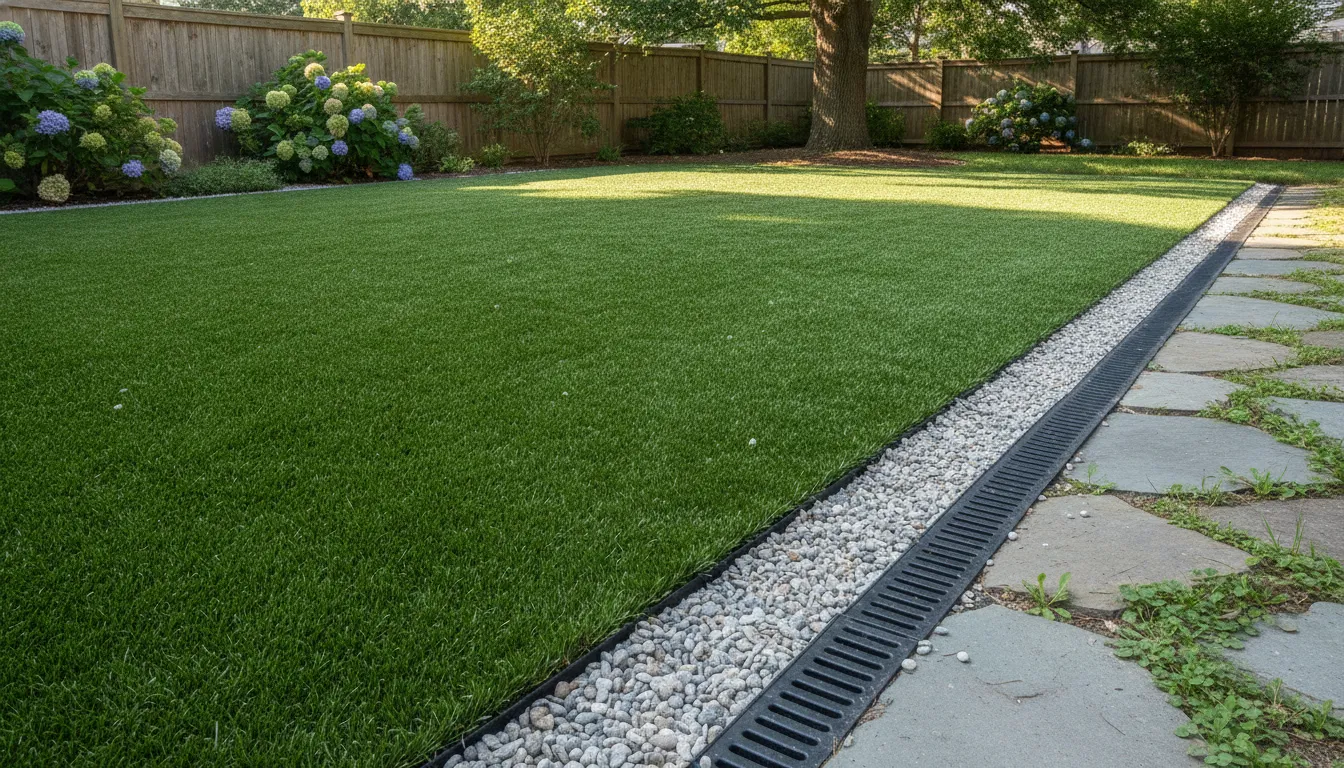
Rinse the area regularly. A clean-water rinse can help move urine residue and loose debris through a permeable turf backing and into the planned base or drainage route. Rinse more often during periods of heavy use or limited rainfall, but avoid creating runoff toward a foundation, neighboring property, or area where water collects. The rinse should support the drainage design, not compensate for poor grading or a blocked outlet.
Remove leaves, soil, and other debris with a soft rake, leaf blower, or similar method that will not pull at seams or disturb the infill. Organic debris left in place can hold moisture and make spot cleaning more difficult. Inspect after storms, landscape work, and seasonal leaf drop, especially if the dog run sits below trees or beside planting beds.
For isolated spots, use the cleaning approach approved for the specific turf and infill system. Blot or lift residue first, then spot clean rather than applying an unverified chemical treatment to the entire area. Gappsi’s guide explains how homeowners can clean and maintain pet turf as part of a consistent sanitation routine. Follow product instructions and avoid mixing cleaning products.
Inspect the installation as you clean. Look for lifted edges, open seams, damaged sections, compacted areas, or places where water no longer drains as expected. Check around transitions to pavers, planting beds, and fencing, where soil and debris can accumulate. If rinsing leaves standing water, pause and identify whether the issue is surface grading, a blocked drainage route, or another site condition before adding more water.
When odor persists after scooping and rinsing, do not simply mask it. Persistent odor can indicate a sanitation issue, restricted drainage, airflow limitations, or a turf and infill combination that needs review. Note when the odor appears, where it is strongest, and whether water drains normally. A professional assessment can then focus on the actual cause and the appropriate system-specific response.
How can you manage heat and choose pet-turf features?
Direct summer sun can make artificial turf hot, including a surface selected for a dog area. Treat heat as a site-planning issue rather than assuming that any product will stay cool. A tree, pergola, shade sail, or other correctly positioned feature can give your dog a place to move out of the sun. Shade also needs to be balanced with drainage, visibility, planting, and access for cleaning.
Temporary water cooling can make the surface more comfortable before use, but it is not a permanent solution and does not replace a heat plan. On a sunny day, place your hand on the turf and check the surface before allowing your dog onto it. Your dog should also have access to drinking water and a shaded resting area. If the turf remains uncomfortable, limit use during the hottest part of the day and reassess the layout.
What should you ask about the turf surface?
Product selection should begin with how the area will be used. Pile height and density affect the look, feel, cleaning access, and way the blades respond to regular foot and paw traffic. A shorter pile may make waste removal and rinsing more straightforward, while a different profile may better match the surrounding lawn or landscape design. The right choice depends on the dog, the size of the area, whether people will use it too, and how it connects to the rest of the backyard.
Ask how the backing is constructed and whether it supports the drainage plan for the site. A pet-turf system should be evaluated as a complete assembly, including the prepared base. Permeable layers, seams, edging, and the path water will take after it passes through the surface. A product label alone cannot confirm that a poorly graded area will drain well.
How do infill and drainage choices affect daily use?
Infill can influence blade support, feel underfoot, and maintenance requirements. Do not select it solely because of a broad claim about odor, cooling, or sanitation. Ask what material is proposed, how it will be maintained, and whether it fits the needs of your dog and household. If a product discussion raises questions about recycled rubber or other infill materials, ask for clear product documentation instead of relying on an unsupported safety promise. The EPA notes that its federal research on tire crumb characterized constituents and potential exposure routes, while also stating that the reports were not themselves a risk assessment: read the EPA research context.
Gappsi identifies pet-specific turf products and specialized drainage systems for year-round use. Homeowners who want to review that option can see the Gappsi pet turf option. For a Nassau or Suffolk property, the practical evaluation should include shade, surface checks, cleaning access, grading, drainage, and the way the dog area fits the whole yard. That review is more useful than choosing based on a single feature or an unverified product promise.
How should a dog run connect to the rest of the backyard?
A dog run works better when it is planned as part of the backyard rather than placed as an isolated strip along a fence. The connection affects how dogs move, how owners clean the area, and how the rest of the landscape is used. A coordinated layout can place artificial grass for dogs near a convenient door while keeping gates, planting beds, patios, and drainage paths practical.
The goal is not to make every surface identical. It is to create clear transitions between pet turf, paving, lawn, and planting. The right arrangement depends on the property’s grade, existing drainage, fence lines, and the routines of the household.
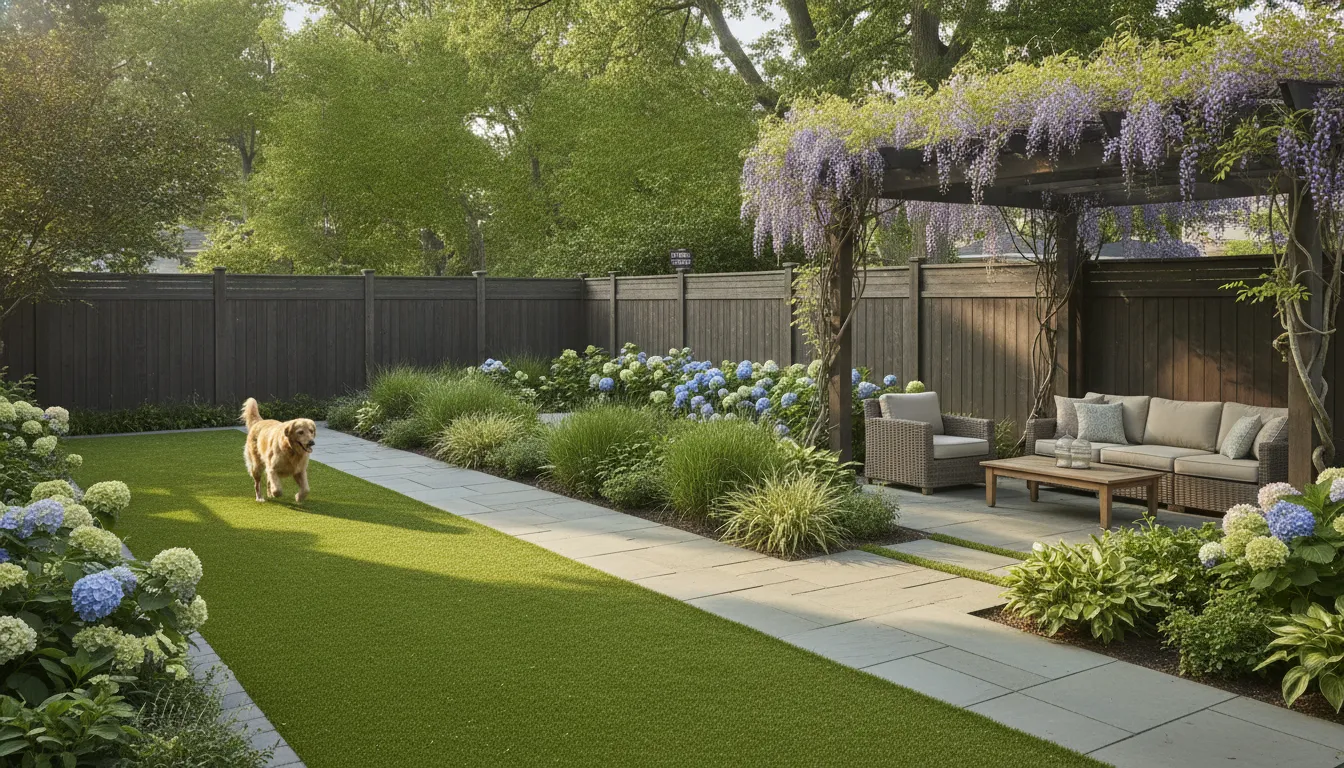
Use the comparison below as a planning framework. An isolated pet area may be appropriate for a simple, dedicated run, but an integrated design leaves more options for daily use and future landscape changes.
| Planning element | Isolated pet area | Coordinated dog-run design |
|---|---|---|
| Fencing | Uses a defined enclosure with limited relationship to other outdoor spaces. | Aligns fence runs with the yard, sightlines, planting, and service access. |
| Gates | May have one basic entry point that serves both people and pets. | Places gates where they support safe circulation, deliveries, cleaning, and access from the home. |
| Drainage | Can be treated as a small surface area without resolving nearby runoff. | Coordinates grading, the turf system, and drainage destinations so water does not collect at transitions or near foundations. |
| Transitions | Often ends abruptly at soil, concrete, or an existing lawn edge. | Uses considered edging and level changes between turf, pavers, lawn, and planting areas. |
| Planting | May leave little room for screening, shade, or separation from dogs. | Places planting where it can define the run without creating blocked sightlines, toxic-plant concerns, or hard-to-clean debris zones. |
| Patios | Requires owners to cross the yard to reach seating or entertaining areas. | Connects the run to patios with durable, cleanable walking surfaces and a deliberate route. |
| Maintenance access | May be difficult to reach with a hose, cleaning tools, or replacement materials. | Preserves practical access for rinsing, solid-waste removal, inspections, and future repairs. |
| Future use | Serves one purpose and may limit later backyard changes. | Leaves flexibility for play, seating, landscape improvements, and other household needs. |
Transitions deserve particular attention. A hard edge can help contain turf and simplify sweeping, while a paver path can keep muddy or wet feet away from the house. Planting should provide structure without dropping excessive debris into the run or narrowing the cleaning route. Shade trees, structures, or other site features can also be considered when planning summer comfort.
For a full residential layout, review Long Island dog-run installation as a construction and design project, not only a turf purchase. A site-specific plan can coordinate fencing, grading, drainage, paving, planting, and the selected pet-turf system around how the family actually uses the backyard.
What should a Long Island pet-turf plan specify?
A useful pet-turf plan should describe the conditions below the grass as clearly as the visible surface. Before choosing artificial grass for dogs, ask the installer to document how water, waste, foot traffic, fencing, and future yard improvements will be handled. This checklist can help Nassau and Suffolk County homeowners compare complete installation plans rather than isolated turf products.
- Site conditions: Record existing soil, slopes, low areas, tree roots, irrigation lines, utilities, and the proposed dog-run dimensions. The plan should identify how the area relates to the house, foundation, planting beds, patios, and neighboring properties.
- Drainage destination: Show where rainwater and liquid waste will go. The design may include grading, a permeable backing, a prepared base, an outlet, or an appropriate dispersal area. It should not simply assume that water will disappear. Confirm that the finished grade directs water away from foundations and does not create a nuisance for adjacent areas.
- Base preparation: Specify excavation depth as determined by the site, aggregate or other base materials, compaction, and the finished slope. Ground preparation and topsoil grading are important parts of performance, especially where Long Island soils hold water or the existing yard is uneven.
- Turf system: Identify the pet-specific turf product, pile characteristics, backing, infill if used, and intended application. Ask how the selected system supports drainage and routine cleaning. Avoid treating a portable potty mat and a constructed dog run as the same scope of work.
- Seams and edging: Show seam locations, fastening methods, perimeter restraint, and transitions to pavers, concrete, planting, or existing lawn. Clean edges reduce trip points and help keep the turf system in place during everyday use.
- Cleaning access: Include enough room to remove solid waste, rinse the surface, clear leaves, and inspect drains or outlets. The plan should state what routine sanitation the homeowner will perform and which cleaning products are appropriate for the selected system.
- Heat plan: Note the direction of direct summer sun and identify possible shade from structures, trees, or planned features. Water can provide temporary cooling, but homeowners should check the surface before allowing pets onto it.
- Fence and gate: Specify fence location, gate swing, latch position, privacy screening, access from the house, and clearance for maintenance. These details affect safety, convenience, and how naturally the dog run fits the backyard.
- Coordination and exclusions: Clarify responsibility for permits, utility locating, demolition, irrigation changes, fence work, drainage connections, planting, hardscape, and disposal. A coordinated plan prevents assumptions between separate trades.
- Maintenance: List expected scooping, rinsing, spot cleaning, debris removal, seam inspection, and drainage checks. Explain how persistent odor or standing water will be assessed instead of promising an odor-free result.
Gappsi Group can coordinate grading, drainage, synthetic turf integration, fencing, planting, hardscape, and 3D design as part of a broader design-build plan for homeowners across Nassau and Suffolk Counties. That approach helps the pet area work with the rest of the property, rather than becoming an isolated patch in the yard.
Contact Gappsi through our contact page
Frequently Asked Questions
Is artificial grass safe for dogs?
It can be a practical surface for a dog area when the turf, infill, base, drainage, edges, and cleaning plan are selected for the site. Safety is not determined by the blades alone. Ask what materials are included, how waste and rinse water will move, and how the surface will be managed in direct sun. The EPA notes that research on recycled tire crumb explored possible exposure routes, but its reports were not themselves a risk assessment: EPA research on recycled tire crumb.
Can dogs pee and poop on artificial grass?
Yes, but each type of waste needs a different response. In an appropriate system, urine can pass through a porous backing and into the drainage path. Solid waste remains on the surface, so it must be removed promptly and the area rinsed as appropriate for the installed system. Grading and the underlying base are part of the sanitation plan, not optional details.
How do you control dog-urine odor?
Start with a permeable system and a drainage design that does not trap moisture below the turf. Then remove solid waste, rinse routinely, and follow the system-specific cleaning guidance. Drainage, sanitation, airflow, infill choice, and routine cleaning all affect odor control. Persistent odor can indicate a drainage or sanitation problem, so it should be assessed rather than covered with a deodorizer.
What maintenance does artificial grass for dogs require?
Plan for regular waste removal, rinsing, debris clearing, and spot cleaning. Inspect seams, edging, and low areas periodically, especially after heavy rain or frequent use. Cleaning frequency depends on the number of dogs, the size of the area, weather, and the turf system. Artificial grass reduces some lawn tasks, but it is not maintenance-free.
Can fleas and ticks live in artificial grass?
Artificial grass does not provide the same soil and plant environment as a natural lawn, but it cannot guarantee complete elimination of fleas or ticks. Leaves, organic debris, shaded edges, and nearby planting can still create pest concerns. Keep the area clear, maintain the surrounding landscape, and follow your veterinarian’s guidance for pet parasite prevention. This cautious distinction is consistent with published pet-turf guidance: pet-turf pest guidance.
Ready to plan a dog-friendly backyard?
A well-planned pet-turf area can bring drainage, cleaning access, shade, and the rest of your backyard design into one practical plan. Gappsi Group can discuss the site conditions and layout for a residential pet-turf or dog-run project in Long Island.
Contact Gappsi through our contact page to discuss your project.