


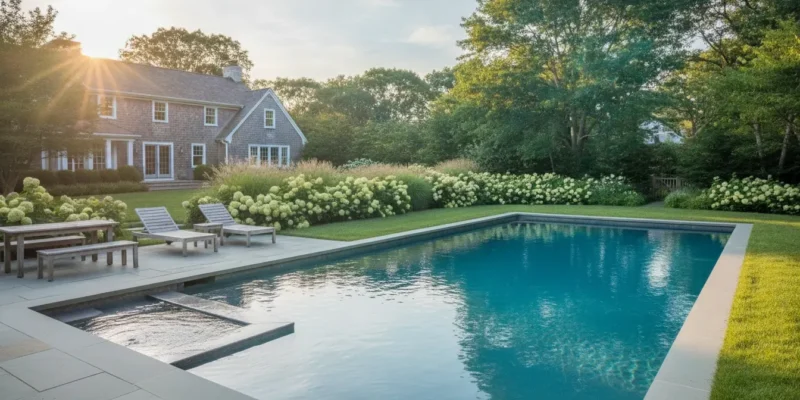
If you are asking how many gallons are in my swimming pool, you can get a useful estimate with a tape measure, a calculator, and the right formula for your pool’s shape. The most important measurements are the pool’s length, width, and water depth. A pool with a sloped bottom, steps, benches, or an irregular outline needs a few extra calculations, but the process is still manageable for a homeowner.
Contact Gappsi through our contact page
The estimate is useful for planning water treatment, choosing equipment, and understanding how much water a pool holds. This guide explains the formulas, shows worked examples, and identifies when a professional measurement is the better choice.
How Many Gallons Are in My Swimming Pool?
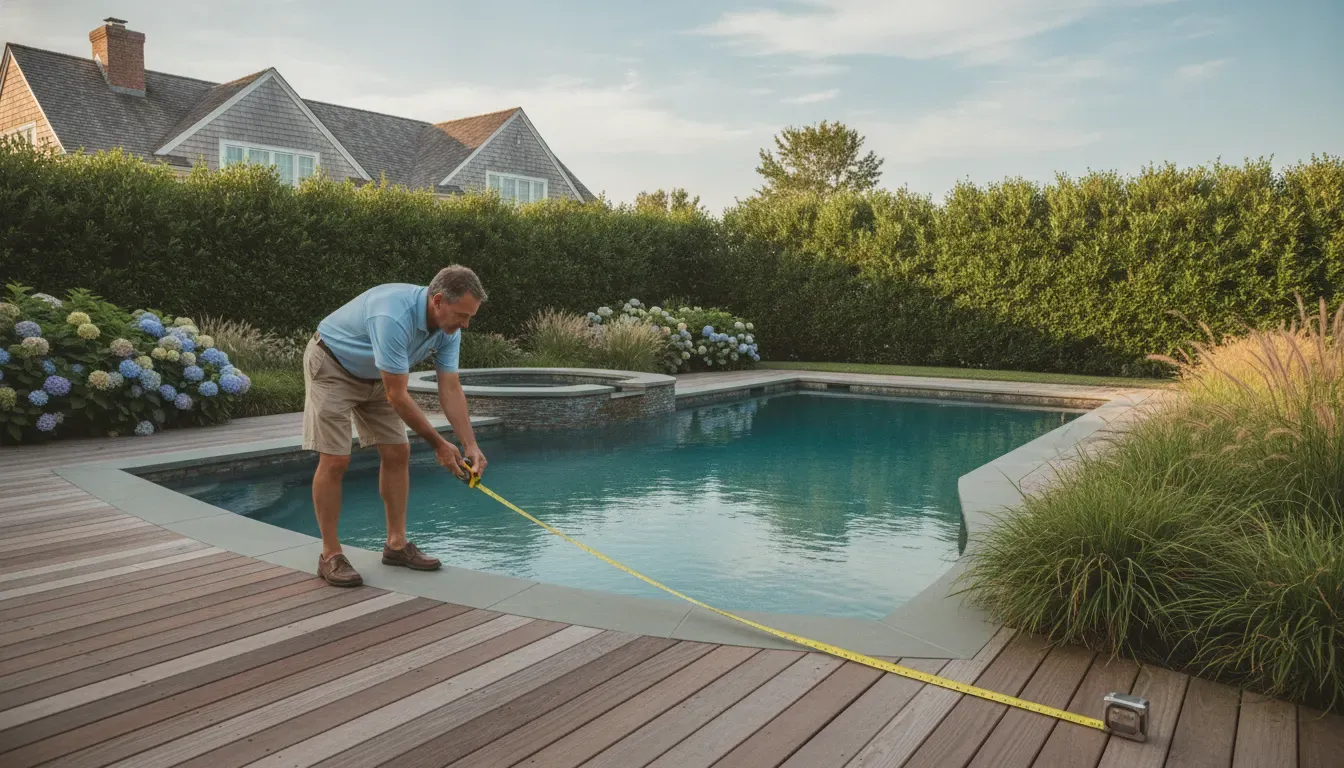
Start by measuring the water surface, not just the outside edge of the pool. Measure length and width in feet. For depth, measure the actual water depth at representative points. If the pool has one consistent depth, use that number. If the bottom slopes, calculate an average depth before multiplying.
One cubic foot of water contains approximately 7.48 gallons. For a homeowner estimate, many pool professionals use 7.5 as a convenient rounded conversion factor. The general process is:
- Measure the pool dimensions in feet.
- Determine the correct surface-area formula for the shape.
- Multiply the surface area by the average water depth.
- Multiply the cubic-foot volume by 7.48, or use 7.5 for a rounded estimate.
For example, a rectangular pool that is 30 feet long, 15 feet wide, and 5 feet deep has a volume of 30 x 15 x 5 x 7.5, or approximately 16,875 gallons. The result is an estimate because built-in steps, benches, slopes, and water level changes alter the actual capacity.
Quick pool-gallon formula reference
| Pool shape. | Measurements to use. | Formula for approximate gallons. |
|---|---|---|
| Rectangle. | Length, width, depth. | Length x width x depth x 7.5. |
| Variable-depth rectangle. | Length, width, average depth. | Length x width x average depth x 7.5. |
| Round. | Radius or diameter, average depth. | 3.14 x radius x radius x average depth x 7.5. |
| Oval. | Length, width, average depth. | Length x width x average depth x 0.785 x 7.5. |
| Irregular. | Separate section measurements. | Calculate each section, then add the totals. |
The table is a starting point for an estimate. Choose the row that best matches the water shape, then adjust for shelves, steps, benches, and connected features. When the pool is not a clean geometric shape, several smaller estimates are usually more useful than one oversized rectangle.
Contact Gappsi through our contact page
What Is the Formula for a Rectangular Pool?
A rectangular pool with a consistent depth is the simplest shape to calculate. Use this formula:
Length x width x depth x 7.5 = approximate gallons
Suppose your pool is 32 feet long, 16 feet wide, and has a uniform water depth of 5 feet. The calculation is straightforward.
- 32 x 16 = 512 square feet of surface area.
- 512 x 5 = 2,560 cubic feet of water.
- 2,560 x 7.5 = 19,200 gallons.
If your measurements include inches, convert them to decimals before calculating. Six inches equals 0.5 feet. Three inches equals 0.25 feet. Nine inches equals 0.75 feet. A length of 32 feet 6 inches becomes 32.5 feet. Using feet and decimal feet together keeps the formula consistent.
Do not measure only the deck or coping. The waterline may be inside the finished edge, and an interior ledge or step can reduce the water area. For a planning estimate, use the waterline dimensions and note any features that occupy a meaningful part of the pool.
How Do You Adjust for a Sloped or Variable-Depth Pool?
Most inground pools are not the same depth from end to end. The practical homeowner method is to find the average depth and use it in place of a single depth.
Average depth = (shallow-end depth + deep-end depth) / 2
For example, a 32-foot by 16-foot pool measures 3.5 feet at the shallow end and 7.5 feet at the deep end. Its estimated average depth is 5.5 feet. The calculation is shown below.
- 32 x 16 = 512 square feet.
- (3.5 + 7.5) / 2 = 5.5 feet average depth.
- 512 x 5.5 x 7.5 = 21,120 gallons.
This approach works best when the bottom slopes in a fairly even way. A short shallow shelf and a large deep area can make a simple average less accurate. Divide the pool into sections when the depths or shapes change significantly. Then calculate each section separately.
For a two-section pool, measure the length and average depth of the shallow section, calculate it, then repeat the process for the deep section. Add the two gallon estimates together. This takes longer than one average, but it better reflects a pool with a distinct shelf, hopper, or abrupt change in depth.
What Formula Works for Round and Oval Pools?
Round pools
For a circular pool, you need the radius, which is half the diameter. Use this formula:
3.14 x radius x radius x average depth x 7.5 = approximate gallons
If a round pool has a 20-foot diameter, its radius is 10 feet. With an average depth of 4 feet, the estimate is 3.14 x 10 x 10 x 4 x 7.5, or approximately 9,420 gallons.
If you measure the diameter but do not want to calculate the radius first, use the equivalent shortcut below.
diameter x diameter x average depth x 0.785 x 7.5 = approximate gallons.
Oval pools
An oval pool can be estimated by treating its outline as an ellipse. Use the formula below.
length x width x average depth x 0.785 x 7.5 = approximate gallons.
For an oval pool that is 30 feet long, 15 feet wide, and 4.5 feet deep on average, multiply the dimensions in sequence. The result is approximately 11,927 gallons. This is a planning number, not a replacement for a measured capacity from the pool manufacturer or builder.
How Can You Estimate an Irregular Pool?
Freeform, kidney-shaped, L-shaped, and other irregular pools do not fit one simple rectangle. The most reliable homeowner method is to break the pool into two or more familiar shapes.
- Sketch the pool from above and mark the waterline measurements.
- Divide the outline into rectangles, circles, triangles, or oval-like sections.
- Measure the depth of each section, including a shallow and deep measurement when needed.
- Calculate the gallons for each section using its own average depth.
- Add the section estimates together.
For a kidney-shaped pool, you might divide the outline into two overlapping ovals or into a rectangle plus two rounded ends. For an L-shaped pool, calculate each rectangular leg separately. Avoid double-counting the area where two sections overlap. The sketch does not need to be architectural, but it should show exactly which dimensions belong to each section.
A pool with a spa connected by a spillway should also be treated as separate volumes unless you are deliberately estimating the combined system. Measure the spa, steps, tanning ledge, and main basin as separate areas when those features are large enough to affect chemical dosing or equipment sizing.
Why Does Pool Volume Matter?
Knowing the approximate gallon capacity helps you make better decisions about water care and pool equipment. Chemical labels use water volume to establish treatment amounts. If the estimate is far too low, a homeowner may underdose a treatment. If it is too high, the homeowner may use more product than needed. Always follow the product label and ask a pool professional when the volume is uncertain.
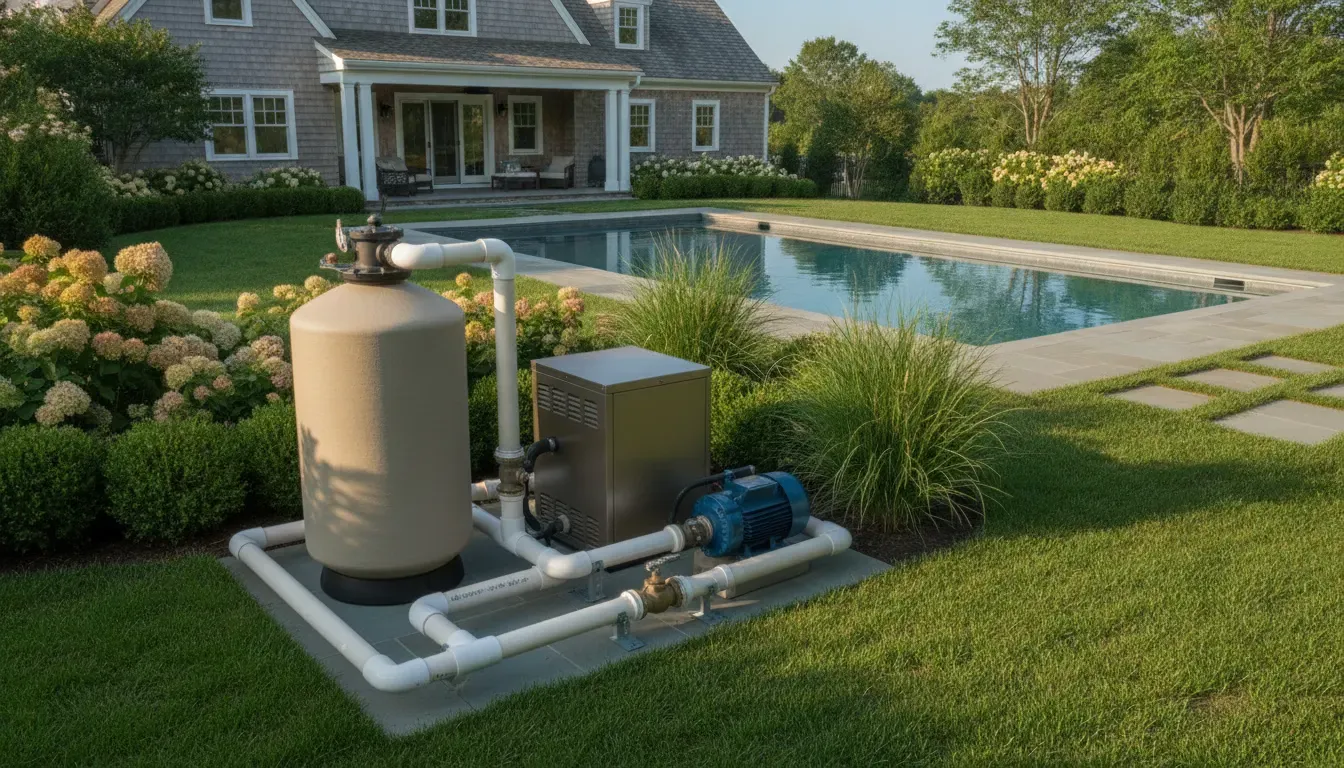
Volume also helps inform the selection of pumps, filters, heaters, salt systems, cleaners, and automation. Capacity is not the only sizing factor. Plumbing layout, turnover goals, available utilities, pool usage, and the desired swimming season matter too. Gappsi’s pool equipment guide explains why circulation, filtration, sanitation, heating, and controls need to be planned as one system.
A reliable volume estimate is especially useful when you are comparing a pool renovation with a new build. A design team can account for the basin, steps, benches, tanning ledges, water features, and the equipment pad before the project begins. Gappsi designs and builds custom swimming pools on Long Island, including gunite, vinyl liner, and fiberglass options.
How Should You Use the Estimate for Pool Care?
Use the gallon estimate as a working number, then keep a record with your pool equipment paperwork. Write down the dimensions, the average-depth method, and any features that were excluded. This makes future maintenance conversations easier and helps you recognize when a treatment or equipment recommendation does not match the pool’s actual size.
Volume is also useful when a pool is drained and refilled. A fill estimate can help you plan water delivery, hose time, and startup steps. The actual fill level will vary with evaporation, splash-out, and the amount of water held by connected features. Do not use a rough calculation to override a product label or a technician’s instructions.
- Save the estimated gallons with your pool records.
- Update the estimate after adding a spa, shelf, or water feature.
- Use the same unit system each time you recalculate.
- Ask for a measured volume before a major correction or redesign.
What Should Homeowners Check Before Using the Estimate?
Before using your result for a chemical treatment or equipment decision, review the measurements and the assumptions behind them. A short checklist can prevent a small measurement error from becoming an expensive correction.
- Measure the water surface rather than the exterior deck.
- Use actual water depth, not the height of the pool wall.
- Use average depth for a sloped bottom.
- Account for steps, shelves, benches, spas, and large water features.
- Break irregular shapes into sections instead of forcing one rectangle.
- Keep feet and decimal feet consistent throughout the formula.
- Use the estimate as a starting point and follow chemical-label instructions.
For seasonal planning, pair the volume estimate with Gappsi’s pool opening guide. Homeowners evaluating convenience features can also review the pool automation guide and pool heater guide. These decisions work best when they are made from the pool’s actual dimensions and the way your household plans to use the space.
When Should You Get a Professional Pool Measurement?
A homeowner calculation is appropriate for a quick estimate, but professional measurement is the safer choice when the number will guide construction, major chemical correction, equipment replacement, or a renovation. Ask for help when the pool has an irregular outline, multiple depth transitions, a large tanning ledge, connected spa, deep hopper, or several built-in features.
Professional planning can also confirm whether the existing pump, filter, heater, and sanitation system match the pool volume and plumbing. A measured design is particularly important before changing the pool shape or adding a feature that changes the water capacity.
Gappsi serves homeowners across Nassau and Suffolk County with pool design, construction, and related outdoor living planning. Use the Gappsi contact page to request a consultation about a new pool, renovation, or equipment plan.
Contact Gappsi through our contact page
Frequently Asked Questions
How many gallons are in a 16 x 32 swimming pool?
The answer depends on depth. At a consistent 5-foot depth, a 16 x 32 pool holds approximately 19,200 gallons using the 7.5-gallon conversion. A pool with a sloped bottom should use its average depth instead.
How many gallons are in a 20 x 40 pool?
At a consistent 5-foot depth, a 20 x 40 rectangular pool holds approximately 30,000 gallons. If the shallow end is 3 feet and the deep end is 7 feet with an even slope, the 5-foot average produces the same estimate. Steps and ledges can lower the actual capacity.
How do I calculate gallons when my pool depth changes?
Add the shallow and deep water depths, divide by two, and use that average in the normal shape formula. If the bottom changes abruptly or the pool has several sections, calculate each section separately and add the results.
Is 7.5 the exact number of gallons in a cubic foot?
No. One cubic foot contains approximately 7.48 US gallons. Using 7.5 makes homeowner calculations faster and is usually close enough for an initial estimate. Use a more exact calculation or a professional measurement when precision matters.