


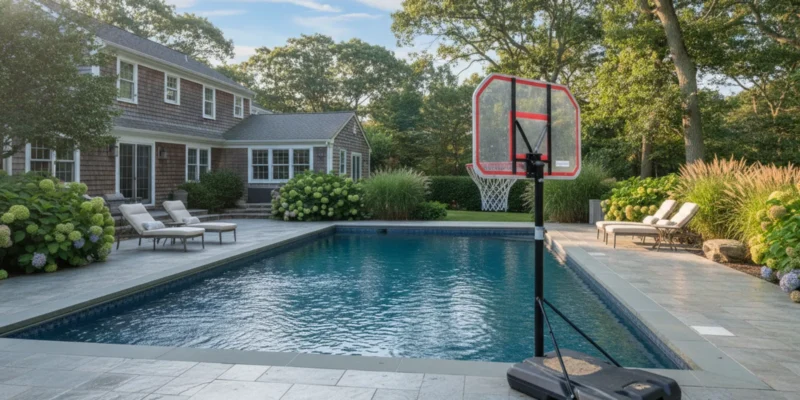
Choosing the best pool basketball hoop means balancing stability, fit, and how people will use the pool. A hoop should make play convenient without crowding the deck, obstructing circulation, or creating an avoidable hazard. Start by comparing the mounting style, available space, poolside surface, and the ages and habits of the swimmers who will use it.
Contact Gappsi through our contact page
Posted by Gappsi Group
What makes the best pool basketball hoop for your yard?
There is no single model that suits every pool. The right choice depends on the deck layout, how often the hoop will be used, and whether you want to move it or leave it in place. A portable unit offers flexibility, while a fixed installation can keep the playing position consistent. Either way, the hoop needs a stable base or properly planned anchoring, outdoor-suitable materials, and enough clearance for safe movement.
Think about the entire activity area rather than judging the hoop by the backboard alone. Players need room to approach, turn, and retrieve a ball. Other swimmers need an unobstructed path around the pool. Check where the hoop, ball, and players will be in relation to steps, ladders, gates, loungers, furniture, and changes in deck level.
- For occasional play: A portable hoop may suit a household that wants to move equipment when the pool is not in use.
- For regular play: A fixed mount can keep the hoop from shifting, but it requires careful placement and an appropriate installation plan.
- For a small deck: Prioritize clear routes and compact placement over a large playing footprint.
- For shared family use: Consider adjustability and whether the equipment can be secured or removed when not in use.
Which pool basketball hoop mounting style should you compare?
Most choices fall into three broad categories: portable weighted bases, deck-mounted systems, and permanently installed supports. Product designs vary, so check the manufacturer instructions for each model rather than assuming that all hoops in a category install the same way.
| Mounting style | What to consider | Best fit to investigate | Questions to ask |
|---|---|---|---|
| Portable weighted base | Footprint, base stability, moving and storage | Households wanting a movable setup | How is the base filled and maintained? Can it be moved without dragging? |
| Deck-mounted | Deck material, anchor design, location, and installation details | Owners seeking a set playing position | Is the surface appropriate for the mounting method? |
| In-ground or fixed support | Foundation, excavation, utilities, drainage, and future access | Projects where a permanent position is practical | What preparation is needed, and how will the work coordinate with the pool? |
A portable base is not automatically safer simply because it avoids drilling. Its mass, wheel system, and placement matter, and a loose or poorly maintained unit can move. A fixed model is not automatically the right answer either. It may require drilling, excavation, or coordination with the pool deck, so confirm installation requirements before selecting a product.
How should you plan pool basketball hoop placement?
Map the proposed location before buying. Measure the available deck and mark the hoop footprint, including any base, supports, or projecting hardware. Then check approach and walking areas. Do not place equipment where it blocks a gate, pool ladder, emergency access route, or the normal path between the house and pool.
- Identify the play direction. Decide where players will stand and move, and where a missed shot may travel.
- Mark circulation routes. Keep a clear route around the pool, including access to steps and exits.
- Check the surface. Look for slopes, loose pavers, joints, drains, and uneven transitions that could affect a base or anchor.
- Review nearby obstacles. Consider trees, roof edges, fences, lighting, and windows that may be exposed to stray balls.
- Confirm product dimensions. Include the base and support, not just the backboard and rim.
- Test the layout. Use temporary markers to visualize the footprint and walking space before installation.
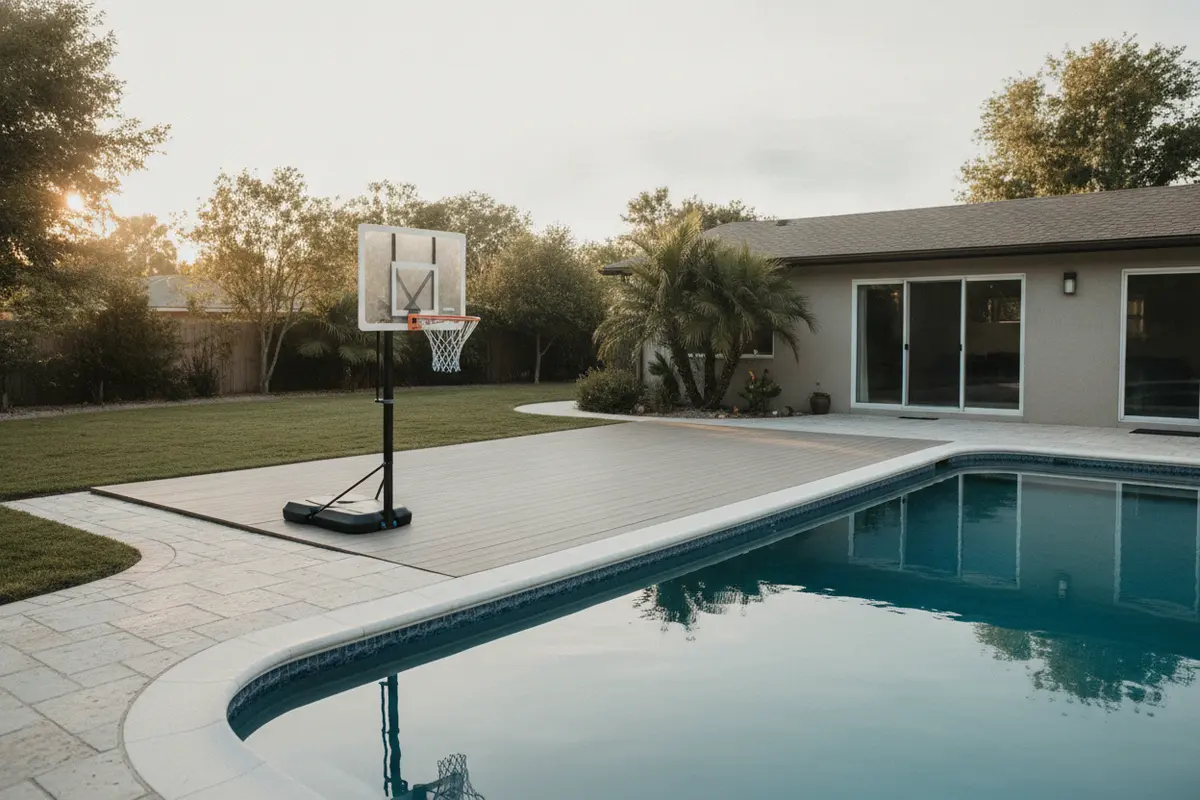
Keep play and circulation in mind at the same time. A position that looks open from indoors may narrow the deck near a ladder or furniture. If the area is already tight, a movable unit needs a defined storage spot. Review Gappsi’s swimming pool project gallery for examples of pool settings and consider how paving and equipment occupy the same space.
What materials and construction details matter?
Poolside equipment is exposed to sun, water, and repeated handling. Examine the product’s stated materials and care instructions. Look for components intended for outdoor exposure, corrosion-resistant hardware where specified, a backboard and rim suited to the intended level of play, and a base or mounting system that matches the installation surface.
Inspect practical details as well. Are edges smooth? Can the unit be adjusted without tools? Is the adjustment mechanism accessible? Does the manufacturer specify a fill material or weight for the base? Can the unit be covered or stored as directed? These questions help distinguish a hoop that fits your routine from one that becomes difficult to maintain.
- Read assembly and anchoring instructions before purchase.
- Confirm whether the product is designed for poolside use and what maintenance it requires.
- Check whether replacement parts are available from the manufacturer.
- Follow stated fill, ballast, and stability requirements; do not improvise weights.
- Inspect fasteners and moving parts periodically, especially after weather or frequent use.
Compare hoop height adjustment, backboard size, and rim construction according to who will play. A larger or more adjustable unit is not always the better fit. A simpler system may be easier to place and maintain, while frequent play may justify a more substantial design if the deck can accommodate it.
How do you compare the best pool basketball hoop choices?
Use a consistent comparison rather than relying on appearance or one product feature. Record the dimensions, mounting method, setup requirements, storage plan, and warranty terms for each option. Then compare those facts against the actual pool layout.
| Decision point | Portable hoop | Fixed hoop |
|---|---|---|
| Can the position change? | Usually movable, subject to base design and safe handling | Generally remains in one location |
| What space is needed? | Base footprint plus room to maneuver and store | Clearance around the installed support and play area |
| What installation is involved? | Assembly and correct ballast or filling per instructions | May require anchors, surface preparation, or foundation work |
| What should be verified? | Base stability, wheels, fill, and storage | Deck suitability, attachment, drainage, and service access |
Do not compare price alone. A less expensive unit may not suit the deck or desired play pattern, while permanent work can add planning considerations beyond the hoop itself. Request the full installation scope where professional work is involved, including surface preparation, access, drainage, and how the area will be left after the work.
What should a real-world placement check look like?
Imagine a family with a narrow pool deck, a ladder on one end, and outdoor seating near the house. A large portable base placed beside the ladder may provide a convenient shot but create a bottleneck. Moving it toward the seating could interfere with chairs and the path to the house. In this case, the decision is not simply portable versus fixed. The family should mark both footprints, identify a storage location, and consider whether a smaller fixed position preserves a better route.
Now consider a larger backyard renovation where the pool, paving, fencing, and lighting are being planned together. The hoop location can be reviewed before final surfaces are installed. The design team can account for the support, drainage, ball travel, and access rather than drilling into a finished area without reviewing what is below it. This kind of sequencing helps prevent a recreation feature from conflicting with the rest of the outdoor plan.
A third example is a household that uses the pool occasionally but wants open deck space for gatherings. A removable unit may be useful only if adults have a safe way to move it and a dry storage location. If the base is too heavy to handle comfortably, the theoretical flexibility may not be practical. Write down who will move the equipment and when before treating portability as a benefit.
Contact Gappsi through our contact page to review your pool and deck layout
What safety checks should happen before play?
A pool basketball hoop does not replace active adult supervision or other pool safety measures. Set household rules that suit the swimmers, follow the product instructions, and stop play if the equipment is unstable or the deck is wet and slippery. The U.S. Consumer Product Safety Commission pool safety guidance offers general information for families planning pool use.
Before each use, check that the base is stable or the fixed mount is secure. Confirm that the deck around the hoop is clear of toys, cords, and furniture. Keep the hoop away from access points, and ensure that users do not climb on the support or hang from the rim. Establish rules about pushing, diving near the equipment, and retrieving a ball from the water.
Pay attention to the deck, too. Water, algae, debris, and uneven paving can make movement less predictable. If the unit shifts, rattles, leans, or has exposed hardware, take it out of use and address the issue according to the manufacturer’s guidance.
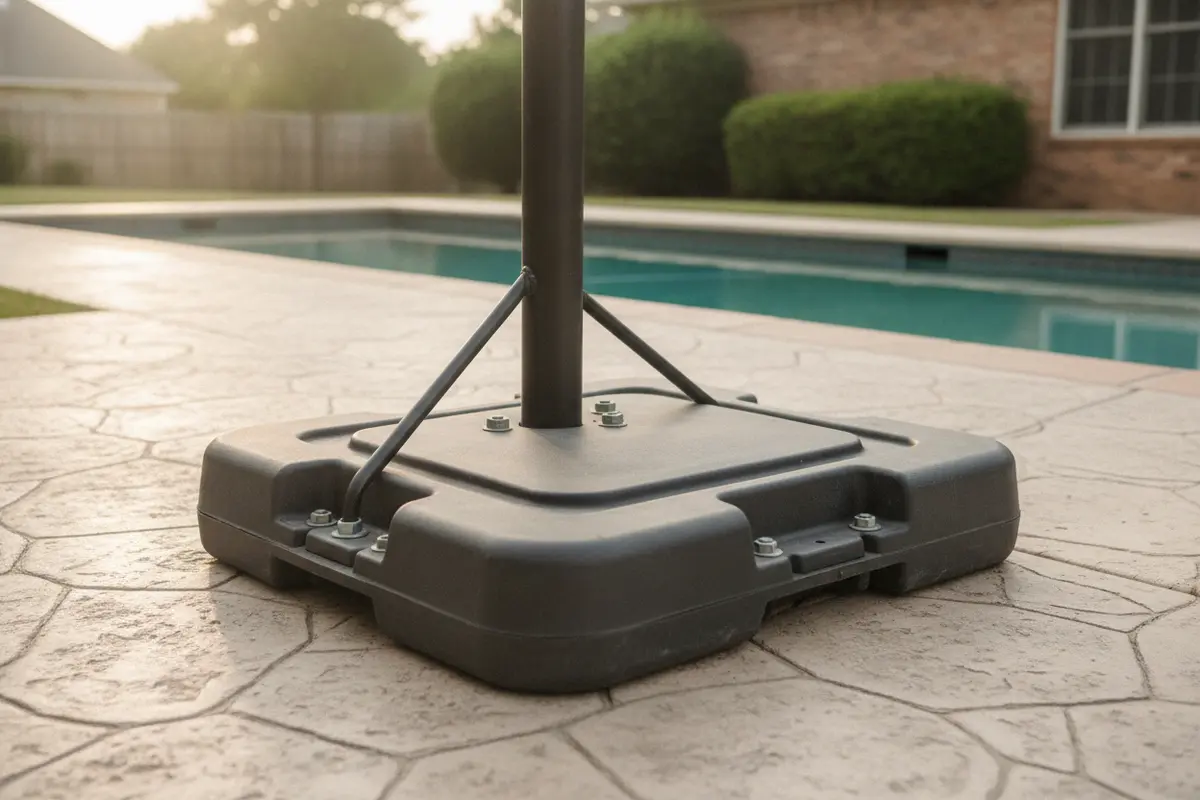
When does installation need a pool or hardscape professional?
Professional input is worth considering when the proposed support must attach to existing paving, when the deck is cracked or uneven, or when excavation and drainage may be involved. The goal is to avoid choosing a mounting approach that conflicts with the pool structure, utilities, coping, or deck construction. A review can also help coordinate the hoop location with paving, fencing, lighting, and circulation.
Bring measurements and product information to a project discussion. Note the pool dimensions, deck material, access points, proposed hoop model, and known utility or drainage locations. Photos from several angles can make the layout easier to discuss. Gappsi offers outdoor pool and hardscape planning. Explore the backyard project examples and stone and porcelain surfaces when considering how materials and recreation equipment share a space.
Related planning may include landscape layouts, fencing, or a broader custom swimming pool project. These are starting points; the right scope depends on the property, existing construction, and product requirements.
What should you ask before choosing a hoop?
Use these questions to avoid surprises:
- What exact footprint does the assembled hoop require?
- What surface and clearances does the manufacturer require?
- How is the unit stabilized, and what inspection or maintenance is needed?
- Can it be moved or stored safely when it is not being used?
- Will installation affect the pool deck, drainage, utilities, or access?
- What household rules will keep play away from ladders, gates, and other swimmers?
- Who will complete surface preparation, anchoring, assembly, and cleanup?
- What happens to the location if the pool deck is renovated later?
If installation is part of a larger backyard project, decide the hoop location before finalizing paving and circulation. Moving a fixed support later may require additional work. The pool category and masonry project archive provide useful starting points for a site-specific discussion.
Contact Gappsi through our contact page before planning the installation
Frequently Asked Questions
Can I use a portable basketball hoop beside any pool?
No. Check the unit’s instructions, footprint, base stability, and available deck space. The base must not block circulation or pool access, and the surface must suit the product.
Is a fixed pool basketball hoop safer than a portable one?
Not automatically. Each type needs correct installation and a suitable location. A portable base must be stable as instructed, while a fixed system must be attached to an appropriate surface and maintained.
How far from the pool should the hoop go?
There is no single distance for every pool or product. Follow the manufacturer’s clearance requirements and leave clear routes to steps, ladders, gates, and exits. Consider where players and missed shots may travel.
Can a hoop be anchored to existing pavers?
That depends on the paving, base beneath it, anchor design, and product instructions. Do not assume that pavers alone provide an adequate attachment. Have the surface and installation method assessed before drilling or anchoring.
Should a portable hoop stay outside all season?
Follow the manufacturer’s storage and weather instructions. If the unit is moved, plan a dry storage location and use the stated handling method rather than dragging or improvising support.
Ready to plan your poolside setup?
Contact Gappsi through our contact page
The best choice is the one that fits your pool, deck, and household rules without compromising clear access, so measure first and verify product requirements before installation.