


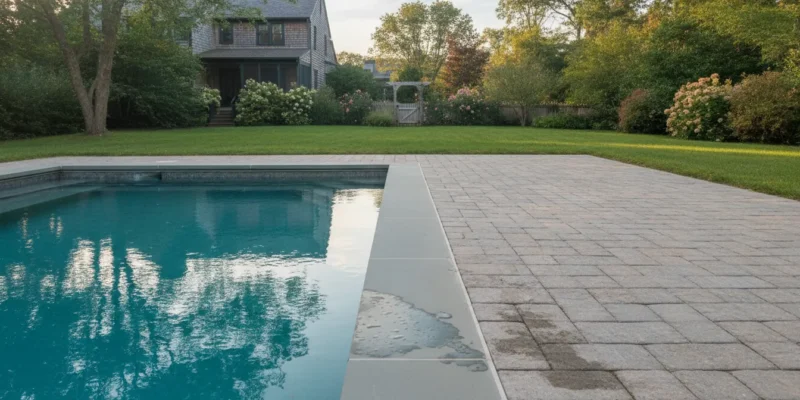
A loose stone at the waterline is easy to step over until it rocks under a wet foot. Pool deck coping repair Long Island homeowners ask about usually starts there: one cracked unit, a hollow sound, or a joint that has opened after winter. The coping is the cap on the pool’s bond beam, not the walking surface of the deck. Fixing the right piece, and leaving the sound pieces alone, is the whole decision.
Contact Gappsi through our contact page
Posted by Gappsi Group
What does pool deck coping repair on Long Island actually fix?
Pool coping is the finished cap set on the concrete bond beam at the top of the pool wall. It covers that structural edge, gives swimmers a place to grip, and sheds splash water toward the deck. A repair puts damaged units, failed mortar, and open joints back into service. It does not rebuild the patio, and it does not resurface the pool interior.
On a Nassau or Suffolk County pool, the usual repair targets are easy to name:
- One or a few cracked or spalled coping units while the rest of the line still sits tight.
- Hollow or rocking pieces where the mortar bond has let go, but the concrete under them is still sound.
- Open mortar joints or a failed sealant line between the coping and the deck.
- A short run that has shifted, while the rest of the perimeter still lines up.
The deck field is a different assembly. A sunken paver, a wide patio crack, or water sitting in the walking surface belongs with pool deck repair, not the coping cap. A full interior remodel is a separate scope. Plaster and waterline tile sit in Gappsi’s gunite pool renovation guide.
Before anyone prices a reset, the edge has to be read in place. A tap with a plastic mallet tells you which units are bonded and which are only sitting there. A straightedge along the top shows tilt that a photo will hide.
Why does pool coping crack or come loose after a Long Island winter?
Coping rarely fails for one reason. Water, freeze-thaw, and small movement work together. A hairline joint lets splash in. A cold night turns that water to ice. The next summer the unit sounds hollow, and the joint beside it is wider than it was in May.
Freeze-thaw is the local driver. Long Island winters cycle above and below freezing often enough to stress any joint that holds water. The same exposure is why material choice matters on a new edge, which is the subject of Gappsi’s pool coping materials guide. A repair article can only say this: a unit that already holds water will keep moving until the path for water is closed.
Other causes show up on the same walk:
- Mortar that has powdered or washed out, so the stone is no longer stuck to the beam.
- A rigid joint where the coping meets the deck. That line has to move. If it was hard-grouted, the deck and the beam fight each other.
- Deck settlement that lifts one side of a coping unit and leaves the pool side low.
- Impact from a ladder, a cover reel, or a heavy cleaner dropped on a corner.
- Age. Sun, pool chemistry at the waterline, and decades of wet-dry cycles break the face of softer stone even when the set is still firm.
B&D Pools describes the same pattern in a cracked coping repair guide: small cracks widen, mortar weakens, and once one section moves, the pieces beside it often follow. Their climate is Maryland, not Long Island, but the mechanism matches what Nassau and Suffolk pools see every March.
How can you tell a coping repair from a problem in the deck or the shell?
Stand at the waterline and separate three layers. The coping is the cap. The deck is the field you walk on. The shell is the pool wall and floor under the water. A good repair plan names which layer is actually failing.
Use a short field check before you approve any work:
- Tap each suspect unit. A tight ring means the bond is still there. A hollow thud means the mortar has let go, even if the stone looks fine from above.
- Rock the piece with your foot. Movement you can feel is a loose set. A crack with no movement may still be a surface break only.
- Look at the joint between coping and deck. A torn sealant line or a hard grout joint that has sheared is a movement problem, not a stone problem.
- Check the deck just outside that joint. If pavers have dropped or water sits against the coping, the base or the slope may be the real job. That is deck work.
- Look below the waterline. A crack that continues from the coping down through the waterline tile and into the plaster is no longer an edge repair. That is shell work.
- Sight down the perimeter. One low corner is local. A long wave, or several areas that have dropped together, points past a patch.
Pool Installer Authority notes that coping caps the bond beam, sheds splash, and leaves a graspable edge. A typical overhang is about three-quarters of an inch to an inch and a half past the pool wall. Their coping and tile installation overview also treats the coping-to-deck joint as a movement joint. That joint gets backer rod and sealant, not hard grout. If it never had room to move, a new stone on the same detail will crack again.
Contact Gappsi through our contact page to have the edge, the joint, and the beam read together.
When is a localized pool coping repair enough?
Repair is the right scope when the damage is limited and the concrete under the coping is still solid. The goal is to put the failed pieces back, close the water path, and leave the sound run alone.
A localized repair is usually enough when:
- Only one or two units are cracked, and neighbors do not rock.
- The hollow area is a short run, not most of one side.
- The bond beam under the loose pieces is hard, uncracked, and free of exposed steel.
- The deck elevation still meets the coping, so you are not shimming a stone to hide a settled patio.
- You can still match the profile. Bullnose, pressed edge, and a flat paver cap are not interchangeable if the rest of the pool keeps the old shape.
The work itself is straightforward, and it is not a weekend pry-bar job. Sound units stay. Failed units come off only after the sealant and mortar joints are cut, so the beam is not torn up with them. The top of the beam is cleaned to bare, sound concrete. New or salvaged pieces go back in a wet-rated mortar bed, lined up for height, overhang, and pitch so splash leaves the pool. Joints between stones are filled to match the existing line. The joint against the deck gets backer rod and a flexible sealant, not a hard grout bridge.
If the removed stone is still whole, it can often go back. A cracked face, a lost bullnose, or a piece that shattered on the way up needs a match. Natural bluestone, travertine, and precast concrete each have their own thickness and edge. Forcing a near match onto one corner is what makes a repair look like a patch. When the old profile is no longer made, replacing a longer run on that side is often cleaner than a single odd stone.
When should damaged coping be replaced instead of reset?
Replacement is the better scope when the edge has stopped acting as one system. Patching the worst stone leaves the next hollow unit to fail next winter.
Plan on replacement, of a side or of the full perimeter, when:
- Many units rock, or the same spot reopens after an earlier patch.
- Mortar has failed along a long run, not in one joint.
- Removal shows spalls, soft concrete, or exposed steel in the bond beam. New stone cannot bond to that.
- The line is wavy or tipped toward the water along more than a short section.
- The material itself is breaking down: deep scaling, lost edges, or a profile you no longer want once the pool is being updated.
| What you see | Lean toward repair | Lean toward replacement |
|---|---|---|
| Cracked units | One or two, with tight neighbors. | Cracks repeating down a side. |
| Sound when tapped | Most units still ring tight. | Long hollow stretches. |
| Mortar and joints | A few open joints. | Powdered mortar along the run. |
| Bond beam | Hard and intact once stone is off. | Spalling, cracks, or exposed steel. |
| Deck joint | Sealant can be cut out and replaced. | Deck has dropped or heaved against the edge. |
| Match | Same profile is still available. | Profile is gone, or several sizes are mixed. |
Citadel Stone’s coping replacement notes put a practical sequence on full replacement: cut the sealant before any prying, work in short sections, and do not set new stone until the beam is clean and dry. They also separate material cost from removal, labor, and beam repair, which is the right way to read an estimate. A number that is only the stone price will not survive the first hour of demolition.
Gappsi does not publish a per-foot rate for this repair, and a national supplier range is not a Long Island bid. The honest cost drivers are how many feet come off, whether the beam needs patching, how hard the old mortar is to remove, and whether corners and curves have to be cut. Ask for those lines on the quote. If the interior finish, the waterline tile, and the coping are all failing together, price that as one renovation rather than three small patches. The older Gappsi field note on gunite pool renovation in Nassau County is the right companion when the shell, not just the cap, is in the scope.
How should the repair be detailed so it survives the next winter?
The stone you see is only half the repair. The details under and beside it decide whether the edge is quiet next spring.
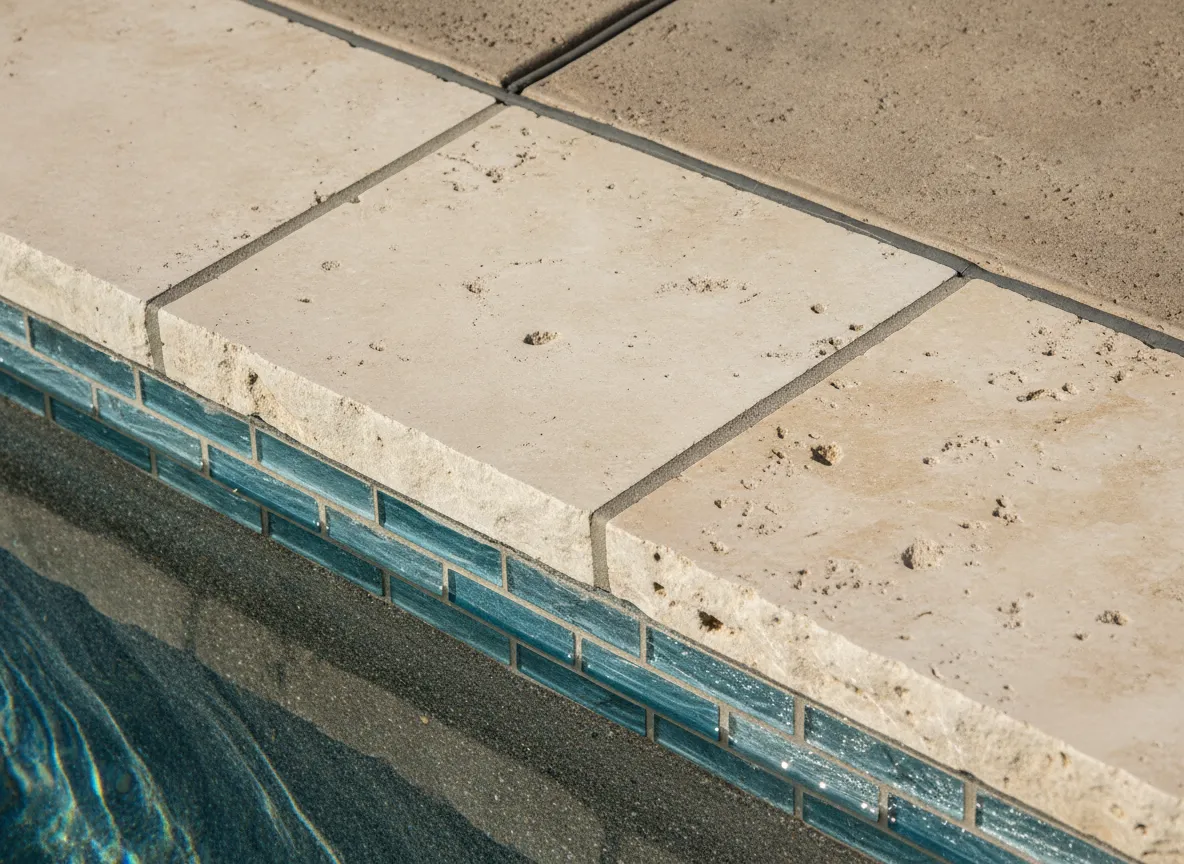
Bond-beam prep. Old mortar has to come off. High spots get ground down so the new bed is even. Any spall is patched and cured before stone goes down. Setting over dust, paint, or damp weak concrete is why a reset sounds hollow again in a year.
Pitch and overhang. The top should send water off the pool, not back into the wall. Overhang should match the pieces you are keeping, so the finger grip and the shadow line stay consistent. A new stone set proud of its neighbors becomes a toe catch.
The deck joint. Leave a movement joint. Backer rod sets the sealant depth, and the sealant stays flexible. Hard grout across that line is a repeat crack waiting for February. Where the 2024 International Swimming Pool and Spa Code is adopted, residential travertine and brick-set pavers need slope. Fielder Pools cites at least one-eighth inch per foot, with a steeper public minimum. Their deck drainage notes cover the walking surface. The lesson for coping is the same. Water has to leave the edge. A coping reset will not fix a deck that ponds against it.
Material care after the set. Natural stone and concrete caps often need a penetrating sealer once the mortar has cured. Porcelain does not take the same sealer plan. Gappsi’s notes on pool coping and patio sealing and on stone and paver cleaning and sealing cover that maintenance step. Do not seal a joint that is still damp, and do not use the sealer to hide a loose set.
If you are changing material rather than matching it, decide that before demolition. A switch to porcelain or a different stone thickness changes the bed depth and the way the deck meets the edge. That choice is a materials decision, covered for natural stone in the natural stone pool coping guide and for porcelain in the porcelain coping tile guide. A repair that quietly becomes a full material change should be priced as replacement.
What should you ask before approving pool deck coping repair?
A clear quote is a scope, not a single price. Walk the edge with the estimator and write down what stays.
- Which units come off, and which stay? Mark them. “Repair as needed” with no count is how a small reset becomes a full side.
- What happens if the beam is soft once the first stone is up? You want a unit price or a stop-and-talk rule, not a surprise change order.
- How will height and overhang match the pieces that remain?
- What goes in the deck joint? The answer should include backer rod and flexible sealant.
- Who cuts the waterline if tile has to come out with the coping? Tile work is not free just because the stone is already off.
- How long before the pool can be used, and what cure time the mortar and sealant need in cool weather?
- Is the deck in the same contract? If pavers against the edge have to be lifted to rebuild the joint, say so. Otherwise you will have a new cap beside a low patio.
Gappsi builds and remodels gunite and vinyl pools across Nassau and Suffolk Counties, and sets natural stone and porcelain at the waterline as part of that work. See the Long Island swimming pool services page for the build and remodel scope, and the porcelain and natural stone pavers page for the materials used on edges and decks. Hiring a marble specialist is its own question, answered in the marble coping installer guide. This page stays on the damaged edge you already have.
Bring photos of the hollow spots, any crack that continues under the waterline, and a note about whether the deck ponds after rain. That is enough to tell a reset from a replacement before anyone orders stone.
Contact Gappsi through our contact page
Frequently Asked Questions
Can one cracked pool coping stone be replaced by itself?
Yes, when the neighbors are tight, the bond beam is sound, and the same profile is still available. If the pieces on either side also rock, replacing one stone only moves the failure to the next joint.
Does a hollow sound always mean the coping must be replaced?
No. A hollow tap means that unit is no longer bonded. If the concrete under it is solid, the piece can often be reset. Replacement is for long hollow runs or a beam that is breaking down.
Should pool deck coping repair wait until spring on Long Island?
Open joints and loose stones should be looked at before another freeze. Setting mortar and sealant still need temperatures the product allows, so the work may be scheduled for a mild stretch rather than the coldest week.
Will new coping fix a pool deck that holds water?
No. Coping sheds water off the beam. Standing water on the patio is a deck slope or base problem. Repairing the cap and leaving the pond does not stop the next winter’s damage.
Can coping be repaired during a gunite resurfacing?
It can, and it often should be, because the waterline tile and the cap come off together more cleanly than in two separate jobs. If the plaster and tile are still sound, the coping can be repaired on its own.
Ready to plan a pool coping repair?
A short site look separates a few loose stones from a beam, a deck, or a shell that needs more than a patch. Gappsi can walk the edge with you and say which scope fits.