


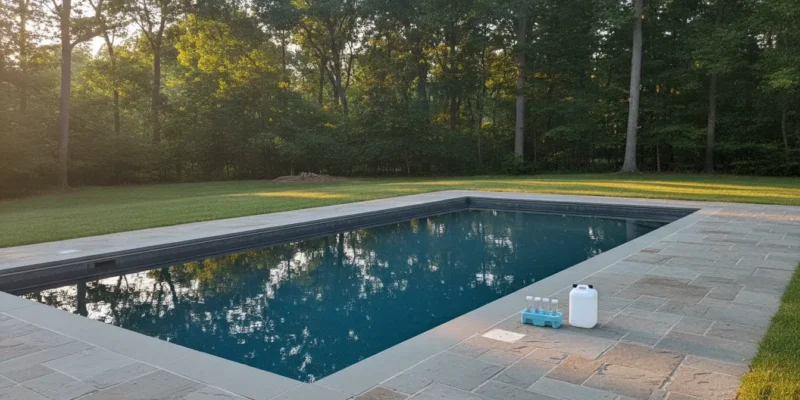
If you are asking how do you lower pH in swimming pool water, start with a fresh test, not a guess. The Centers for Disease Control and Prevention says home-pool pH should sit between 7.0 and 7.8, and that a reading outside that band can weaken chlorine or bromine, irritate skin and eyes, and stress equipment. On a Long Island gunite, vinyl, or fiberglass pool, the usual fix is a measured dose of muriatic acid or dry acid, added with the pump running, then a retest. Do not chase the number in one pour.
Get swimming pool guidance from Gappsi
Posted by Gappsi Group. We design and build custom gunite, vinyl liner, and fiberglass pools across Nassau and Suffolk County, and we talk with homeowners about equipment when a water reading will not stay put. This guide is the homeowner sequence for a high reading. It is not a dose chart for your pool, and it is not a service call.
What Does a High Pool pH Reading Mean?
pH is a scale from 0 to 14. Pool water near 7 is neutral. A higher number is more alkaline. The CDC pool-health guidance asks owners to check disinfectant and pH at least twice a day when the pool is in heavy use. Chlorine in the typical 1 to 4 ppm band, or bromine in the typical 3 to 8 ppm band, does its job better when pH is in range.
A high reading often shows up before the test strip does. Water looks dull. Chlorine drops faster than usual. Swimmers notice dry skin or red eyes. A pale film can form on tile or on a plaster finish. Those signs are a reason to test, not a reason to dump acid.
High pH is common, not mysterious. Fresh fill water on Long Island is often alkaline. Warm weather drives carbon dioxide out of the water and the number climbs. A salt chlorine generator tends to push pH up while it makes chlorine. A waterfall, spa spillover, or strong return jet does the same thing by aerating the water. Adding bicarbonate, stabilizer, or a calcium product can lift it too.
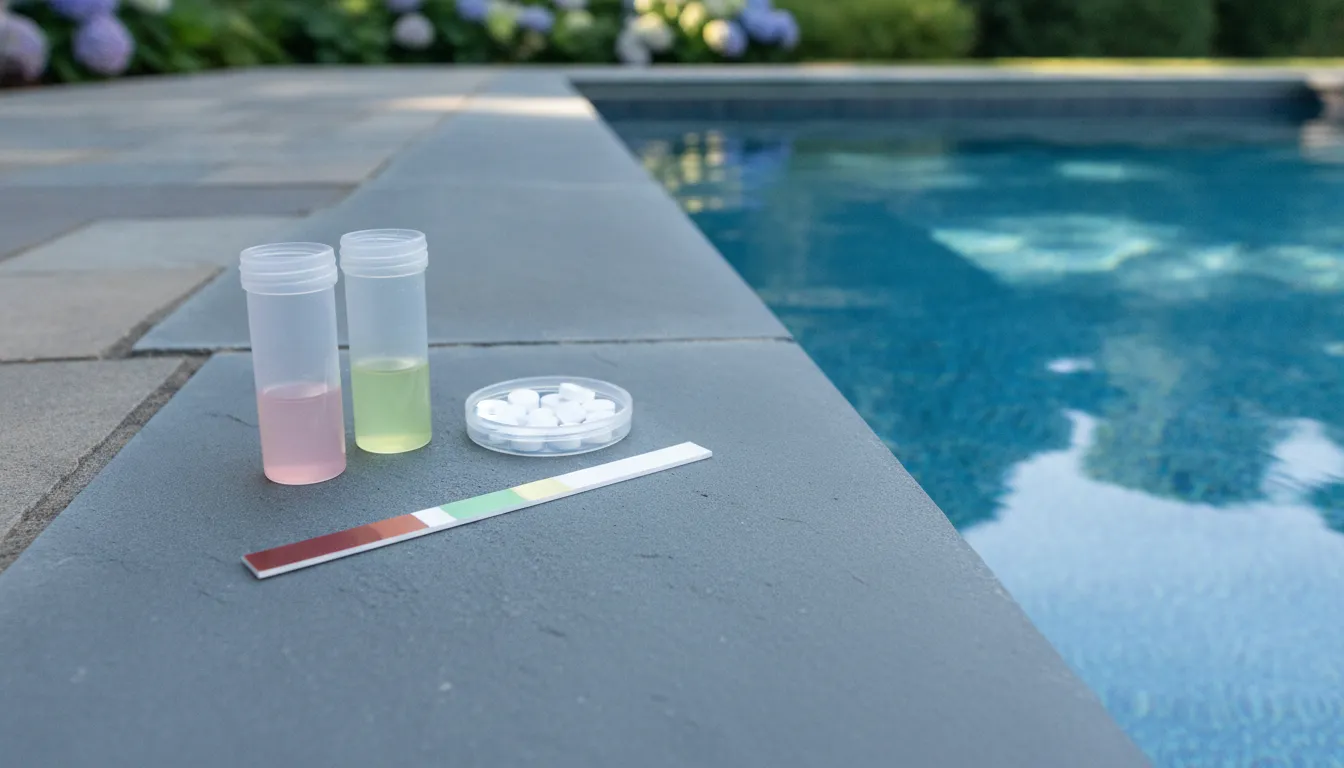
Test the water you have today. A strip from last weekend, or a reading taken right after a party, is not a dosing plan. If you are comparing a salt system with a traditional chlorine setup, our note on salt water and chlorine pools covers that choice. This page stays on the pH adjustment.
How Do You Lower pH in a Swimming Pool Safely?
Two products do the work. Muriatic acid is liquid hydrochloric acid. It moves pH quickly and it is the product many pool pros reach for. Sodium bisulfate, sold as dry acid or pH decreaser, is a granule. It is easier to measure and a better first choice if you are new to pool chemicals. Both are acids. Both can burn skin, eyes, and lungs, and both can etch a plaster or vinyl surface if they sit in one spot.
The CDC reports that pool-chemical injuries send about 4,500 people to U.S. emergency departments each year, and more than one-third of those injuries are in children or teens. Read the label. Wear gloves and eye protection. Keep the container closed and out of reach. Never mix acid with chlorine. Add acid to water if you dilute it. Never add water to a jug of acid.
- Retest pH and total alkalinity with a kit you trust. Write both numbers down.
- Read the product label for your pool volume. Start with less than the full suggested amount.
- Run the pump so the water is moving. Turn off waterfalls and spa jets for this dose.
- Pour the dose slowly around the perimeter, or into moving water, not into one corner.
- Let the pump circulate, then retest before you add more.
- Stop when pH is inside 7.0 to 7.8. Do not aim below 7.0.
There is no universal cup count in this article. A 20,000-gallon gunite pool and a smaller vinyl pool do not take the same dose, and your alkalinity changes the amount. The label on the jug in your hand is the dose sheet. If the label and your test do not agree, stop and ask before the second pour.
Total alkalinity usually drops when you add acid, because the same acid that lowers pH also consumes alkalinity. If alkalinity is already low, do not keep adding acid to chase pH. Raising alkalinity is a different job, with a different product, and it is outside this page. Get pH into range first, retest both numbers, and only then decide whether alkalinity needs its own adjustment on another day.
Which Acid Should You Use, and What Changes the Dose?
Pick the product you can handle safely, then let the label set the amount. Liquid acid is fast and inexpensive. Dry acid is slower to dissolve and simpler to portion. Neither one is a weekly habit. Use one only when a current test says pH is high.
| Choice. | What it is. | When it fits. | Watch-outs. |
|---|---|---|---|
| Muriatic acid. | Liquid hydrochloric acid. | Use it for a clearly high reading if you are comfortable with strong acid. | Watch for fumes, burns, and etching if it pools. |
| Sodium bisulfate. | These are dry acid granules. | Use it for a first adjustment or a smaller pool. | It is still an acid, and it still lowers alkalinity. |
| No dose yet. | Retest only. | Wait if the last test is old or alkalinity is already low. | Guessing wastes product and can overshoot. |
Volume, current pH, and current alkalinity change the amount more than the brand name does. So does what the pool did overnight. A hot afternoon, a long waterfall run, or a fresh top-off from the hose can lift the number again before the next test. That is a reason to retest, not a reason to double the last dose.
Gappsi builds pools with salt chlorine generators, gas heaters, heat pumps, and cartridge, sand, or DE filters, including Pentair, Hayward, Jandy, and Raypak equipment. The chemical step is still the same. The equipment only explains why the number moved.
Write the test down before you open the jug. Note the date, the pH, the alkalinity, whether a waterfall ran, and whether you topped off with the hose. The next morning you can see whether the dose held or the pool pushed the number back up. That log is more useful than a bigger second dose.
Keep swimmers out until you have retested. Acid in the water is not a reason to close the pool for the day, but it is a reason to wait for circulation and a new reading. Store the jug closed, upright, and away from chlorine. The CDC safety notes on home pools are blunt about this. Read the label, wear protection, and keep chemicals away from children and pets.
Why Does Pool pH Climb Again After You Fix It?
A single good test does not mean the water will stay there. Aeration is the usual reason it climbs back. Every hour a waterfall, deck jet, spillover, or bubbler runs, it drives off carbon dioxide and pH rises. Our note on pool waterfall care is about the feature itself. For pH, the practical move is to turn the feature off while you dose, then limit how long it runs on days you are fighting a high reading.
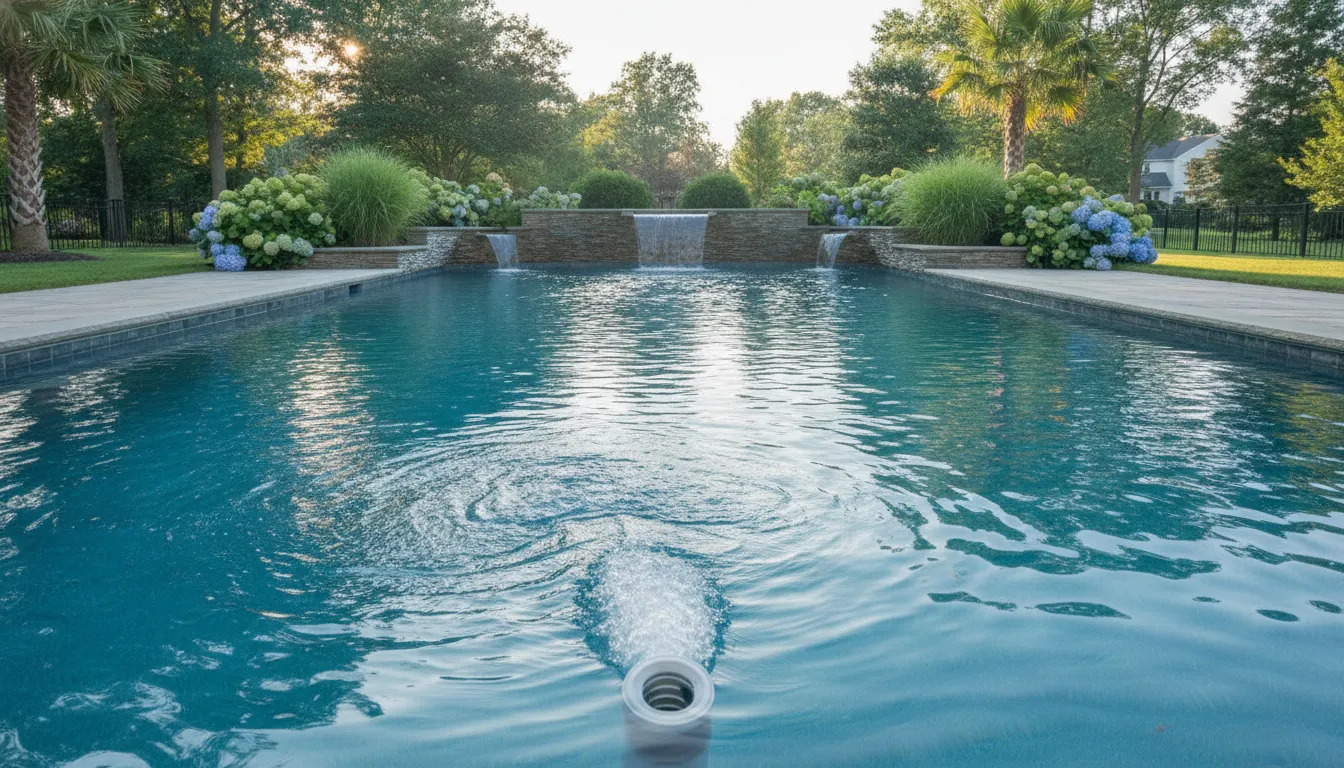
A salt chlorine generator can raise pH as a normal part of making chlorine. Lowering the output after a heavy swim week sometimes slows the climb. It does not replace a test. New plaster on a gunite pool can also push pH up for weeks while the surface cures. That startup window needs more testing, not a bigger jug.
If the reading is high again the next morning and nothing is aerating the pool, look past the bottle. A heater that short-cycles, a pump that is not moving water, or a filter that is not clearing the pool will not be fixed by another dose of acid. Annual water care is one slice of upkeep, which we separate from repairs in our pool maintenance cost guide. Persistent chemistry trouble is a symptom list, not a price.
When Does High pH Point to the Pool System?
Stop dosing and look at the system when three things line up. The test is still high after two careful, partial doses. Alkalinity is falling while pH will not. And the pool has a symptom that acid cannot explain, such as cloudy water that returns overnight, a noisy pump, a weak return, or a water level that drops.
Circulation comes first. If the pump is loud, losing prime, or pushing little water, the dose you added is not mixing. Our pool pump noise guide is the place to sort sound from a real flow problem. A skimmer that is not pulling the surface, or a basket packed with debris, does the same thing to a test result. See when a skimmer needs replacement before you treat a circulation problem as a chemistry problem.
A waterline stain or a rough band at the tile can be scale from water that has sat too alkaline, or it can be a surface issue of its own. Pool waterline tile cleaning covers the cleaning question. Acid in the water will not scrub a tile line, and scrubbing a tile line will not set pH.
Heat is a separate decision. A gas heater or heat pump that runs long hours in a cool Nassau or Suffolk evening can change how often you test, and a failing heater can look like a water problem. Compare equipment before you assume the jug is wrong. Our pool heater cost note and our solar pool heating guide are planning pages, not repair tickets.
A salt system that is new this season deserves a closer look than a fresh bottle of acid. Output set too high, a dirty cell, or a long daily runtime can keep lifting pH even after a careful dose. Our guide to saltwater pool system maintenance covers the equipment side. Use it when the generator, not the test kit, is the thing that changed.
The deck and the shell matter too. Scale on coping, a chalky plaster spot, or a soft vinyl seam is a surface question. Another cup of acid will not repair it, and it can make a marked area worse if the dose sits still. If the water is balanced and the surface still looks wrong, that is a repair conversation, not a third dose. Our pool deck repair page is the right next read when the surround, not the water, is the problem.
Cracks, a falling water level, or a damp spot far from the deck are not pH problems. Acid will not find a leak. If the level drops after you have ruled out splash-out and backwash, read pool leak repair and pause the chemistry experiment. On a gunite shell, a crack needs its own look, which we outline in gunite pool crack evaluation.
Gappsi’s pool work started as a division in 2007, inside a company Giuseppe Abbrancati founded in 1987. The showroom at 1015 West Jericho Turnpike in Smithtown is where homeowners compare plaster finishes, stone coping, and equipment before a build. A pH article will not design that pool. It should tell you when the reading is a bottle-and-retest job and when it is time to talk about the system.
Contact Gappsi through our contact page if the reading will not hold and you want a conversation about the pool, the equipment, or a new system. Choose Swimming Pools in the service menu and describe the test results in your message.
Frequently Asked Questions
What pH should a home swimming pool hold?
The CDC recommends 7.0 to 7.8 for home pools. Many owners aim for the middle of that band so chlorine stays effective and swimmers stay comfortable. Test on a schedule instead of waiting for cloudy water.
Can baking soda lower pool pH?
No. Baking soda raises total alkalinity, and it can nudge pH up, not down. To lower pH you use muriatic acid or sodium bisulfate, in a partial dose, with the pump running.
Should you pour the whole dose in one spot?
No. Acid that sits on a plaster, pebble, or vinyl surface can mark it. Walk the dose around the pool into moving water, keep people and pets out, and retest before a second addition.
How often should you retest after adding acid?
Wait until the pump has circulated the water, then test again before any further dose. The CDC asks for at least two disinfectant and pH checks a day during heavy use. One morning reading is not a week’s plan.
When should you stop adjusting and ask about the pool?
Stop when two partial doses do not hold, when alkalinity is collapsing, or when you also see weak flow, a noisy pump, a falling water level, or a surface problem. Those point to circulation, a feature that aerates the water, or a repair, not to a larger jug.